



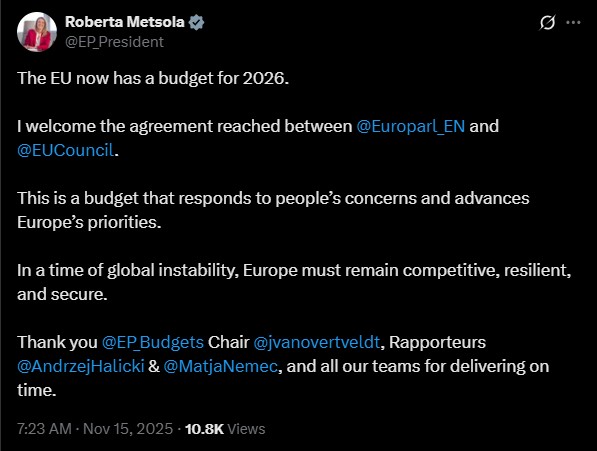
The European Council has finalised the negotiations over the EU Budget for 2026 which has been approved by the European Parliament.
The new budget sets €192.8 billion in commitments and €190.1 billion in payments. Commitments refer to the total amount the EU is legally pledging for multi-year programmes, while payments reflect the actual money expected to be disbursed during the year.
For comparison, this year’s 2025 budget stands at €199.4 billion in commitments and €155.2 billion in payments. The difference between the two figures reflects the EU’s multi-annual financing structure, where many programmes—such as cohesion policy, infrastructure, research and defence—are paid out gradually over several years.
The Single Market, Innovation and Digital heading will rise to €22.16 billion in 2026, roughly €1 billion more than the €21.38 billion allocated in 2025. This item covers programmes such as Horizon Europe, the Single Market Programme, and EU space initiatives including Galileo and Copernicus.
The security and defence allocation increased slightly to €2.81 billion in 2026, up from around €2.1 billion this year. This includes the European Defence Fund, Military Mobility, and short-term defence procurement support.
The Cohesion, Resilience and Values heading—covering the Cohesion Fund, ERDF, ESF+, and the EU’s resilience and recovery instruments—will increase from €66.4 billion in 2025 to €71 billion in 2026, reflecting continued regional development and post-COVID structural funding priorities.
Spending on European public administration will rise from €12.06 billion in 2025 to €13.28 billion next year. This covers the budgets of the EU institutions themselves, including the Parliament, Commission, Council, Court of Justice, and the European External Action Service, as well as salaries, pensions, and the European Schools.
Overall, the 2026 budget reflects a slight tightening in commitments compared with 2025, but a significant increase in expected yearly expenditure—showing the EU moving from planning towards implementation across several major programmes.

Newsroom


Leave a Reply