



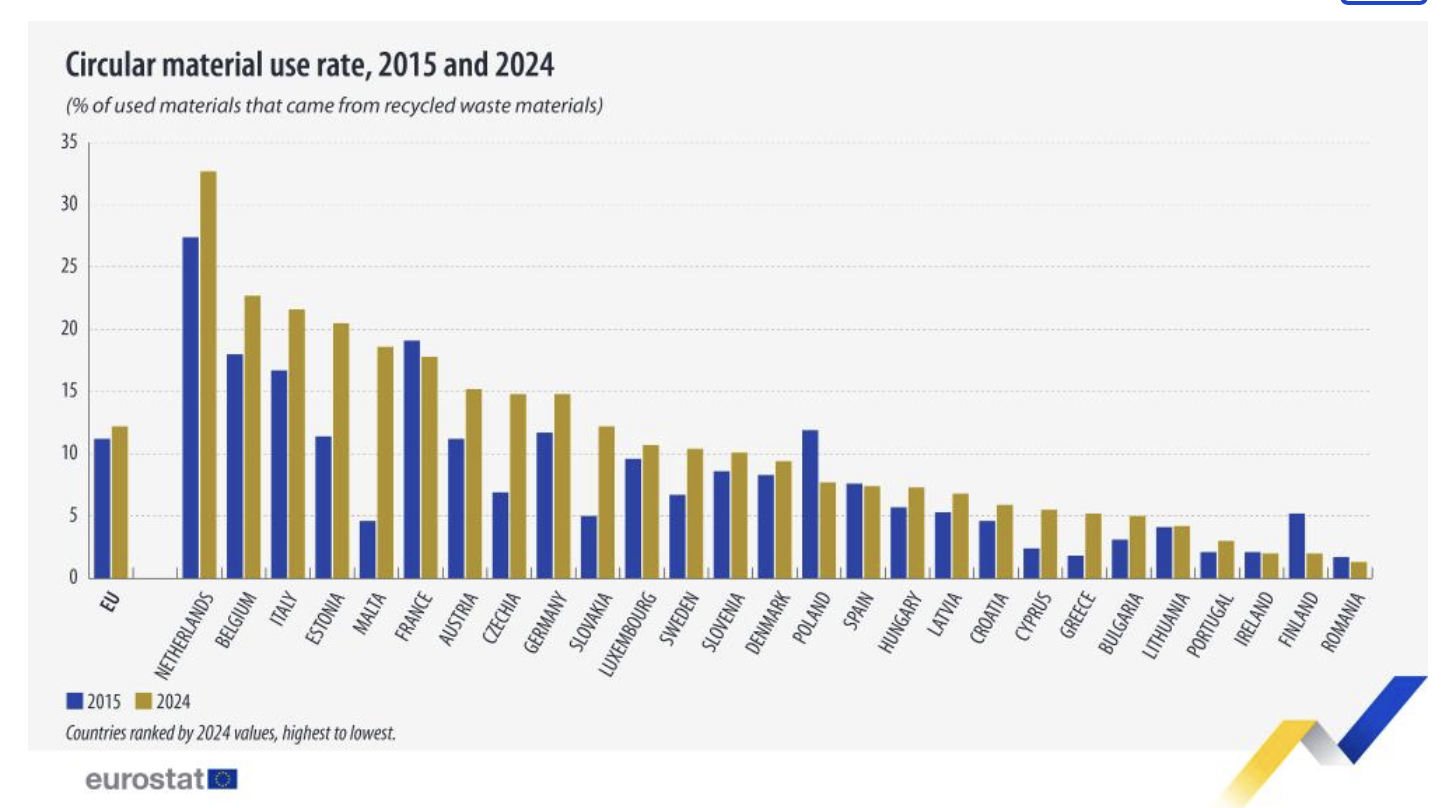
The EU’s use of recycled materials reached a record 12.2% in 2024, according to new Eurostat figures released today. The indicator, known as the circular material use rate, measures the share of recycled resources re-entering the economy, offering a key benchmark of Europe’s progress toward a more sustainable, circular economic model.
The rate edged up by 0.1 percentage points compared with 2023 and stands 1.0 point higher than in 2015, signalling slow but steady structural change across the bloc. Despite this progress, performance varies widely among member states, reflecting different levels of resource extraction, recycling infrastructure, and industrial composition.
The Netherlands remained the clear leader with a circularity rate of 32.7%, followed by Belgium at 22.7% and Italy at 21.6%. At the other end of the scale, Romania recorded the lowest rate at 1.3%, while Finland and Ireland registered just 2.0%, and Portugal 3.0%. These disparities highlight uneven advances in recycling capacity and resource efficiency across the EU.
Between 2015 and 2024, 21 member states improved their circularity rates, with Malta posting the largest increase at +14.0 percentage points. Estonia (+9.1 pp), Czechia (+7.9 pp), Slovakia (+7.2 pp) and the Netherlands (+5.3 pp) also saw substantial gains. However, six countries experienced declines, most notably Poland (-4.2 pp) and Finland (-3.2 pp).
Across material categories, recycled metal ores showed the highest reuse rate at 23.4%, followed by non-metallic minerals (14.3%), biomass (9.9%), and fossil energy materials (3.8%). These figures reflect both the technical feasibility and economic incentives associated with recycling different types of materials.
Under the EU’s 2020 Circular Economy Action Plan, member states aim to double the bloc’s circularity rate to 23.2% by 2030. While current improvements mark a positive trajectory, the latest data suggests significant scaling-up of recycling systems and resource-efficient production will be required to meet this target.
Eurostat’s latest packaging-waste data also underline the scale of the challenge, with the EU generating 79.7 million tonnes of packaging waste in 2023 and recycling just 42.1% of plastic packaging.

News Editor
Journalist and Newscaster


Leave a Reply