



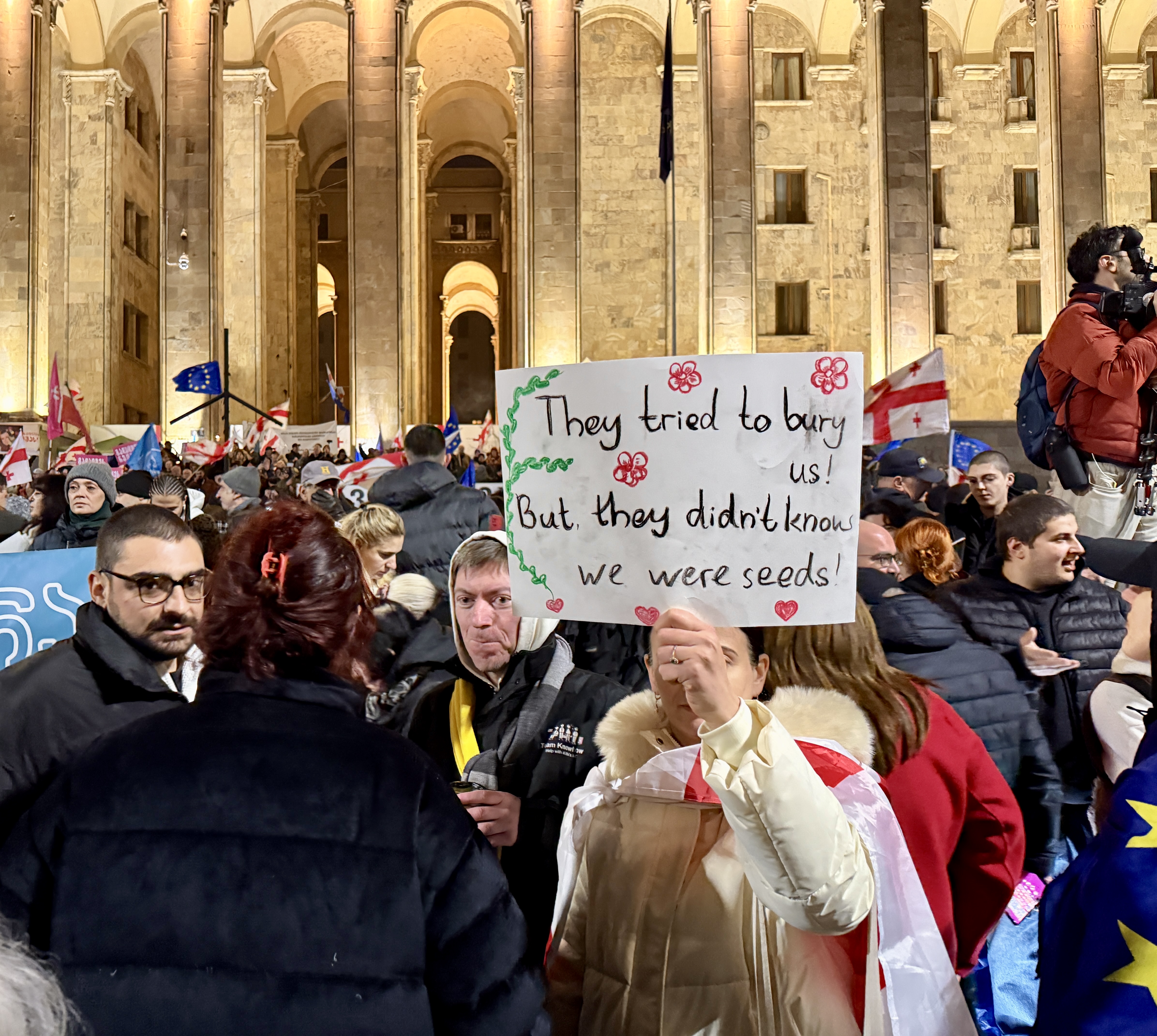
It was a year ago, on November 28, 2024, when, drowned in absolute nihilism after the rigged elections, the Georgian people set their disappointment aside, gathered themselves, and rushed into the streets to protest what was later labeled a constitutional coup. In that moment, they were not thinking about labels at all, they were simply fueled by anger at the fact that the so-called Prime Minister, Irakli Kobakhidze, had announced the suspension of EU accession talks. That one statement was enough for Georgians to understand that they were at war.
A year later, Georgia has marked 366 days of non-stop, uninterrupted protests, and for anyone to truly grasp the scale of bravery behind those powerful images circulating online, you need to know what has been happening beyond the frames.
At this moment, Georgia has more political prisoners per capita than Russia. Over the past year, the Georgian Dream regime has launched criminal cases against 160 people, while hundreds have been, and still are, administratively arrested and detained for up to two weeks. More than a thousand citizens have been issued colossal fines simply for appearing at daily protests.
Almost all major opposition leaders are now in jail, including leaders and members of the United National Movement, co-chairs of the Ahali Party/Coalition for Changes, the leader of Droa, the leader and a member of Girchi – More Freedom, the leader of Strategy Aghmashenebeli, and others. While they have been behind bars, the regime has initiated new criminal charges against them, in some cases carrying sentences of up to fifteen years. Moreover, Georgian Dream has filed a constitutional lawsuit seeking to ban three mainstream opposition parties, the United National Movement, the Coalition for Changes, and Lelo. As for the remaining parties, the speaker of the GD-led Parliament, Shalva Papuashvili, stated that while their electoral weight is small so they will not be banned yet, they are already named in the lawsuit.
After enforcing a series of repressive, Russian-style laws on foreign agents and foreign funding, independent media outlets and civil society organizations stand on the verge of annihilation, which, in fact, was the openly announced purpose of these laws. Over the past year alone, 400 cases have been reported of journalists being arrested, beaten, or assaulted. The first detained female journalist and media owner, Mzia Amaglobeli, remains in custody, her health severely deteriorating.
All of this, combined with the unfortunate reality that international support and sanctions remain insufficient, would normally create the perfect conditions for any resistance movement to fall into apathy but not for Georgians. Despite everything, despite the fines, the arrests, the assaults, despite every attempt to break their spirit, the Georgian people have managed to maintain an unbroken chain of protests for 367 consecutive days. Some rallies are smaller, some swell into the tens of thousands like last night, but they continue. The Georgian spirit of resistance remains alive and it will not stop until its goal is met: No Russian regime in a European Georgia.

Journalist and editor based in Georgia.



Leave a Reply