



Yesterday, on 17 February 2026, the United Nations Convention on the International Effects of Judicial Sales of Ships came into force, following the deposit of its third ratification instrument. Under Article 21 of the treaty, the Convention enters into force 180 days after three states have ratified it.
The Convention establishes a harmonised legal framework under which a judicial sale of a ship that confers clean title on the purchaser in one State party must likewise confer clean title in every other State party. This addresses a longstanding uncertainty in maritime law, where vessels sold by court order in one jurisdiction have in some cases later been detained again elsewhere because their ownership status was not recognised abroad.
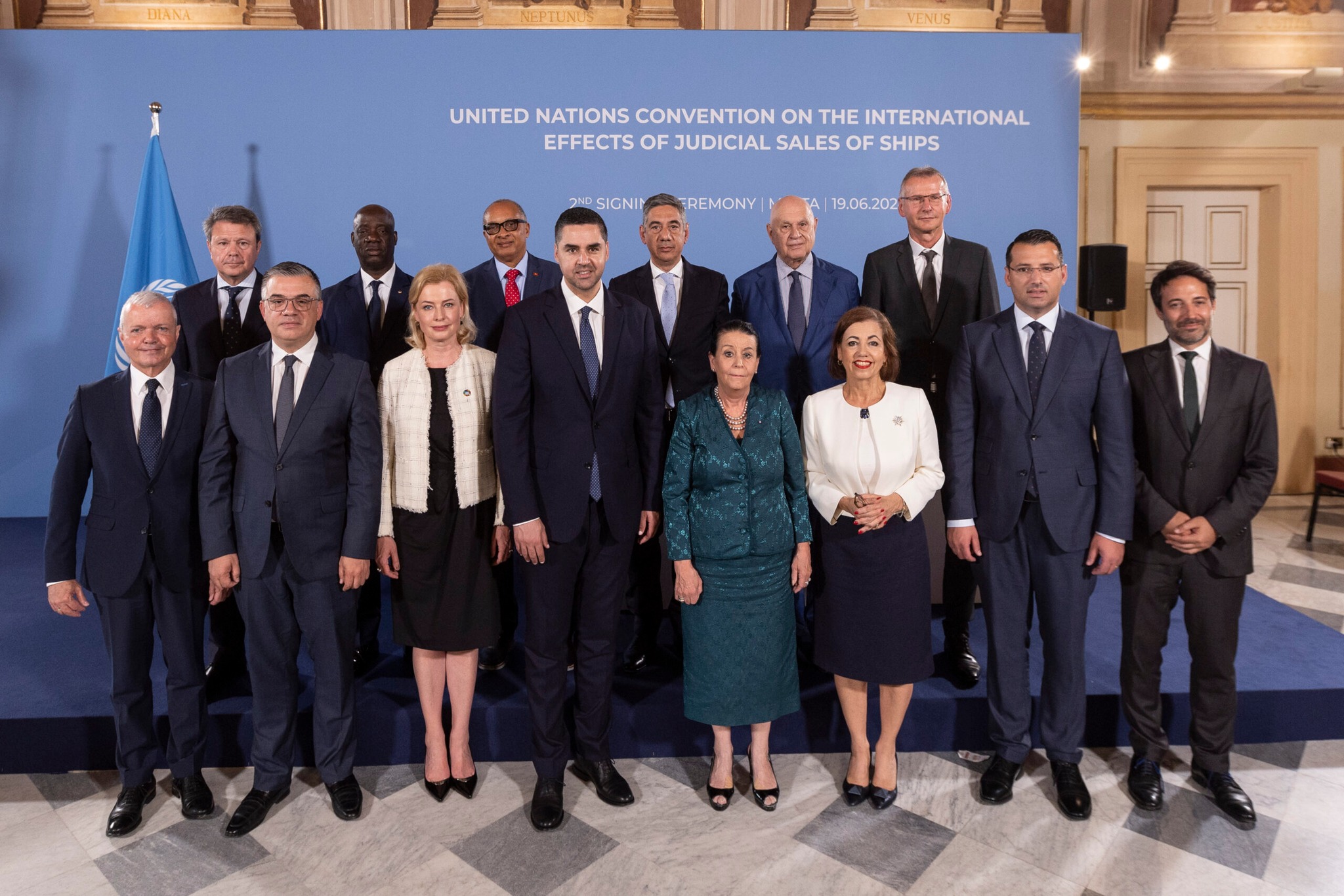
The Convention was adopted by the United Nations General Assembly on 7 December 2022 and opened for signature in 2023–24. Malta signed the instrument on 19 June 2024 at a ceremony in Valletta attended by representatives including Minister for Foreign and European Affairs and Trade Ian Borg, Minister for Transport, Infrastructure and Public Works Chris Bonett, and other officials.
As of its entry into force, three states have ratified the Convention: Barbados, El Salvador, Spain.
Their ratifications triggered the treaty’s coming into force.
In addition, a broader group of countries — extended well beyond the three ratifiers — have signed the Convention, indicating political support without yet completing the internal steps required to make it legally binding for them. Signatories include Antigua and Barbuda, Belgium, Brazil, Burkina Faso, China, Côte d’Ivoire, Croatia, Cyprus, Dominican Republic, Ecuador, Gabon, Ghana, Grenada, Honduras, Italy, Liberia, Libya, Luxembourg, Malta, Panama, Sao Tome and Príncipe, Saudi Arabia, Singapore, Switzerland, Sierra Leone, and Tanzania, among others.
The Convention’s principal aim is technical: to reduce cross-border legal uncertainty associated with court-ordered sales of vessels. Under the regime, once a judicial sale has been conducted and a certificate of judicial sale issued, registries in other States Parties must deregister old mortgages and recognise the purchaser’s clean title, and courts must refuse re-arrest based on pre-sale claims.
Despite its entry into force, the Convention’s practical reach is currently limited because only three countries have ratified it. Many major maritime nations and ship-registries have signed but not yet ratified, meaning the regime will apply only among the (currently small) set of States parties. Legal experts generally view it as an incremental step toward harmonisation rather than an immediate, sweeping transformation of global maritime law.
Malta’s involvement reflects its interest in international maritime legal frameworks, though the immediate impact on the local economy and ship registry is likely to be modest until more states adopt the treaty. You can find the convention here.

Newsroom
Leave a Reply