



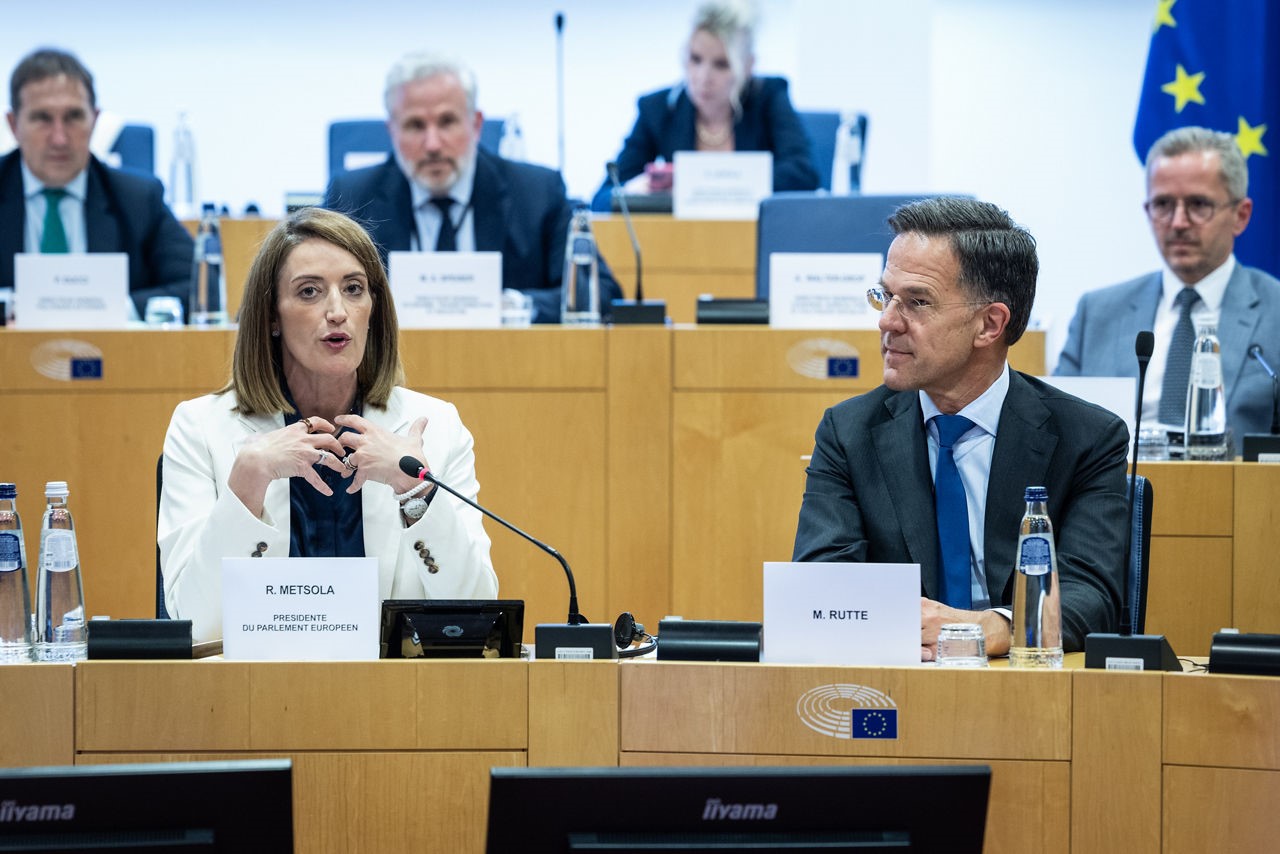
Yesterday, European Parliament President Robert Metsola announced that the Council presidency and European Parliament negotiators reached a provisional agreement on a new defence simplification package aimed at removing administrative delays in procurement, permitting, reporting and cross-border cooperation.
The EU is moving ahead with new legislation to simplify defence procurement, accelerate permitting and boost industrial readiness, as it continues to cooperate with NATO on Europe’s defence needs and preparedness. The agreement is intended to give member states and Europe’s defence industry a faster route to procure equipment, expand production and strengthen Europe’s defence capacity ahead of the EU’s 2030 defence readiness objectives. The deal was announced with NATO Secretary General Mark Rutte at the European Parliament’s Conference of Presidents in Brussels.
Secretary-General Rutte told the EU Parliament’s political leadership that NATO-EU cooperation is essential for the security and freedom of European citizens. He also stressed that a stronger Europe means a stronger NATO, while calling for more investment in defence, faster industrial production and sustained support for Ukraine. He added that European allies are stepping up their contribution to collective security and that the upcoming NATO summit in Ankara will show that allies are investing more in defence, scaling up industrial production and maintaining support for Ukraine.
The new EU deal simplifies the management and implementation of the European Defence Fund, reduces administrative requirements for funding applications and increases support for small and medium-sized companies involved in defence projects.
The agreement also preserves the role of European public bodies, including the European Defence Agency, as central purchasing bodies. This is intended to help member states cooperate on joint procurement instead of competing against each other in a fragmented defence market.
One of the most important parts of the agreement is the acceleration of permit-granting procedures for defence readiness projects. Under the provisional deal, permit procedures will be subject to a maximum duration of 102 working days.
The agreement also includes a tacit approval mechanism, meaning that a permit request may be considered approved if the competent authority fails to take a decision before the deadline expires. Member states will still be allowed to derogate from this rule in cases involving grave risks to human health or national security.
The package also simplifies intra-EU transfers of defence-related products and reforms security and defence procurement rules. The aim is to reduce administrative delays, increase cooperation between member states and make it easier for the European defence industry to operate across borders.
The provisional agreement increases procurement thresholds under the defence procurement directive, giving public authorities more space to focus on major defence projects instead of being buried under bureaucracy. It also introduces more flexibility for occasional joint procurement, framework agreements and contract modifications.
Two new mandatory general transfer licences will also be introduced: one for transfers between certified suppliers and recipients, and another for transfers within intra-EU industrial partnerships.
The legislation is part of the EU’s broader defence readiness agenda and follows the Commission’s fifth omnibus package on defence readiness, presented in June 2025. The package forms part of the White Paper for European Defence Readiness 2030, which aims to strengthen Europe’s ability to respond to military threats and reduce bottlenecks in defence production.
The agreement still has to be formally endorsed by the Council and the European Parliament before undergoing legal and linguistic revision and final adoption.
The European Parliament has been consistently supportive of Europe’s defence and NATO cooperation and the new reforms are a culmination of years-long efforts to continue streamlining the European defence industry. The reforms in this policy-direction are set to continue.
The new reforms can be found here.

Newsroom
Leave a Reply