



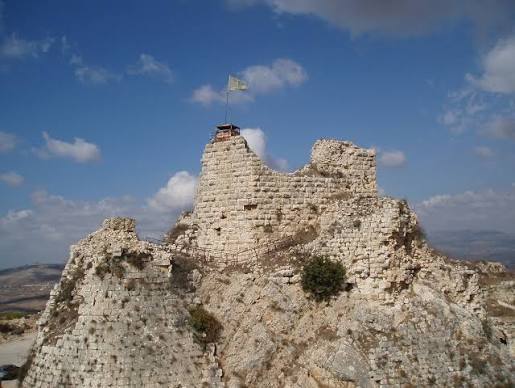
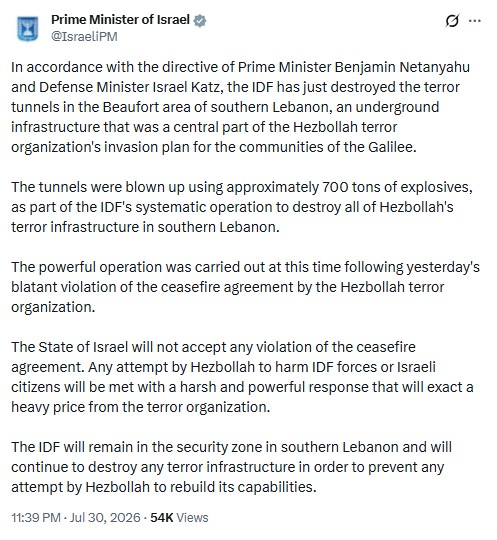
Israel says it has detonated approximately 700 tonnes of explosives to destroy a large Hezbollah tunnel network beneath the Beaufort Ridge in southern Lebanon, only days after the medieval Beaufort Castle was inscribed on UNESCO’s World Heritage List and simultaneously placed on the List of World Heritage in Danger.
Israeli Prime Minister Benjamin Netanyahu announced that the explosives had been used to demolish tunnels which, according to Israel, Hezbollah intended to use in attacks against communities in northern Israel. The Israeli military said that it had destroyed a significant portion of a multi-level underground network which had served as the principal command centre of Hezbollah’s Bader Unit in southern Lebanon.
The Israeli military claims that the network was built over more than a decade with Iranian funding and contained living quarters, electricity and water infrastructure, weapons stores, an operating room, kitchens and defensive positions capable of accommodating hundreds of fighters. Israel also says that Hezbollah launched approximately 400 missiles and other projectiles from the wider Beaufort Ridge area during the war.
These claims are strongly disputed by the Lebanese authorities.
Sarkis Khoury, Lebanon’s Director General of Antiquities, has categorically denied that Hezbollah tunnels were constructed beneath the castle. Lebanon’s Ministry of Culture and Directorate General of Antiquities said that the positions shown in Israeli maps and videos were located away from the archaeological monument and had no connection to the castle itself. Culture Minister Ghassan Salamé later said that the alleged tunnels were more than 700 metres from the fortress.
Lebanon’s Ministry of Culture says that Beaufort Castle has been under the exclusive administration of the Directorate General of Antiquities since Israel withdrew from southern Lebanon in 2000. Lebanese officials maintain that the fortress was subsequently restored and operated as an archaeological and tourism site, rather than as a Hezbollah military installation.
The condition of the monument following the latest demolition remains unclear. Initial footage released by the IDF after the explosion shows the structure still intact. Israeli forces continue to control the castle and the surrounding territory, preventing Lebanese antiquities officials from carrying out a full inspection.
Beaufort Castle, known in Arabic as Qalaat al-Shaqif or Shaqif Arnoun, became a UNESCO World Heritage Site in July 2026 as one of the five Mount Amel Castles. The other components are Toron Castle in Tibnin, Dubieh Castle in Chakra, Maron Castle in Deir Kifa and Chama’ Castle. UNESCO simultaneously placed the entire group on the List of World Heritage in Danger through an emergency procedure because of the threats posed by the continuing conflict.
Both Israel and Lebanon are parties to the original 1954 Hague Convention. The convention requires parties to refrain from using cultural property or its immediate surroundings in a manner likely to expose it to damage and to refrain from hostile acts against such property.
UNESCO had already expressed alarm over Israeli strikes in the immediate vicinity of Beaufort Castle before its formal World Heritage inscription. The organisation stated that cultural properties under enhanced protection benefit from the highest available level of legal protection against both attack and military use.
Israel captured the castle from the Palestine Liberation Organisation during its 1982 invasion of Lebanon and used it as a fortified military position throughout much of its occupation of southern Lebanon. Israeli troops withdrew from the fortress in May 2000. The IDF seized it again on 31 May 2026, raising the Israeli and Golani Brigade flags above its ruins.

Newsroom
Leave a Reply