



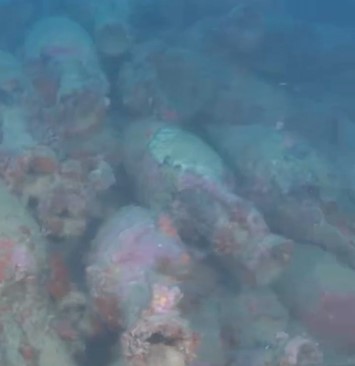
A Roman-era shipwreck containing hundreds of amphorae has been discovered off the coast of Mazara del Vallo in western Sicily, in what Italy’s Culture Minister Alessandro Giuli has described as one of the most important underwater archaeological discoveries of recent years.
The wreck is believed to date from between the 2nd and 1st centuries BC, making it more than 2,000 years old. It lies approximately three nautical miles, or 4.8 kilometres, from the Sicilian coast, at a depth of around 46 metres.
The archaeological deposit includes hundreds of amphorae spread across an area measuring approximately 21 metres long, six metres wide and almost two metres high. This measurement refers to the concentration of the surviving cargo rather than necessarily to the original dimensions of the ship itself.
Two large lead anchor stocks and a lead fistula, or pipe, have also been identified among the remains.
Most of the amphorae identified so far are of the Dressel 1A type, while archaeologists have also identified Lamboglia 2 amphorae, probable North African examples and a Neo-Punic amphora.
Dressel 1 amphorae were among the principal transport containers of the late Roman Republic and were used mainly for carrying Italian wine. Their presence in large numbers across the western Mediterranean is evidence of the extensive commercial networks that connected Roman Italy with other Mediterranean and European markets during the final centuries of the Republic.
Lamboglia 2 amphorae were similarly associated with the maritime wine trade, particularly production originating around the Adriatic. The variety of amphorae found together on the Mazara wreck could eventually help archaeologists reconstruct the vessel’s route, where it loaded its cargo and the markets for which it was travelling.
The wreck was initially mistaken for a rock
The discovery was made by diver Giacomo De Mola, who was surveying the seabed together with Igor Bisulli when their sonar equipment detected what initially appeared to be an ordinary rock formation.
De Mola descended to inspect the object and instead found an extensive concentration of amphorae resting on the seabed.
The discovery was immediately reported to the Soprintendenza del Mare of the Sicilian Region, triggering an official investigation of the site. Specialist authorities subsequently documented the wreck and began taking measures to protect it.
De Mola described it as the most extraordinary discovery of his life, saying that after descending towards what he believed was a rock he instead found himself above hundreds of amphorae that had remained underwater for more than two millennia.
Italian Culture Minister Alessandro Giuli praised the Carabinieri, including its specialist Cultural Heritage Protection units, and Sicily’s Superintendency of the Sea for their work on the discovery.
The Italian authorities said further documentation and archaeological studies will now be carried out to establish the precise nature of the wreck, its cargo and its commercial route, while ensuring that the site remains protected.
Sicily’s seabed continues yielding ancient shipwrecks
The discovery comes during an unusually active period for underwater archaeology around Sicily.
In June, the Sicilian authorities announced new findings from the Roman wreck at Capo Mulini, dating from roughly the same late-Republican period. Archaeometric studies of its amphorae are being used to reconstruct commercial routes and the movement of goods through Roman Sicily.
Also in June, archaeologists recovered the hull of the Secca di Capistello wreck off Lipari, a Hellenistic merchant vessel from the 3rd century BC whose cargo of amphorae had been recovered decades earlier.
The waters around western Sicily have produced some of the Mediterranean’s most significant archaeological discoveries, including Roman anchors, ancient commercial wrecks and the famous Dancing Satyr of Mazara del Vallo, recovered by Sicilian fishermen in the late 1990s.

Newsroom
Leave a Reply