



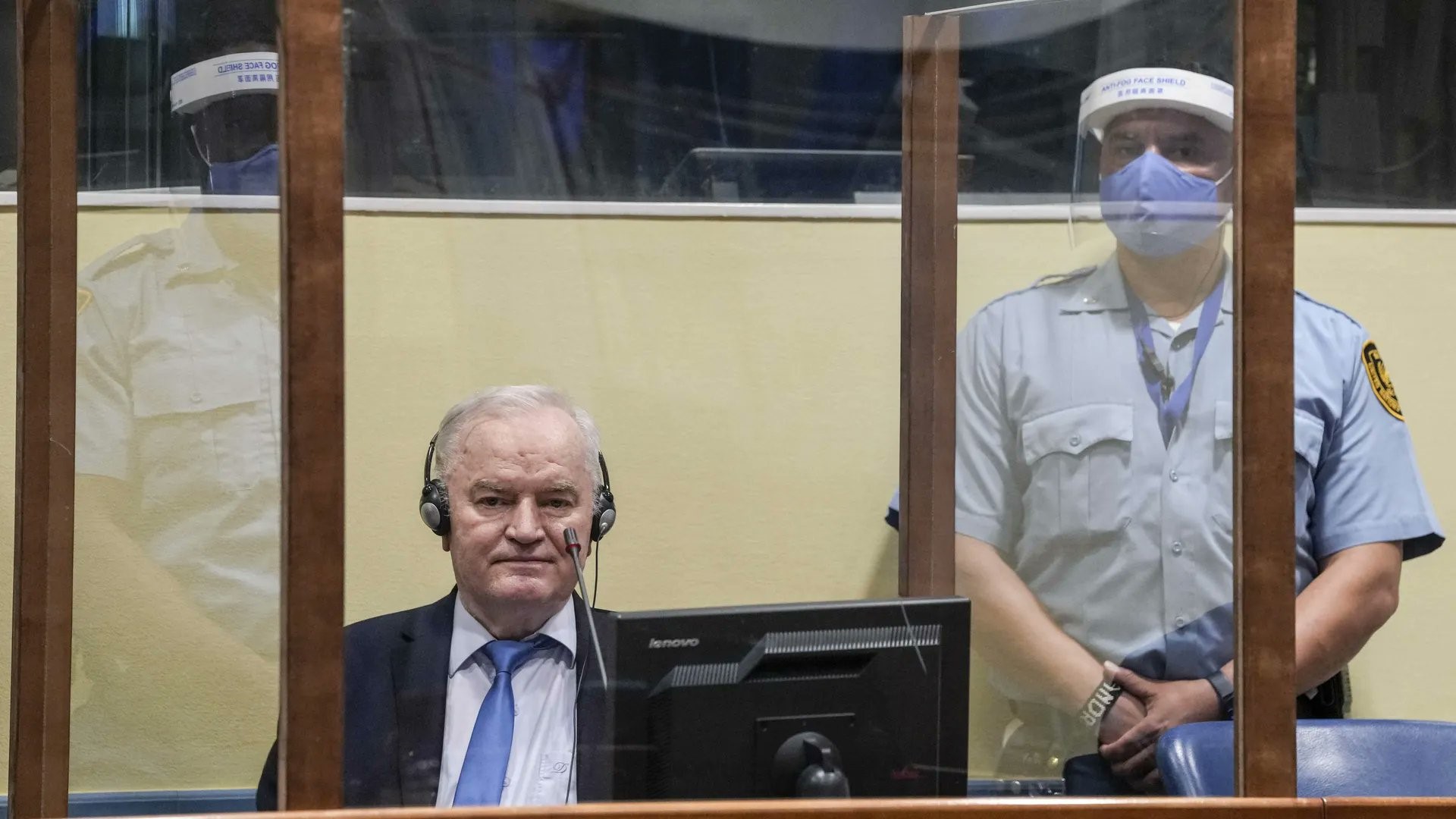
The Butcher of Bosnia, Ratko Mladić, has died while in United Nations custody in The Hague, where he was serving a life sentence for genocide, crimes against humanity and war crimes committed during the Bosnian War.
The International Residual Mechanism for Criminal Tribunals confirmed that Mladić died today while hospitalised in The Hague. A formal inquiry has been opened into the circumstances of his death. Mladić’s health had deteriorated significantly in recent years, and a request for his early release on humanitarian grounds was rejected in May.
Ratko Mladić was the commander of the Bosnian Serb Army and gave the orders that culminated in the Srebrenica genocide, during which more than 8,000 Bosniak Muslim men and boys were systematically murdered in July 1995.
Srebrenica had been declared a United Nations “safe area” and was protected by Dutch UN peacekeepers, known as Dutchbat. The peacekeepers failed to prevent Mladić’s forces from taking the enclave and separating men and boys from women and children before the executions began.
The failure became one of the darkest episodes in the history of UN peacekeeping. Decades later, the Dutch Supreme Court ruled that the Dutch state had acted unlawfully in relation to approximately 350 men who had been expelled from the Dutchbat compound despite the peacekeepers knowing that they faced a serious danger of being murdered.
Srebrenica was not Mladić’s only crime.
Under his command, Bosnian Serb forces subjected Sarajevo to a campaign of terror lasting almost four years, bombarding residential areas and deliberately targeting civilians with artillery and sniper fire. More than 10,000 people were killed during the siege. International prosecutors concluded that the purpose of the campaign was explicitly to terrorise Sarajevo’s civilian population.
Mladić also commanded ethnic-cleansing campaigns across Bosnia in which thousands of civilians were murdered, tens of thousands were imprisoned in brutal detention facilities, and large populations of Bosniaks and Croats were forcibly expelled from Serb-controlled territory. His forces also took hundreds of United Nations peacekeepers hostage and used some of them as human shields against NATO air strikes.
He was arrested in Serbia in May 2011 after spending almost 16 years as a fugitive and was transferred to The Hague. In November 2017, the International Criminal Tribunal for the former Yugoslavia convicted him of genocide, persecution, extermination, murder, deportation, forcible transfer, terror, unlawful attacks on civilians and hostage-taking, and sentenced him to life imprisonment. His convictions and sentence were upheld on appeal in 2021.
The genocide conviction related specifically to Srebrenica. The Tribunal did not convict Mladić of the separate genocide charge relating to crimes against Bosnian Muslims and Croats in several other Bosnian municipalities, although it convicted him of crimes against humanity and war crimes committed as part of the wider campaign of ethnic cleansing.
Mladić remained unapologetic.
Christiane Amanpour interviewed him for CNN during the Bosnian War and confronted him over accusations that he was a war criminal. Mladić responded that there was “no greater honor than defending your people,” a justification that would remain essentially unchanged throughout the rest of his life.
The massacres in Bosnia were allowed to continue for years while Western governments hesitated over military intervention. UN peacekeepers were repeatedly humiliated and constrained by an inadequate mandate, while Bosnian Serb forces continued shelling cities, conducting ethnic cleansing and attacking areas that had supposedly been placed under international protection.
It was only after Srebrenica, and following another deadly attack on Sarajevo, that NATO finally launched Operation Deliberate Force in August 1995.
NATO aircraft struck Bosnian Serb command facilities, communications networks, ammunition depots, air defences and other military targets. The campaign lasted approximately two weeks and fundamentally changed the military and political balance. NATO itself credits the operation with helping convince the Bosnian Serb leadership that continuing the war was no longer advantageous, paving the way towards the Dayton Peace Agreement later that year.
The lesson would be repeated several years later in Kosovo.
Serbian and Yugoslav forces conducted a systematic campaign of violence against Kosovo’s ethnic Albanian population, involving mass expulsions, killings, sexual violence, destruction of mosques and persecution. International judges later convicted senior Serbian and Yugoslav officials for crimes against humanity arising from the campaign. Hundreds of thousands of Kosovo Albanians were driven from their homes.
Again, diplomacy and international condemnation failed to stop the violence until NATO resorted to military force in March 1999 and began bombing Serbian military and state targets. The campaign ended after Belgrade accepted the withdrawal of its security forces from Kosovo.
Bosnia remains one of the clearest historical examples of the consequences of allowing an aggressive nationalist regime to carry out mass atrocities while the international community limits itself to declarations, negotiations and insufficient peacekeeping missions.
Mladić spent years carrying out his crimes while openly presenting himself as the defender of the Serbian people. He lived another sixteen years as a fugitive before finally being arrested, and another fifteen years in The Hague before dying in custody.
He died a convicted genocidaire and war criminal.
The victims he left behind numbered in the tens of thousands, while the political and ethnic divisions created by the wars in Bosnia continue to shape the Balkans to this day. Even now, Mladić continues to be celebrated as a hero by sections of the Serbian and Bosnian Serb nationalist establishment.

Newsroom



Leave a Reply