



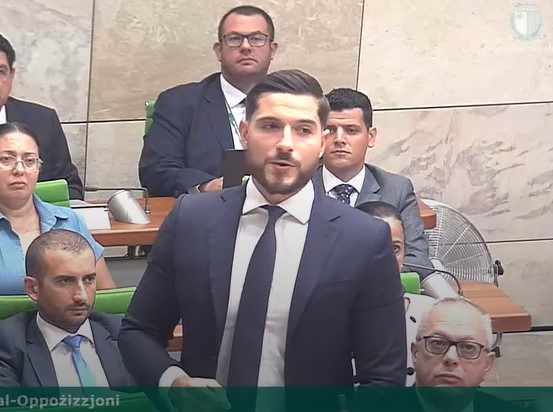
Replying to the Prime Minister in Parliament yesterday, Nationalist Party leader and Opposition Leader Alex Borg said it was ironic that Prime Minister Robert Abela travelled to the United Nations General Assembly to speak about strong institutions, international law and peace while the reality in Malta was, very different.
Borg said that over the past three months, the Prime Minister had been given opportunities to strengthen Malta’s institutions but had refused to move forward with the necessary reforms, referring to his rejection of PN’s proposed debate to implement the reforms of the public inquiry into the murder of Daphne Caruana Galizia.
“Behind every discourse are children and people who simply want to live in peace,” Borg said, arguing that this was where politics needed to begin.
Turning to Ukraine, Borg said the war had been ongoing for years, leaving thousands dead and many more displaced. He reiterated the Nationalist Party’s “absolute and clear condemnation” of Russia’s invasion.
“No country should have the right to occupy the territory of another nation or impose decisions through force,” he said.
Alex Borg said Malta should support any initiative capable of guaranteeing long-term peace while respecting Ukraine’s sovereignty and giving Ukrainians the full right to determine the future of their country.
He said the same principle needed to be applied to Gaza, pointing to the suffering of Palestinians and saying that the international community could not ignore images of children and civilians trapped under rubble or people being denied medical treatment and humanitarian assistance.
The PN’s position, he said, was clear: it wanted lasting peace in the Middle East and supported a two-state solution in which both Israel and a Palestinian state could live in mutual respect and security.
“The killing must stop and humanitarian aid must reach those who need it,” Borg said.
He added that the Palestinian people deserved transparent and accountable leadership capable of working for their future, while stressing that terrorism could never be a route to peace.
Borg also raised climate change and Malta’s growing infrastructure pressures, saying that the country’s credibility was at stake.
He said the public expected proper planning and investment in infrastructure, arguing that the increase in Malta’s population should have been anticipated and reflected in long-term planning.
The Opposition Leader also stressed that Malta, despite being a small country, could make a significant contribution internationally.
He pointed to Malta’s historic role in shaping international law relating to the oceans, recalling the initiative led by Malta’s ambassador to the United Nations, Arvid Pardo, in the 1960s.
In a landmark address to the UN General Assembly in 1967, Pardo called for an international regime governing the seabed and ocean floor beyond national jurisdiction and advanced the principle that their resources should be regarded as the common heritage of mankind. His initiative helped trigger the UN process that ultimately resulted in the 1982 Convention on the Law of the Sea.
Borg said Malta should once again use its voice internationally to fight for peace, human rights and the rule of law.
He also called for the United Nations itself to be strengthened, arguing that international institutions must remain effective and capable of addressing the challenges facing the world.

Newsroom

Leave a Reply