



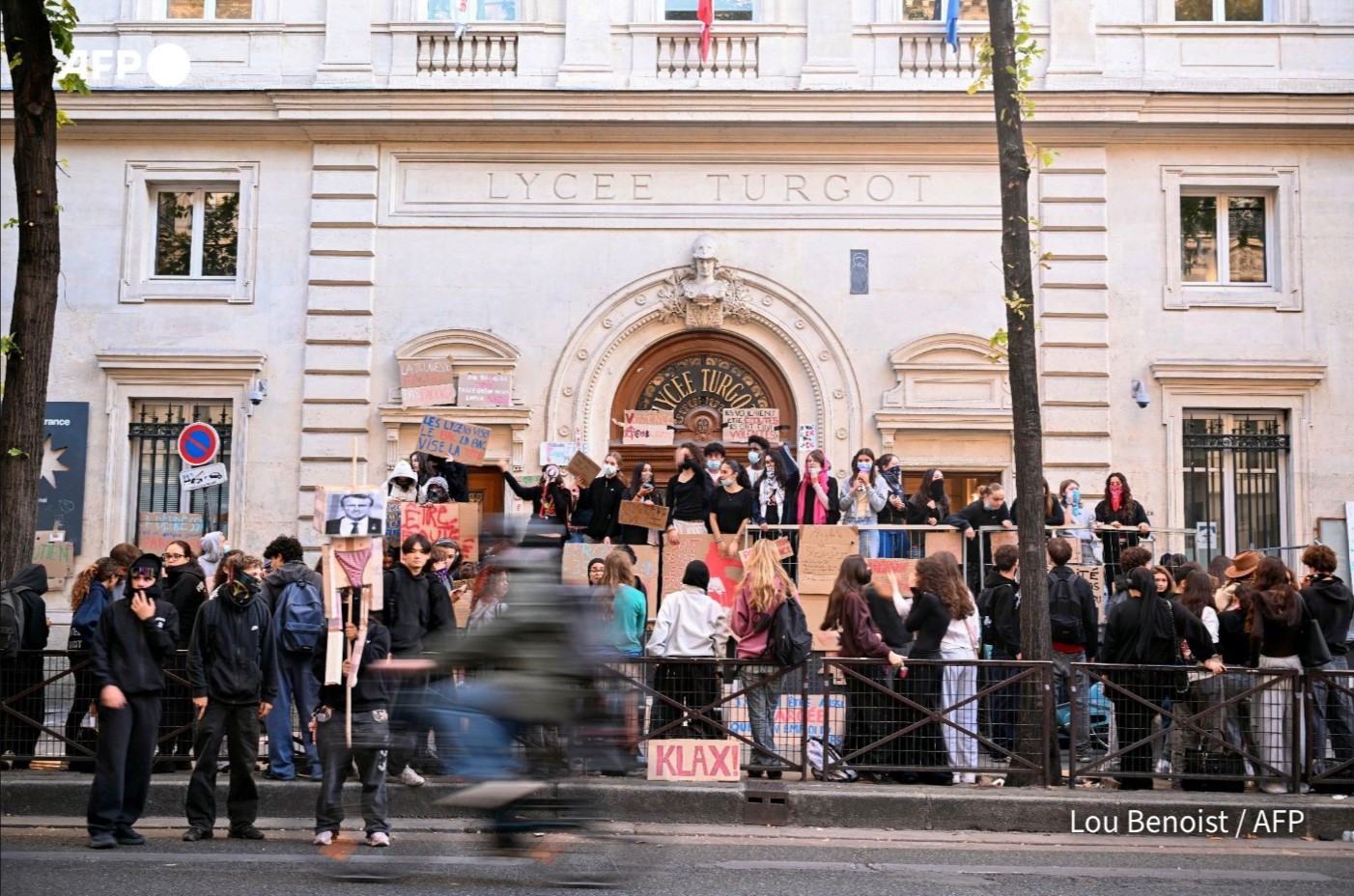
Student protests that began in the Paris suburbs in September have spread across France, with trade unions, teachers, parents and far-left political groups joining demonstrations earlier today in support of students demanding better conditions in the country’s schools.
The movement began on 17 September at a school in Créteil, south-east of Paris, where students and teachers protested over a lack of resources and staff. It subsequently spread to schools across the Paris region before reaching cities and towns throughout France.
Students at several schools in Paris have refused to enter classrooms and instead organised blockades and pickets. They have complained of dilapidated school buildings, overcrowded classrooms and teacher shortages, as well as poor basic facilities. Complaints have included ageing infrastructure, water leaks and, in some schools, rat infestations. Students have also raised concerns about classrooms becoming excessively cold in winter and extremely hot during the summer months.
Teacher shortages have become a particular focus of the protests. In some schools, classes have been cancelled because there are not enough teachers, while students in poorer areas have argued that their schools are receiving fewer resources than those in more affluent parts of the country.
The protests have largely been peaceful, but some demonstrations have descended into violence, with rioters setting fires, throwing projectiles and clashing with riot police. Police have responded with tear gas and other crowd-control measures in several cities.
France’s Justice Ministry said on Monday that 5,060 people had been taken into custody since the start of the unrest, 87% of them minors. More than 1,800 people were facing prosecution, including 1,483 minors. By Tuesday, the Interior Ministry had raised the number of arrests since the protests began to 6,100.
The protests have spread to cities including Paris, Lyon, Strasbourg, Rennes, Marseille, Nantes, Toulouse, Lille and Bordeaux. In Strasbourg, Lyon, Rennes and Paris, demonstrations turned violent, while large demonstrations were also held in Marseille and Nantes.
The scale of the movement has also grown substantially. The High School Students Union said more than half of France’s high schools were either blockaded or closed on Tuesday. On Monday alone, 589 educational establishments, including 32 universities, were affected by the protests.
Trade unions have now openly joined the mobilisation. France’s CGT union called on workers to demonstrate alongside high-school and university students, citing teacher shortages, overcrowded classrooms, deteriorating study conditions and ageing school buildings.
The protests have also taken on an increasingly political dimension, with the far-left France Unbowed party, led by Jean-Luc Mélenchon, backing the students. The government and other political forces have accused the party of encouraging unrest and claimed that outside groups have contributed to the violence. France Unbowed has denied those accusations.
The government has now moved to address at least some of the students’ demands. Prime Minister Sébastien Lecornu has ordered ministers to examine the replacement of absent teachers, the length of the school day, lunch breaks and repairs to ageing school buildings, with initial proposals expected by the end of October. President Emmanuel Macron has also convened an emergency meeting with senior ministers over the protests.
The unrest comes as the French government faces pressure over its 2027 budget, with education funding set to increase by 1.7% to €65.53 billion, below the rate of inflation. Students and unions argue that the additional funding is insufficient to address the problems facing France’s education system
Live feed from Paris by Reuters today here.
Feature photo by AFP.
Footage of below of Lyon and Paris in that order.

Newsroom
Leave a Reply