



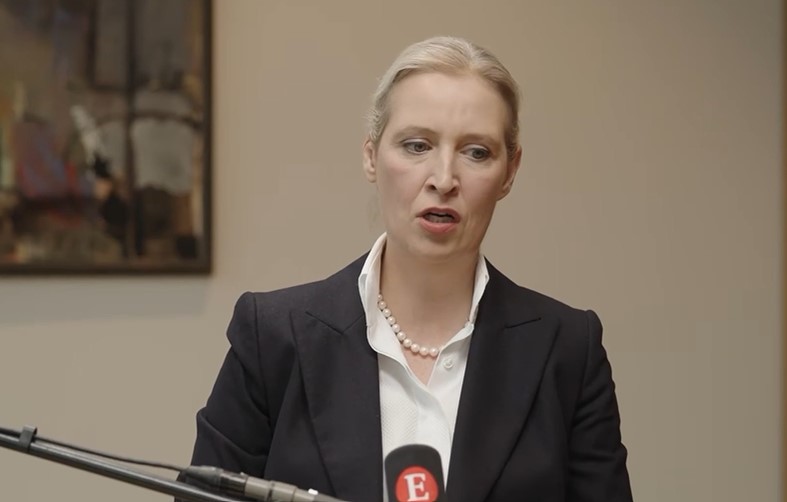
Interviewed by The Economist, AFD Leader Alice Weidel told The Economist that debt in France and Germany is running so high that “we will certainly have a bond market crisis”.
Alice Weidel has been instilling fear among Germans about every major challenge and issue we jointly face in Europe. We should fear Russia, we should fear immigrants and now apparently, we should fear bond yields too. We should fear everything but her whose meticulous genius will save Germany from the iron shackles of Brussels and by extension rejuvenate the nations of Europe.
There hasn’t been a biggest bullshitter in Germany since Hitler walked into the Hofbräuhaus and gave a psychotic speech a to, literally, a bunch of dredged-drunk losers.
Alice Weidel supposedly knows better but she doesn’t because in reality her financial career was not as successful as it seems to be. Alice Weidel presents herself as someone who had a successful career in banking and finance. The lack of this success in her CV may also explain why she is in politics. She worked one year at Goldman Sachs in Germany as an analyst before going to China on a German-governent funded scholarship. From March 2011 to May 2013 she worked at Allianz Global Investors in Frankfurt, in roles described as Vice President, capital-investment consulting (Kapitalanlageberatung), and/or in the board office (Vorstandsbüro). There is no track record of her portfolio performance and at these financial organisations – everyone is a VP.
Taking advice about bond yields and European debt from Alice Weidel is like taking advice for the cooking by the village grocer. She’s a VP yes, and maybe even a President – of their grocer though.
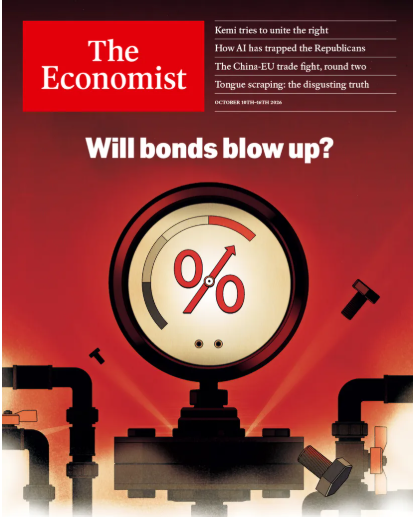
Bond yields hit headlines recently since they went relatively high. The Economist ran a story about it too with a front-page headline “Will bonds blow up?”
Yields for long-term government debt went above 5% this year and the purveyors of doom porn are quick to note. The twenty-year Treasury note first moved back above 5% since the financial crisis of 2008 in 2023 and has gone higher this year, while the yield curve is positively sloped again after the longest inversion on record, and so on and so forth.
Meanwhile, in Europe, there is talk of a sovereign-debt crisis because France and Italy are running debt to GDP ratios at 119% and 138% respectively. Germany, the fiscal conservative kid in the bloc is a bit perturbed (as usual), and wants to rein in European spending as a consequence for the upcoming EU budget. On the other hand, Germany’s far-right champion, is slightly more aggravated than perturbed: she is supposedly extremely alarmed and apparently we should take her seriously because she was VP of consulting at Allianz.
Quick interjection to my holy grail of financial principles derived from the history books: debt is good and it is what fuels economic growth. Secondly, debt is becoming secularly ever more cheap. A debt crisis is indeed a theoretical possibility, but by historical standards, we are still not anywhere near to a global or even European debt crisis. Even the US still has some leg-room left with its debt-to-GDP ratio given that it is lower than Britain’s figure in 1815. The US Dollar remains the pillar currency for global trade and the only currency that trails it is the Euro.
A debt crisis in France or Italy would cause jitters to the currency market but even multiple sovereign-debt crises in Europe would not bring down the Euro because the Euro flows in global trade, which in turn, makes a sovereign debt-crisis in Europe even more difficult to unfold.
Back to bonds and European debt. Italy is a fiscal mess and France can’t keep up with its ever growing public expenditure. However these are truths that we have known for some time now and Lesbian Hitler brings no news. Italy has been backstopped by the ECB by heavily buying its debt through the Public Sector Purchase Programme (PSPP), the Pandemic Emergency Purchase Programme (PEPP) and also the TLTROs (Targeted Longer-Term Refinancing Operations). The ECB holds around 16.4% of Italy debt and the share is slowly declining as the ECB continues to tighten.
The truth is that we should have a bond crisis already, so it’s not happening. We already know the issues, the risks, and the options available and the ECB still has many tools and leg-room to support and even sustain European governments if fiscal conditions worsen.
There is also no shortage of capital that wants to buy bonds. Current high yields of AI-related bonds may entice private capital to move from public debt to more lucrative private debt but capital markets along with banks are currently flush with money. The high interest rate environment is also enabling banks to make free cash from treasuries and bonds enabling banks to passively fatten their books.
Even if we have a global recession and Europe goes into a mess – there is still cushion and an ECB with plenty of leg-room and resources to act. Lowering interest-rates again will also definitely improve the government’s credit situation and this may happen even sooner than we predict. The retarded inflation forecast that goes as far as 2029 is quite a long stretch.
Theoretically, a bond-crisis would come in Europe if governments start defaulting on their bonds and there isn’t any capital supply buying new bonds: this is hardly a very realistic prospect for major European economies.
People in Europe who believe the far-right may not be aware of the monstrosity and power of the Euro: the European economy is a very strong and big beast. Indeed, we are not number 1 globally. We have many problems and serious issues: a bond crisis is not one of them.

Website Editor
Historian and Publisher
Leave a Reply