



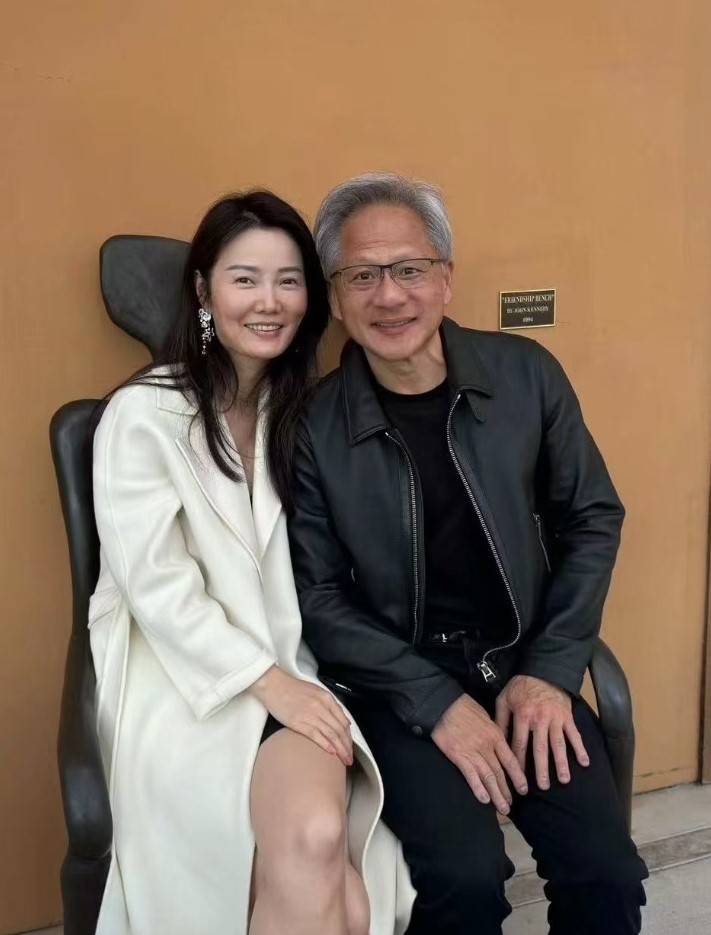
Nvidia, the world’s most biggest company by market value, has announced that it will conduct an independent investigation into its CEO, Jensen Huang’s affair with a Chinese spy and businesswoman. The woman, identified as Alice Huang, (actual name Huang Xiaole (黄小乐) , is a former executive of Singapore-based Megaspeed.
US intelligence services monitored Jensen Huang’as affair for more than a year before their conclusions were publicised in the press.
Megaspeed, a company which has come under scrutiny over its purchases of Nvidia’s sophisticated AI processors and suspicions that it helped China obtain chips which are restricted from export to the country. Megaspeed’s financials are also being scrutinised after its balance sheet grew significantly during Jensen Huang’s affair.
Jensen Huang has sought to deviate from the main concerns by apologising to his wife, family and colleagues after admitting that he had been unfaithful. Nvidia’s board said that the company has no reason to believe that its trade secrets or US national security were compromised. Huang has committed to cooperating with the investigation and will remain CEO.
What is at stake here is whether China has been able to exploit commercial relationships to obtain advanced American technology and intelligence, allowing it to compete more effectively with the United States in semiconductor manufacturing and artificial intelligence.
These concerns are not new. ASML, the Dutch company which manufactures the world’s most advanced semiconductor lithography machines, is also at the centre of growing concerns over China’s efforts to acquire Western technology.
ASML produces the extreme ultraviolet (EUV) lithography machines used by companies such as TSMC to manufacture the world’s most advanced chips, including Nvidia’s processors. Its technology is a core industrial asset for the semiconductor industry. If China manages to replicate it at an industrial scale, it would significantly reduce its dependence on Western technology.
China is already capable of manufacturing advanced chips using older deep ultraviolet (DUV) lithography technology, including through multiple patterning. However, it has not yet demonstrated that it can manufacture EUV machines at the scale and precision achieved by ASML.
ASML maintains that China remains years behind its technology. However, an investigation by The Economist raised questions about ASML’s interpretation of the extent of China’s progress.
A Reuters investigation has also reported that Chinese researchers have developed an operational EUV prototype, although it remains crude compared with ASML’s commercial machines and faces significant technical obstacles, particularly in its optical systems.
China has also recently obtained sensitive components from an F-35 stealth fighter. A cockpit canopy and weapons-bay door from an Australian military aircraft were diverted to Hong Kong while being shipped to the United States for inspection. The Chinese government subsequently took possession of the components, which included radar-absorbing material. The incident raised serious questions about the security of the international supply chain for Western military technology.
China’s efforts to acquire Western technology and knowledge extend beyond the semiconductor and defence industries. Western intelligence agencies have repeatedly warned about systematic attempts to obtain sensitive research, industrial knowledge and technological capabilities through commercial relationships, research partnerships and espionage.
China also operates through networks of companies and state-linked institutions working with European universities and research organisations. In the United Kingdom, the government has recently urged universities to end their arrangements with the China General Technology Research Institute after MI5 identified it as a front for Chinese intelligence. British intelligence said that more than 100 UK-linked academics had contributed to research projects secretly funded by Chinese intelligence, including work on artificial intelligence, cybersecurity and covert communications.
The warning has prompted a wider debate in Britain about how universities should protect sensitive research and whether they should be more closely scrutinised over their partnerships with Chinese institutions.
China presents itself as a benign friend, but it has consistently violated and abused the trust of its Western counterparts. Following decades of intellectual property theft, China openly engages in the daylight robbery of Western technology with impunity. Both Europe and the US have so far been very lenient in imposing consequences for this outright theft and illegal technology transfer.





Newsroom
Leave a Reply