



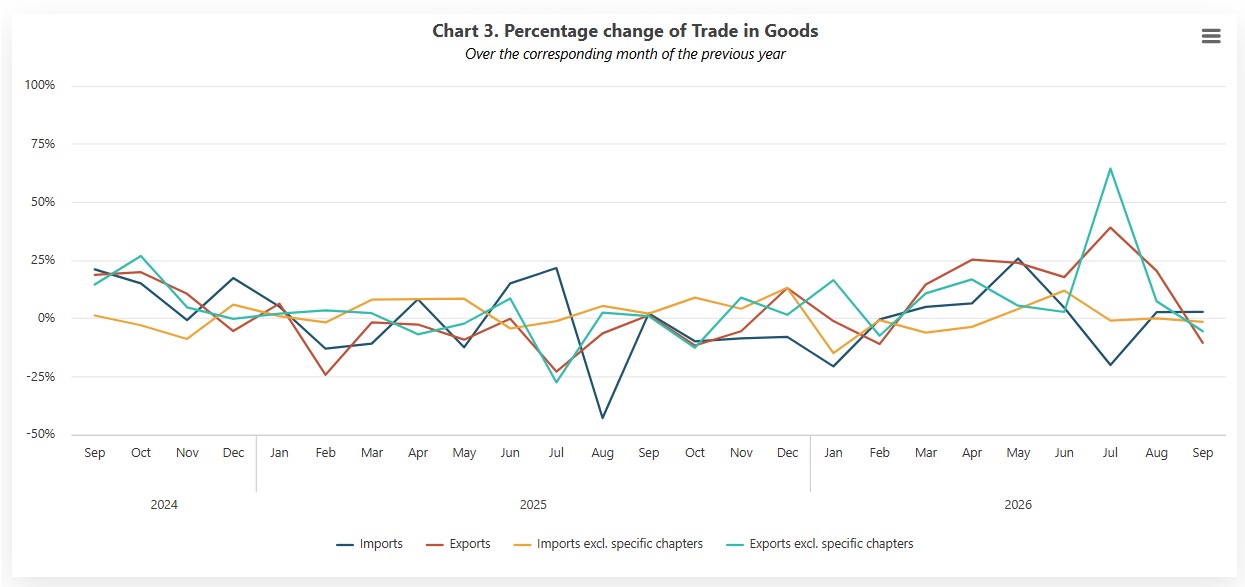
According to the latest NSO data, exports fell by 10.5% in September compared with the same month last year, while imports increased by 2.8%, widening the monthly trade deficit to €431.5 million.
The figures show that Malta exported €426.8 million worth of goods in September, €49.9 million less than in September 2025. Imports, meanwhile, increased by €23.2 million to €858.2 million. The resulting trade deficit reached €431.5 million, compared with €358.3 million a year earlier.
The decline in exports was particularly pronounced in chemicals, which fell by €23.9 million, followed by machinery and transport equipment, down by €16.2 million, and miscellaneous manufactured articles, down by €15.9 million. Food exports provided a partial offset, increasing by €8.7 million.
Mineral fuels, lubricants and related materials accounted for almost the entire import increase (+€84.8 million) but contributed almost nothing to the export side (+€0.8 million). The export decline was concentrated in chemicals (−€23.9 million), machinery and transport equipment (−€16.2 million) and miscellaneous manufactured articles (−€15.9 million)
The September figures follow a pattern that has repeatedly complicated the interpretation of Malta’s trade performance. Large movements in mineral fuels and other categories can make headline export growth look considerably stronger than the performance of the underlying export economy.
These export figures consistently show that trading and bunkering operations were distorting the headline figures. In August, exports increased by 19% year-on-year, but €65.1 million of the €76.9 million increase came from mineral fuels, lubricants and related materials. The headline improvement therefore did not represent an equivalent expansion in the country’s wider export base.
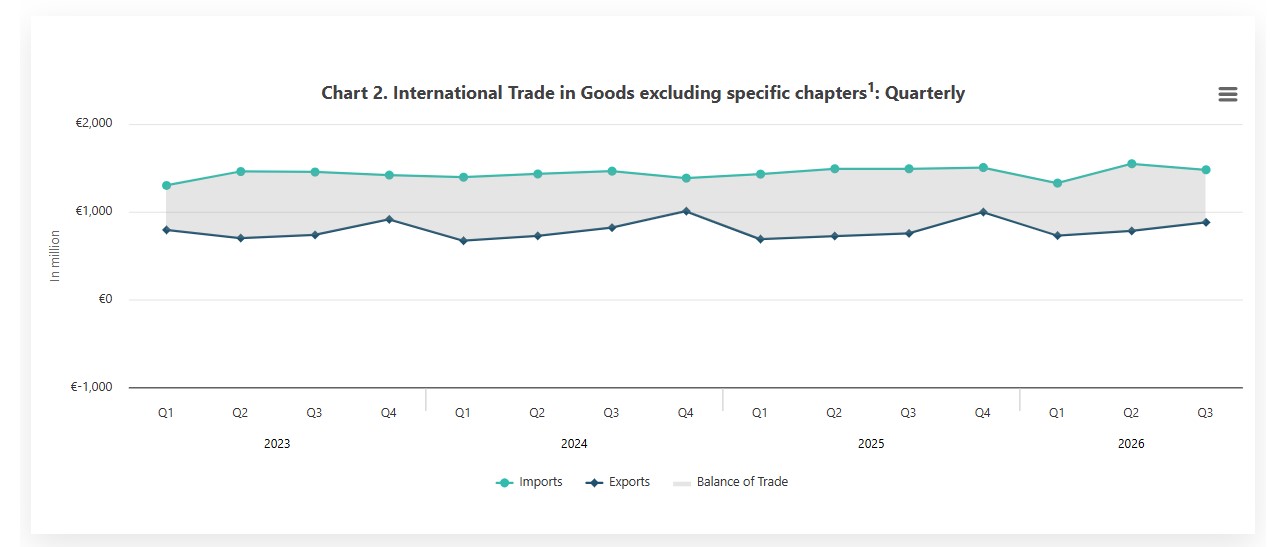
The latest figures provide another reminder of this distortion. Excluding mineral fuels, aircraft and ships, exports in September fell by 5.5% to €294.7 million. Imports on the same basis also decreased, by 1.4%, to €472.7 million. The adjusted trade deficit consequently widened to €178 million, compared with €167.6 million in September 2025.
The longer-term picture remains complicated
During the first nine months of 2026, Malta exported €3.92 billion worth of goods, an increase of €432.7 million compared with the corresponding period last year. Imports decreased by €59.9 million to €7.26 billion, bringing the total trade deficit down by €492.7 million to €3.34 billion.
The largest increases in exports during the period came from mineral fuels, lubricants and related materials, which increased by €198.7 million, machinery and transport equipment, which rose by €185 million, and food, which increased by €43.9 million.
When mineral fuels, aircraft and ships are excluded, exports increased by 10.4% during the first nine months, reaching €2.39 billion. The adjusted trade deficit narrowed to €1.96 billion. These figures show that the underlying export performance has improved compared with the same period in 2025, even though September itself registered a decline.
Previous reports repeatedly pointed to the weakness of Malta’s goods export base, including the decline in exports during 2025, when total exports fell to €4.89 billion from €5.26 billion in 2024. Earlier reports also highlighted how monthly rebounds were not necessarily evidence of a structural recovery.
Germany records the largest increase in exports
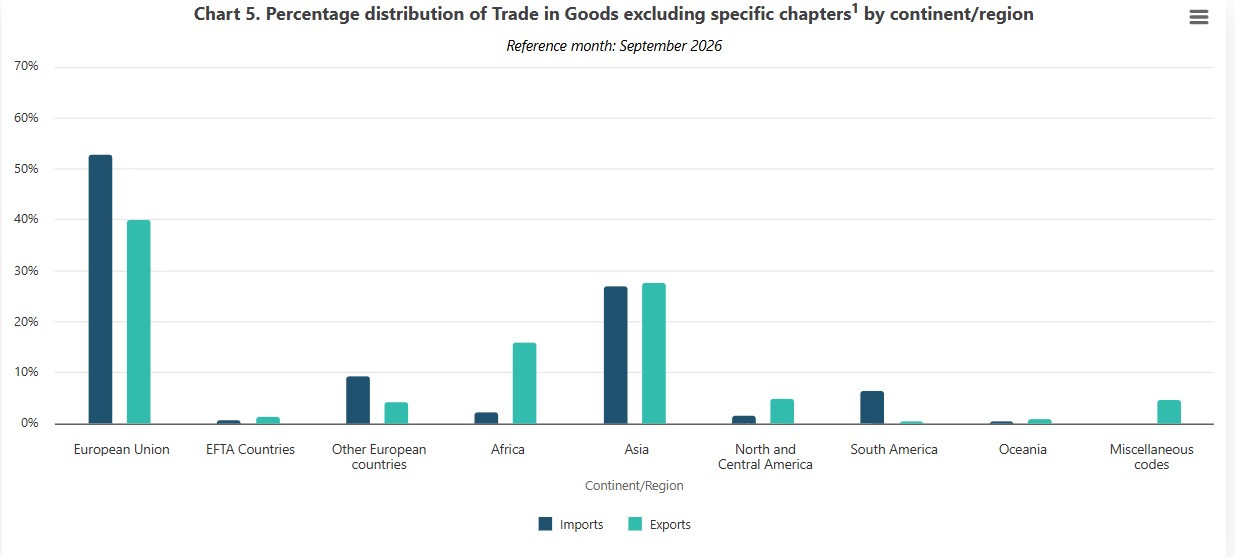
Exports to the EU reached €1.26 billion, accounting for 32.2% of total exports. Asia accounted for a further 20.1% of imports and 13.4% of exports. Germany recorded the largest increase in exports among Malta’s trading partners, at €54.2 million, while exports to Turkey registered the largest decline, falling by €44.9 million.
During the first nine months of the year, Italy was Malta’s largest import partner, accounting for €1.61 billion worth of goods. Spain followed with €563.1 million, while the Netherlands ranked third with €510.7 million. Imports from the European Union amounted to €4.35 billion, representing 59.9% of Malta’s total imports.
Germany was Malta’s largest export destination during the first nine months of 2026, receiving €592.3 million worth of goods. Italy ranked second, with €156.7 million, followed by the United States with €153.4 million.



Newsroom
Leave a Reply