

Advertisement

Cartoon journalism strikes again

It’s not a news item if Andrew Tate mentions Malta. It’s not a news item if he says anything at all, but Lovin Malta editors can’t be bothered to make an effort and use a couple of their brain cells to filter what’s meaningful, important and news-worthy.

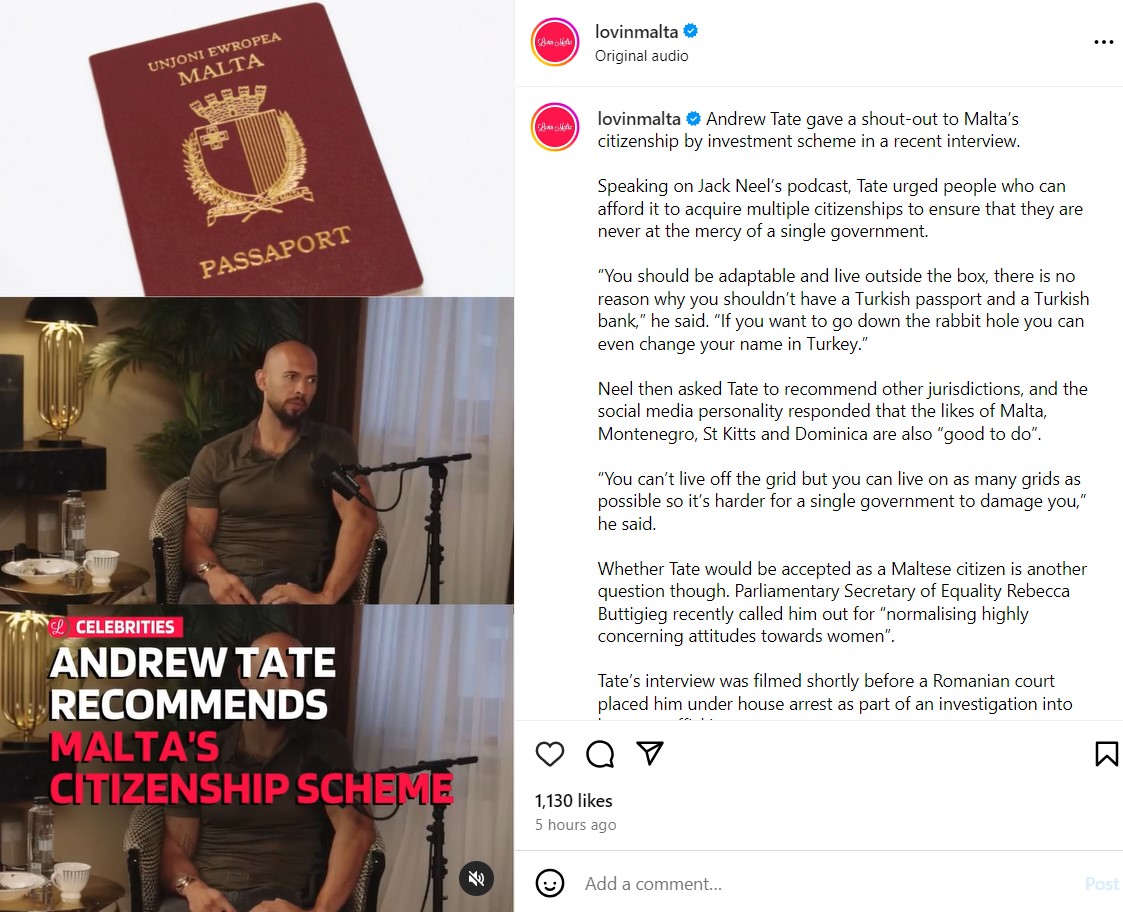
Andrew Tate recently mentioned Malta, so Lovin Malta took the opportunity and made a news item about it because they can’t be bothered to conduct proper journalism. Hits is all what matters.

Lovin Malta has become Malta’s prime cartoon network, ingratiating themselves with corrupt and deceitful politicians like Alex Borg instead of investigating them, publishing all sorts of inanities, and now even quoting Andrew Tate.

It’s so tiring that it hurts. Can’t wait for October.

Comments

  1. […] Lovin Malta be ready to disclose how much of its income is from government revenues given that it is now […]

  2. Matthew Attard avatar
    Matthew Attard

    I’m 21 and I noticed that this problem is pervasive not only among people my age or younger, but also those who are much older. Recently, I took a crash-course in journalism, and to my dismay we were told that we need to make our content as visually-stimulating as possible to not lose our audience, and we need to dumb down our writing to the point of baby talk so they’ll understand our message.

    When you influence people in a way that makes them lose interest in books and long-form educational content in favor of hyper-stimulating short videos, you get individuals who are literally unable to read one page of a book or read, interpret and criticize a text.

    Sadly, we’re living in an age where news platforms are putting more effort into dopaminergic audiovisuals rather than providing insightful news. This is probably to meet the demand for such content and to attract sponsors in order to get funding. Because of this, they start putting out low-quality garbage; their content becomes the fast food of journalism.

    1. Well, it depends what kind of outlet you work for and what kind of audience you have. Yellow journalism and tabloids have been around for a very long time, but so have broadsheets with sombre headlines and long-form articles.

      For many years, The Sun’s (British tabloid) biggest attraction used to be a photo of a topless young lady on page 3. The paper only renounced this page when the internet made the pictures kind of irrelevant. The sensationalist headlines about murders, ‘Brussels regulating the curvature of bananas’ or ‘people rising up in the streets against immigrants’ remain, though. Never mind the facts or the nuanced realities.

      My point is that people have been making up their minds on politics based on sensationalist one liners (many readers never get past the headline) for long before TikTok videos were even a thing. The idea that people have been ‘dumbed down’ or ‘taught to lose interest in high-quality journalism’ is probably untrue. The majority were never sitting down to read complex articles in the first place.

      What has changed is that modern media feed the basest instincts even better than a 1994 page 3 of The Sun ever did. Nightly news turned into a 24-hour news cycle always in search of new headlines. Commercial news channels felt the need to compete with pure entertainment channels so they got supermodels in short skirts to present the news (e.g. Silvio Berlusconi’s channels).

      Then, the internet supercharged sensationalism, short-form text (Twitter), video (YouTube) and do-it-yourself (often conspiratorial) journalism in the form of podcasts. This is yellow journalism on steroids, reaching further than it ever had before. Advertisers will naturally gravitate towards where the audiences are, so new media have gained advertising revenue while print journalism has lost it.

      All that said, serious journalists and serious news outlets remain. Embracing new media does not necessarily mean dumbing down. Mark’s is, for example, a serious blog, and many of the articles linked to are informative, balanced and long-form. Video and audio are not necessarily dumber than text, as many good documentaries and podcasts demonstrate. What you produce as a journalist will depend on your attitude, skill and the editorial line of who you get employed with. Serious stuff is by no means dead. Nor are books so thick that they can serve as door stoppers.

      What concerns me about your story is that the course you attended did not seem to present a balanced view of different types of journalism. It seemed to promote only going with the tide, suggesting that anything that anything that does not have flashing images or is more than 140 characters long is obsolete.

      What also concerns me is the ease with which one can give in to base instincts with new technology. Watch a few YouTube shorts and you will easily descend into a time-wasting rabbit hole of watching the darned 30-second things. I sometimes observe young people in queues frittering time on their phones and I see that they are not even watching short videos. They are simply doomscrolling, watching maybe 3-second snippets out of a video before scrolling down to the next one, in what seems like an endless loop.

      I get the sense that they re bored with what they are doing but at the same time endlessly hopeful that the next video is going to be the best thing ever. I also sense that there is a lack of control in behaviour and an inability to concentrate even on media which is designed for quick and easy consumption (which obviously reflects badly on the ability to concentrate on anything which is longer or more complicated). I sometimes genuinely wonder if handheld devices, the nature of the internet (several tabs open at once), and short videos are giving us all attention deficit hyperactivity disorder.

    2. Something else I could have mentioned is that Lovin Malta may be bad journalism with sinister intent. Rather than being short form because of demand or vanilla because of commercial reasons, they are being paid by interested parties to produce content which will distract the people from real news that is happening and from media houses reporting it. In one word: ‘propaganda’.

Leave a Reply

Your email address will not be published. Required fields are marked *