



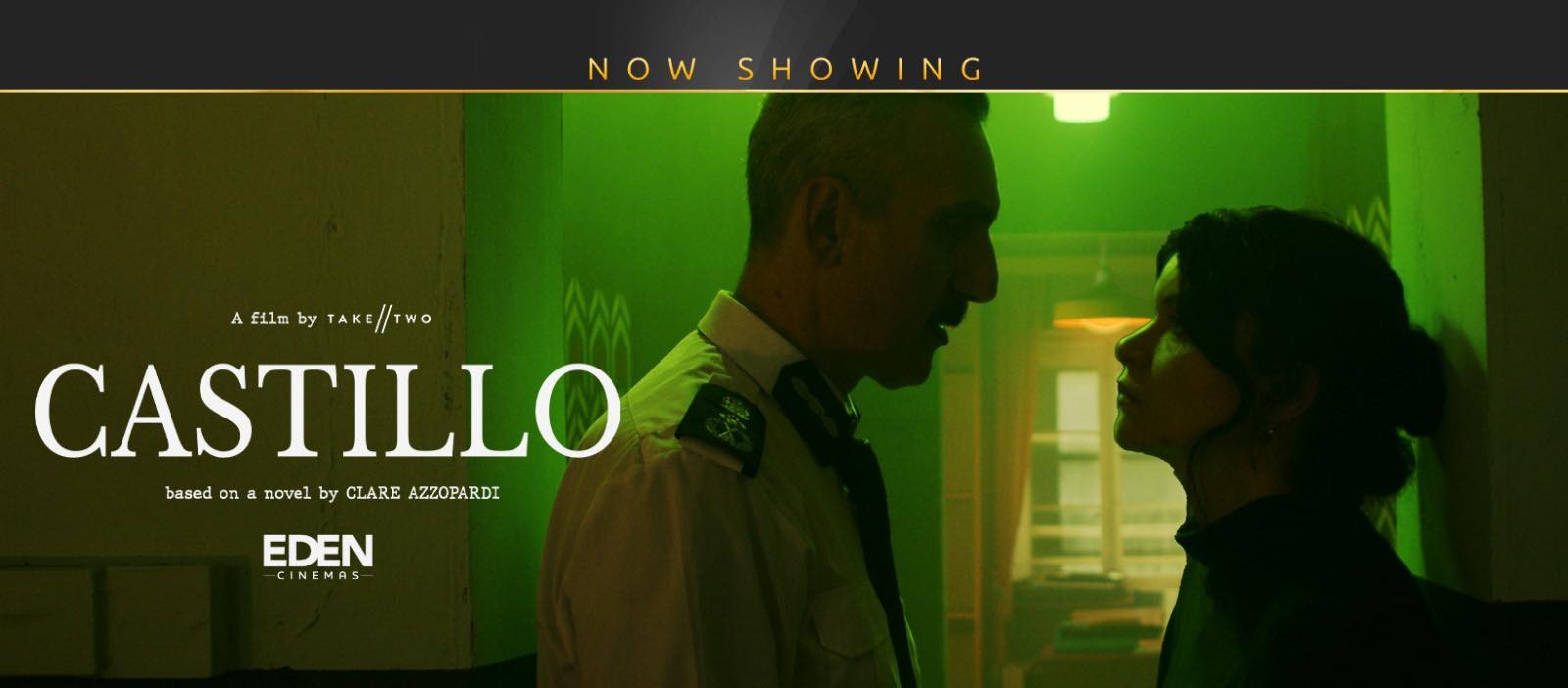
Part of Take Two’s marketing for their new feature film involved videoclips of a number of short interviews of people who attended the premiere. The superlatives were plenty — these came from clearly biased viewers like Lawrence Buontempo, who worked with Take Two on previous productions, or Salvu Mallia, director Abigail Mallia’s father — but most of the superlatives, unfortunately, were lacking any substance anyway.
One viewer simply suggested: “Go see it! You don’t have a choice.”
She was wrong, of course. I did have a choice. Unlike the other post-premiere reviewers who had a microphone in their face, I also had a choice whether to say I liked it or not. The answer is a little complicated. So let’s get right to it.
Castillo is based on the eponymous novel by Clare Azzopardi, a narrative about mothers and daughters, family dynamics in the 1980s and beyond, and one which was marketed as a political thriller, which was a wise business manoeuvre from Merlin Publishers given the previous success of 80s political thrillers like Alex Vella Gera’s Is-Sriep Reġgħu Saru Velenużi, but not necessarily a fair move (for both the novel itself and its intended audience).
It will be fair to mention that I was one of the judges on the National Book Prize adjudication board in 2020 who did not award any novel a prize. Castillo was one of the contenders. It’s also fair to say that I went to watch the film adaptation of the book with an open mind and I asked myself simply one question at the end of it: did I enjoy it?
I promised myself I would not go too far beyond that question.
Castillo, the film, does not follow the book’s narrative too closely. There are clear differences but the bones are very much there as we see Amanda reuniting with her estranged mother, Emma Barbara, after two decades of the latter’s abandonment of the family. The tragic murder of Amanda’s aunt and Emma’s sister, Catherine Penza, is a constant in the background.
Carlos DeBattista’s script is one of the more obvious improvements to Azzopardi’s dialogue. At the very least, DeBattista lent the opening of the narrative far more plausibility than the one in the book. For one, the mother and daughter who haven’t seen each other in over two decades don’t speak to one another as if they were playing boozy bingo the other night.
So far so good. But then that awful soundtrack starts playing — which was far too loud, by the way — an operatic chorale performed by The Abos Project that doesn’t let up until the credits start rolling. This is part of the overarching problem with how Malta was depicted in the film. Castillo caricaturises every aspect of the island, though unintentionally. Malta is more than gloomy houses of character with gritty limestone walls; traditional Maltese tiles; constant swearing and shouting — the whole film is one big shout-fest as if the actors were competing on who could yawp the loudest; the breakwater; and paved village-core alleyways. We still haven’t grasped how to portray a more nuanced Malta.
Even when the political troubles of the 80s are mentioned, the same tired complaint of we-only-had-one-chocolate-and-it-was-terrible — so often repeated that it’s become meaningless — is one of the few lines in the story that contributes to the temporal setting. It’s like the production was so afraid that we’d completely miss that this was a Maltese production that they had to cram every Maltese stereotype that they could think of.
Technically, the cinematography is often gorgeous. There are long takes that make for particularly compelling cinema. The camera is a character in itself — as if making up for the lack of character within the narrative — and its movements are constant and deliberate.
This too, however, turns baroque rather quickly. How many times is the camera going to shift to the telephone before panning back to the recipient? Yes, we know the phone is ringing. The camera waltzes, dances, spins and zooms and, by the end, it’s been far too exhausting and you desperately want to look anywhere else but the screen.
This doesn’t take away from some scenes where this excess worked. When the titular character, inspector Castillo, is walking around the room (but really only in Emma’s mind) while Emma is writing him out of existence in a continuation of her sister’s narrative, the camera pans to the long corridor where his vulnerable and simultaneously intimidating presence is pelting her with insults.
Another long and beautiful shot is when the Tonna brothers are making a bomb in their garage and a squad of vengeful police officers burst into the scene to arrest them.
These efforts have been described by some viewers as revolutionary local cinema but these same people have clearly never watched Limestone Cowboy (another film by Take Two) or, if you wish to go back further, Mario Azzopardi’s 1971 production of Il-Gaġġa.
What’s especially impressive about the cinematography, however, — and this is far more noteworthy — is how it handles the timeline shifts in the narrative. This was not easy to pull off. There are so many timelines — different daughters, different families — criss-crossing each other, coming to terms with each other, but the filming of these shifts was done extremely well. It’s hard to get confused.
The acting too is a revelation. There’s been significant improvement in local performances in the last few years. André Mangion, playing the part of Amanda’s husband is believable in every scene, Simone Spiteri, playing the part of Emma Barbara, managed to carve out a lucid character for herself. The weakest work here came from the protagonist, Amanda, played by Analise Mifsud; staring in the distance and attempting to cry at the end of the film were not plausible or compelling to watch.
The strongest is the titular character, played by Mark Doneo. Doneo steals every scene he is in. His movements, his language, his breathing and the way he inhales a lungful of smoke were all part of a far larger character he was portraying. This is rather ironic because he is entirely a fictional character within the Castillo world, a figment of Catherine Penza’s crime novels, a character that keeps haunting the rest of the family. It’s no surprise that Castillo is also the only interesting and round character in the novel on which the film is based. He’s the only one who seems to have a detailed backstory.
There was certainly an incredible amount of talent amongst the cast and crew — and a healthy dose of funding, courtesy of the National Book Council, Arts Council Malta, and Creative Malta. One inevitable question, therefore, remains: why was this talent and funding squandered on a poor narrative?
Because the problem with Castillo, the film, is the story. We find out so little about the characters’ lives and routines, the plot is contrived and melodramatic — when are we going to learn that you don’t need largeness of plot to convey Malta’s shortcomings? Just look at Luzzu! — and the film feels hollow and bereft of any emotion. The story has no charisma: the characters are shouting all the time, gratuitously slamming things, pushing each other; they are completely humourless and lifeless.
It does certainly feel that the production did all it could and poured so much of their time and effort on a story that simply wasn’t good enough. On that front, they succeeded. Castillo the story got more than it deserved. Sadly, it still wasn’t enough. The film is not memorable or moving and we are left with another eye-roll inducing Malta filed in the cabinet of typically Maltese productions.
So, did I enjoy it? Not so much.

Culture Editor
Author and Literary Critic
Leave a Reply