



One of Malta’s foremost stock brokers and financial advisors recently wrote an article in The Times of Malta encouraging his readers to buy Chinese stocks. The article followed the news that the Chinese Central Bank injected up to $112 billion in new liquidity into its stock market (the Shanghai index alone is up to $6 trillion in mark cap) among other injections of liquidity in the local economy amounting in total to around $1 trillion. Edward Rizzo said that this injection of funds has brought renewed investors interest in Chinese stocks and quoted some “American investment bank” saying that Chinese stocks could rise by 20%.
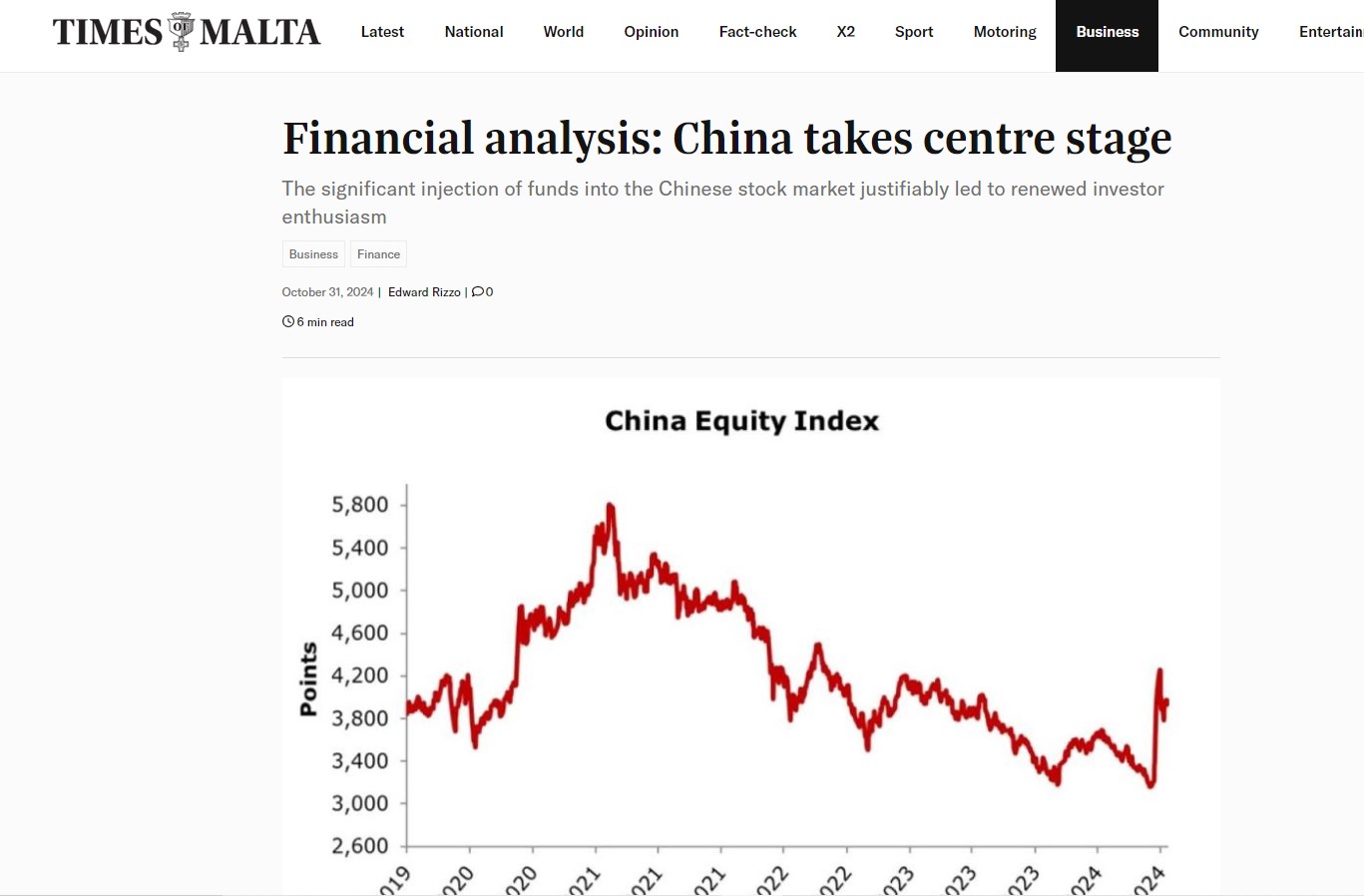
All Chinese stock market indexes are down since then. The CSI 300 index Edward Rizzo is quoting made a 78% return since 2009. By contrast, since 2009, the S&P500 soared by 559%.
There exists an unwritten rule among serious financial advisors that says not to recommend exotic and complex investments to retail clients: these include all kind of bank stocks, and any stocks outside the United States, Europe or Japan. There was a time when AliBaba looked as the most westernised Chinese company set to compete with Western companies, and this was what partly brought interest in the Chinese stock market, yet this was before the Chinese government clamped down on its capitalist class and restricted their activities. Today, even though the Chinese stock market looks “cheap”, it is being avoided by all kinds of investors due to heightened political and economic risks. Fundamentally, China remains a totalitarian dystopia with a crashing economy and fake official economic data.
In order to simplify my discussion I will divide fund managers into two. There are fund managers who invest according to the business and cash that a business generates. Then there are fund managers who invest with a macroeconomic outlook: more often the former make money while the latter lose money all the time. The fund managers that invest via a macroeconomic outlook and consistently beat the market are the exception more than the rule.
This is why it is totally redundant of a financial advisor to recommend the purchase of Chinese stocks via a macroeconomic and financial analysis. What makes his proposal even more redundant is that his analysis fails to underscore the most important fundamental financial instrument in the financial and macroeconomic analysis of the stock market: the credit market.
Actual financial analysts who make an economic analysis of the stock market refer to the credit market first, not the state of the economy. In addition, the most important reaction of markets to a government stimulus is reflected in government bond yields and not in the stock market. Credit markets are actually more important and fundamental than stock markets because they are actually much bigger.
To put it simply, credit markets can reflect the state of investors’ sentiment by gauging government bond yields. Government bond yields will go down when there is a lot of demand for the government bonds. Excessive demand for government bonds may reflect investors’ concerns in the stock market as they transfer their capital into a more secure and stable asset. Relatively low government bond yields, may indicate that investors are taking a higher risk by transferring their capital from bonds to stocks.
The reaction of Chinese government bond yields to the announcement of the stimulus packages was a continued decline, as investors opted to buy bonds instead of stocks. This response can be interpreted as Chinese investors signaling that the government stimulus package is insufficient. Market sentiment is not gauged by a bounce in the one-minute stock-market index trading chart. Chinese government bond yields are collapsing.

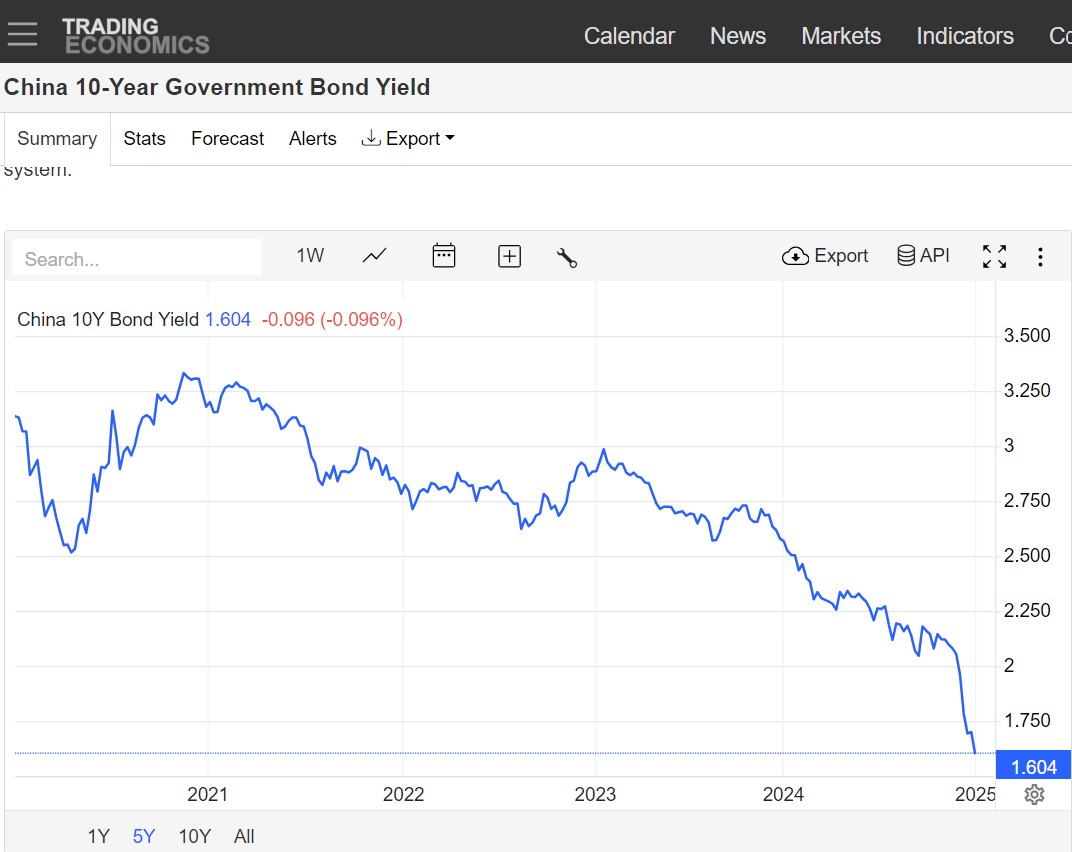
After checking the ten-year government bond yield, considered to be one of the most important gauges, the financial analyst would then turn to the yield curve which can give further confirmation of market sentiment. China’s yield curve is flattening with the gap between thee shorter-term and the longer-term bonds closing even further. This may indicate that long-term market sentiment is bad because the longer-term yield should be much higher and wider apart from the short-term yield.
Yet, even this discussion is redundant. The US stock market is the highest returning stock market in real terms, outpacing by far its Eastern competitors. A discussion by a financial advisor that presents all the facts and context about Chinese stocks would first start by saying, why would you invest in something inferior? The US and the Dollar are the financial leaders of the world. Its stock market has the highest returns and is by far the largest than any other stock market. If one is to study history, the facts at hand indicate that this situation will remain the same for decades to come. For more context you can read this article.

Website Editor
Historian and Publisher

Leave a Reply