



Some Maltese readers are still very confused about the name The Maltese Herald, as they are confusing it with a nowadays defunct, weekly newspaper called The Maltese Herald published in Australia by the Maltese migrant community. Although we respect the past work of the Australian paper, we have no connection with them or their successors.
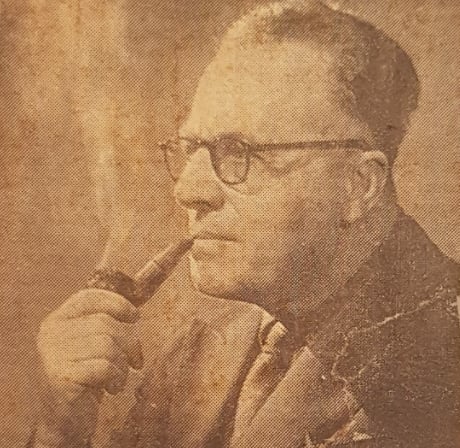
The name was taken from the newspaper that Vincenzo (Ċensu) Bugeja (1887–1963) worked for most of his life and it was called the Paris Herald. The Paris Herald was originally a sister-newspaper of the New York Herald and eventually turned into the International Herald Tribune. Ċensu Bugeja, originally from Lija, was the international editor of the Paris Herald and lived in Paris from 1919.
Ċensu Bugeja was a founding member of the Labour Party in 1921 and one of its major intellectuals. He was often very critical of the Labour Party’s actions especially for being too compromising Gerald Strickland, but was deeply respected by the Labour Party’s officials and also by Dom Mintoff, who kept corresponding with him in the early sixties. In 1928 he was excommunicated by the Catholic Church for his socialist and anti-clerical articles in the satirical newspaper Il-Ħmar which he used to edit from Paris.
We know a lot about Ċensu Bugeja’s history on Paris thanks to a book by Al Laney, first published by Meredith Press in 1947, called “Paris Herald: The Incredible Newspaper”. The Labour Party’s publishing house, SKS, also has copies of his correspondence with various Labour Party officials.
Ċensu Bugeja represented the internationalist, cosmopolitan and progressive streak of the Labour Party’s intellectual fold. He served as a very tough adversary to the established political parties of that time who were capable of easily manipulating an illiterate and very superstitious population. His cosmopolitan mindset, shaped by living abroad and his extensive reading, freed him from the Church’s stringent censorship and persecution in Malta during that era, enabling him to write and publish some of the most incisive, critical, and satirical pieces in the Maltese press during the 1920s and 1930s. During the Second World War, he, survived the Nazi occupation of Paris by hiding in the southern French countryside where partisans and resistance fighters operated.
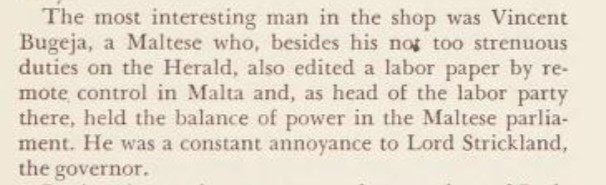
Al Laney describes him as one of the valuable employees of the Paris Herald. You can read the full description about him below. According to Al Laney, one of the inspirations of Ċensu Bugeja and his colleagues at the Paris Herald was Voltaire. Today, Ċensu Bugeja serves as an inspiration for a free and independent press in Malta.


Website Editor
Historian and Publisher


Leave a Reply