



Government finances remained in deficit territory in the first eight months of 2025, with a shortfall of €203.4 million reported in the Consolidated Fund, according to the latest statistics from the National Statistics Office (NSO). This compares to a €98.6 million surplus registered during the same period in 2024, according to the latest data.
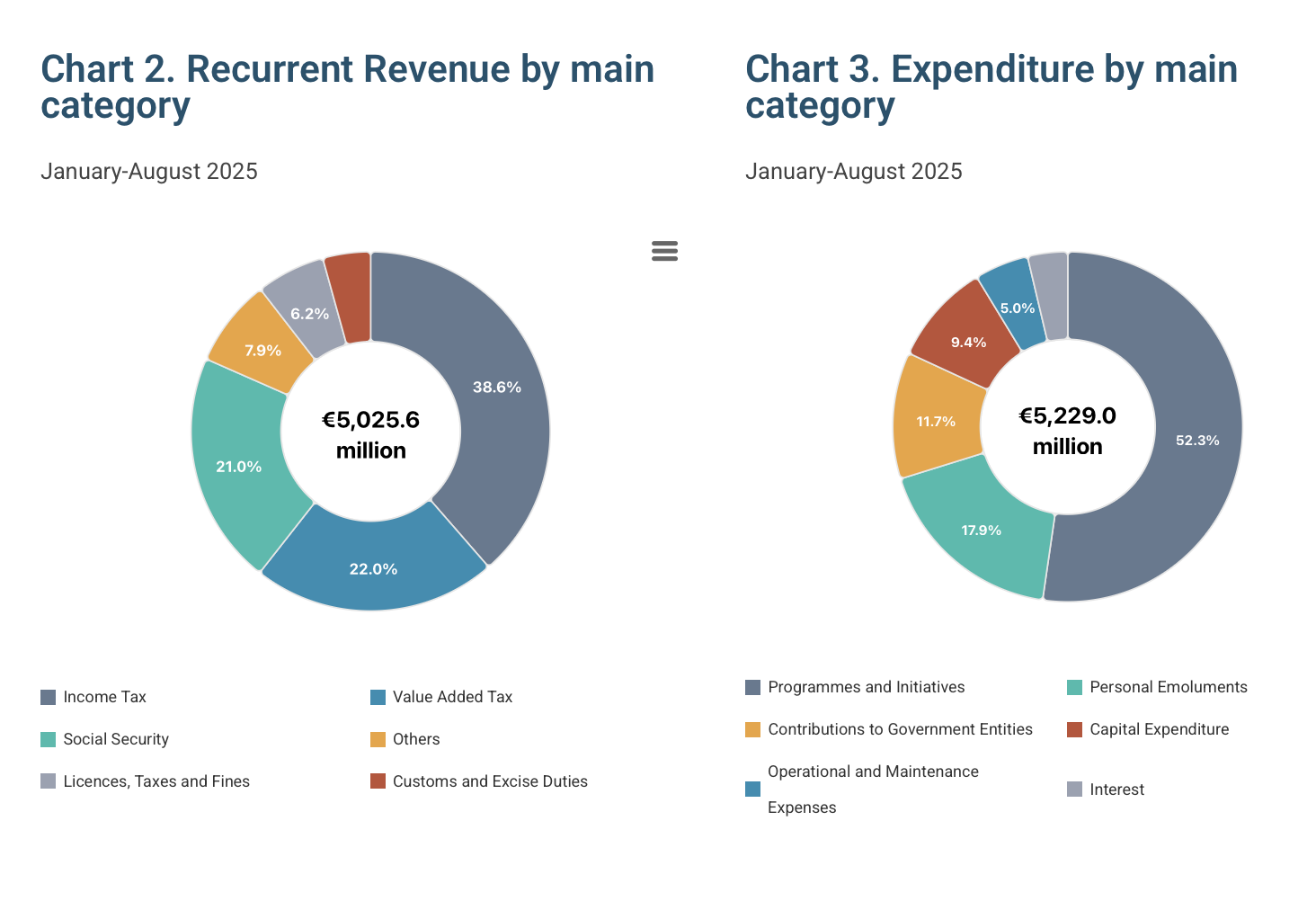
Between January and August, Recurrent Revenue reached €5.02 billion, marking a year-on-year increase of €174.6 million. The largest gains came from Social Security contributions (+€99.1m), Value Added Tax (+€87.1m), and Licenses, Taxes and Fines (+€31.9m). These were partly offset by declines in Grants (-€44.6m) and Income Tax (-€28.4m).
On the expenditure side, the government spent €5.22 billion in the period under review, up by €476.6 million compared with last year. Recurrent Expenditure accounted for the bulk of the increase, reaching €4.54 billion. The rise was driven mainly by Programmes and Initiatives (+€178.3m), particularly in Social Security benefits (+€88.4m), Church schools (+€23.8m), and contributions to the EU’s own resources (+€18.9m). Spending also grew under Personal Emoluments (+€122.8m) and Contributions to Government Entities (+€43.0m).
The interest bill on public debt amounted to €192.5 million, €19.3 million more than in 2024, while capital expenditure rose to €490.0 million, with major allocations for the second electricity interconnector (+€73.5m), RePowerEU projects (+€18.7m), and investment incentives (+€14.9m). These outlays were partly offset by reduced spending on road construction (-€23.3m) and the uptake of electric vehicles (-€21.4m).
By the end of August 2025, Central Government debt climbed to €11.1 billion, up by €1.09 billion compared to last year. The main increase came from Malta Government Stocks (+€902.1m), with additional rises in Treasury Bills (+€171.0m) and Foreign Loans (+€77.7m).
The overall picture shows that while government revenue has continued to grow, expenditure is expanding at a significantly faster pace, leading to a higher debt burden. With the 2026 Budget preparations underway, these figures are expected to guide fiscal priorities, as policymakers seek to balance rising social and infrastructure commitments with long-term debt management.


News Editor
Journalist and Newscaster


Leave a Reply