



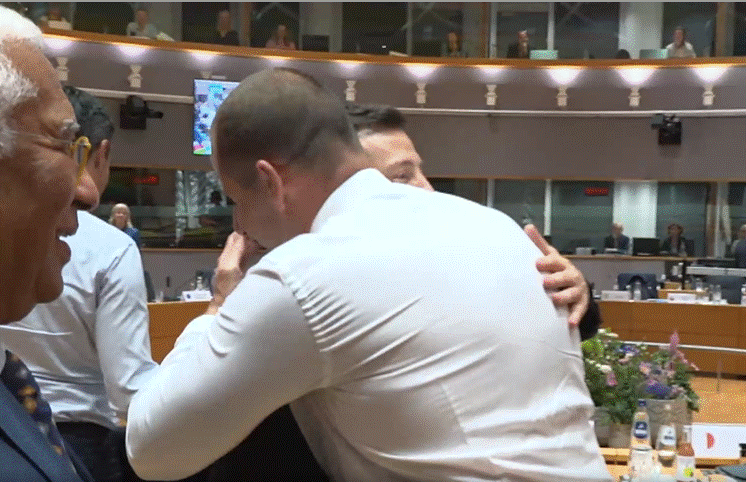
It was a very busy day yesterday in Brussels, with a European Council summit focused on Ukraine, China, trade, the EU’s next long-term budget and the Middle East. Prime Minister Robert Abela was also present for the summit, while Malta also took part in a meeting of the “Friends of Cohesion”, a group of member states defending cohesion funds, agricultural funding and fisheries funding in the next EU budget.
The cohesion funds meeting was held by the “Friends of Cohesion”, a group of 17 EU member states that includes Malta. The meeting was organised by Italy and Romania and chaired by Italian Prime Minister Giorgia Meloni. Its aim was to coordinate the position of countries that want the next EU budget for 2028–2034 to protect cohesion policy, the Common Agricultural Policy and the Common Fisheries Policy, rather than cutting regional-development and agricultural funds to make room for new priorities.
Euronews is running a story today saying that European Council President António Costa has opened a diplomatic channel with the Kremlin, marking a significant shift in EU diplomacy towards Russia since the full-scale invasion of Ukraine. According to Euronews, Costa’s chief of cabinet held several phone calls with a senior Kremlin official, reportedly close to Vladimir Putin, to test whether a communication channel could be opened.
Costa defended the move during the European Council summit, saying the contacts were brief, involved no negotiations and did not include any substantive exchange. His argument is that the EU needs to be ready to defend its own interests if negotiations on Ukraine eventually begin.
The move has split EU leaders. Poland, the Baltic states and Nordic countries are reported to have objected to the initiative, especially because several capitals were not consulted before the channel was opened. Other leaders, including those from Austria and Slovenia, welcomed the idea of keeping some form of communication open with Moscow.
The European Council’s formal position remains that there can be no peace settlement over Ukraine without Ukraine. EU leaders also reaffirmed their support for Ukraine’s sovereignty and territorial integrity, called for stronger security guarantees, and urged faster delivery of air-defence systems, ammunition, drones and missiles. The Council also called for the swift adoption of the EU’s 21st sanctions package against Russia.
China and trade were also high on the agenda. EU leaders discussed the growing trade imbalance with China, with the EU’s goods deficit with Beijing now estimated at around €1 billion per day. There is broad agreement in Brussels that the EU needs stronger trade-defence tools, but member states remain divided over how far to go. France and several other countries are pushing for a tougher line, while Germany and Spain are more cautious because of their trade and investment ties with China.
European Commission President Ursula von der Leyen has been given political backing to work on tougher measures against unfair Chinese competition. These could include faster anti-dumping and anti-subsidy investigations, stronger safeguards, and new rules to reduce Europe’s dependence on single foreign suppliers in sensitive sectors such as rare earths, clean technology, chemicals and metals.
The summit therefore exposed two major strategic debates inside the EU: whether Europe should begin preparing its own diplomatic channel with Russia, and how aggressively it should defend its industries from China’s growing dominance in European markets.
Agenda can be found here. Footage below by Hans von Burchard.

Newsroom

Leave a Reply