




According to the latest Eurostat figures, more women than men graduate from tertiary education in Europe, with women outnumbering men by around 700,000 graduates in 2024.
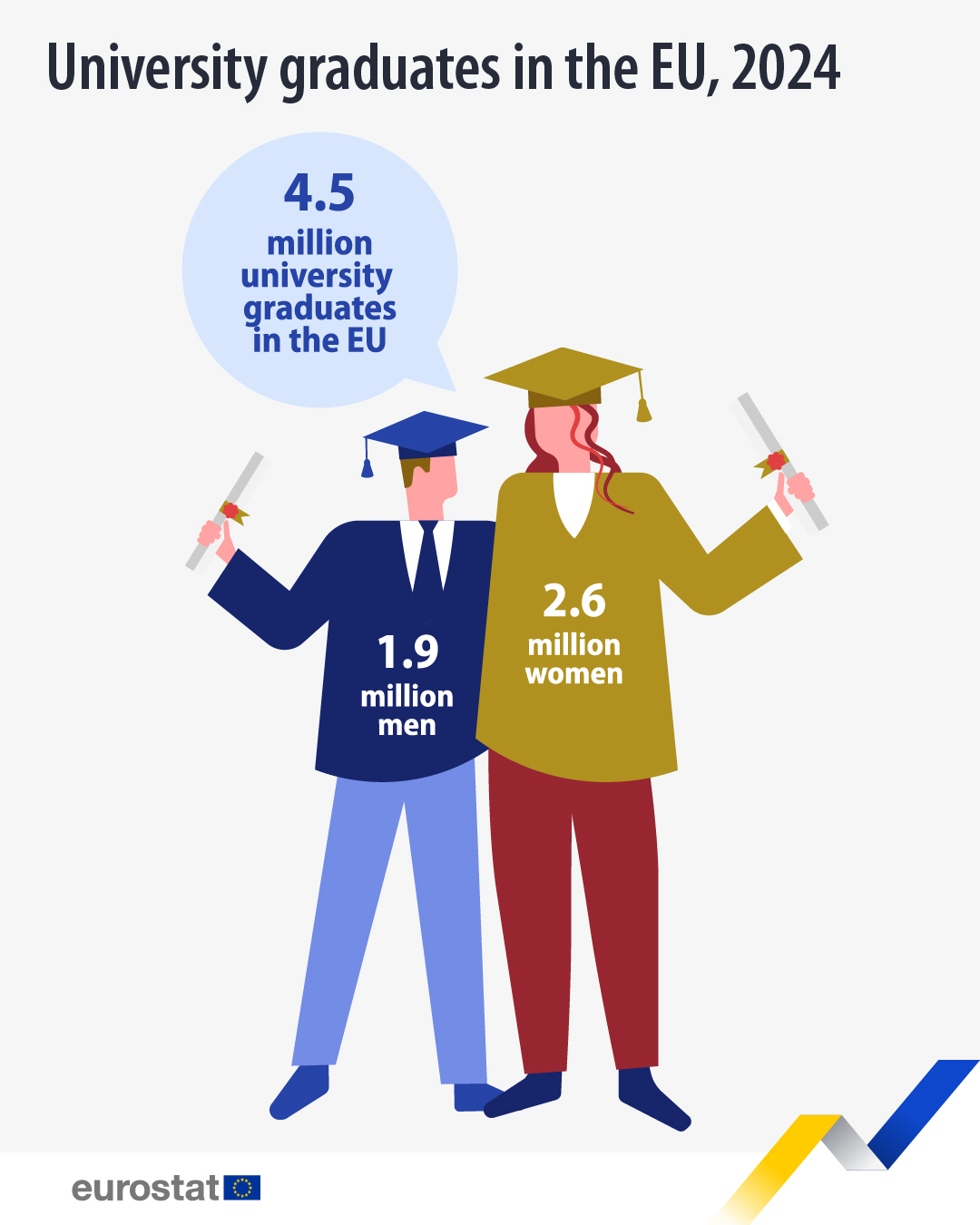
In 2024, there were 4.5 million tertiary education graduates across the European Union, of whom 2.6 million were women and 1.9 million were men. This means there were around 37% more female graduates than male graduates.
The trend of women outnumbering men was recorded across most fields of study. The largest difference was in education, where there were four times as many female graduates as male graduates. On the other hand, men continued to dominate information and communication technologies, where there were 3.7 times as many male graduates as female graduates.
In Malta, the trend is similar, with women also making up the majority of tertiary graduates.
A total of 6,210 people graduated from tertiary education in Malta in 2024, an increase of 6.5% compared to the previous year. Women made up 57.3% of all graduates, compared to 42.7% who were men. For every 100 male graduates in Malta, there were 134 female graduates.
However, the gap between female and male graduates in Malta actually narrowed compared to the previous year. In 2023, women accounted for 60.1% of tertiary graduates and there were 151 female graduates for every 100 male graduates.
Women surpassed men at almost every level of tertiary education in Malta in 2024, with the exception of doctoral qualifications, where male and female graduates were equally distributed.
Despite women making up the majority of graduates overall, men continue to significantly outnumber women in science, technology, engineering and mathematics.
Only 12.9% of Malta’s tertiary graduates in 2024 obtained a qualification in a STEM field. There were 534 male STEM graduates compared to just 264 female graduates, meaning that men accounted for around two-thirds of all STEM graduates.
Business, administration and law remained by far the most popular area of study in Malta, accounting for 33.8% of all tertiary graduates, followed by health and welfare at 22.3%.


Newsroom
Leave a Reply