



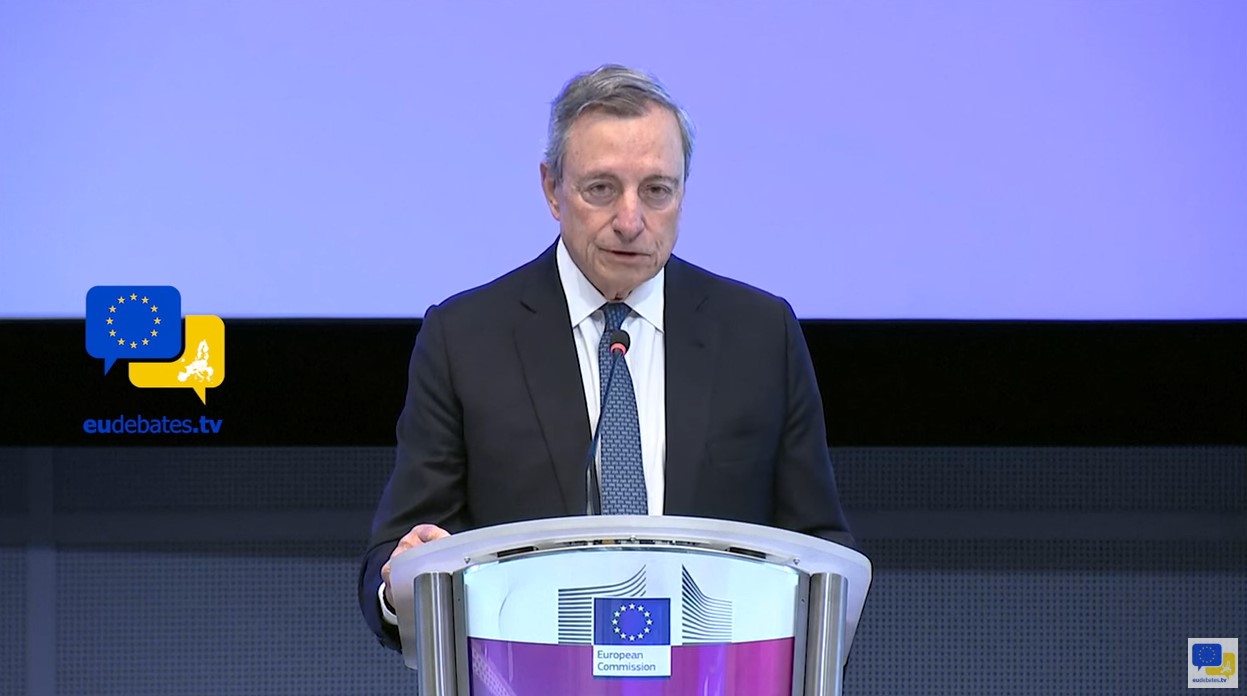
Mario Draghi has joined forces with Irish businessman Patrick Collison, co-founder and CEO of Stripe, to establish the Rhine Group, a new pro-European policy initiative aimed at reversing Europe’s economic decline and strengthening its competitiveness.
Draghi and Collison serve as co-chairs and co-founders of the group, while Spanish economist and former liberal MEP Luis Garicano serves as its Executive Director. Garicano is also Professor of Public Policy at the London School of Economics and previously served as Vice-President of the liberal Renew Europe group in the European Parliament.
The Rhine Group brings together leading figures from business, academia, economics and public policy. Its members include Nobel Prize-winning economist Philippe Aghion, former Estonian President Toomas Hendrik Ilves, The Economist editor-in-chief Zanny Minton Beddoes, Shopify CEO Tobi Lütke and Klarna co-founder Sebastian Siemiatkowski. The group is independent of the European Union’s institutions and intends to develop evidence-based proposals for European governments and policymakers.
The group warns that Europe’s competitiveness is in decline, along with its capacity to fund the fundamental obligations of the modern state, including defence, healthcare, pensions, education, climate investment and social welfare. It highlights that only four of the world’s 50 largest technology companies are European and argues that Europe is particularly weak in the emerging technologies that are expected to shape economic growth over the coming decades.
The Rhine Group insists that Europe’s decline is not inevitable, but warns that this is the direction in which the continent is heading unless urgent action is taken. Despite its weaknesses, Europe remains the world’s second-largest market and retains significant advantages in its universities, research institutions, industrial base, capital and skilled workforce. The challenge, according to the group, is turning those strengths into investment, innovation and globally competitive European companies.
The initiative echoes and seeks to build upon Mario Draghi’s repeated warnings about Europe’s deteriorating competitive position. His 2024 report on European competitiveness contained more than 170 proposals covering energy policy, industrial strategy, digital infrastructure, capital markets, productivity, innovation and defence. The Rhine Group aims to bridge the gap between Draghi’s diagnosis and the implementation of concrete reforms.
It also highlights Europe’s growing dependence on external powers and its increasing vulnerability to events beyond its control. For decades, Europe benefited from expanding global trade, relatively stable international rules and the American security umbrella, allowing European governments to spend comparatively less on defence. Those assumptions have weakened considerably.
The United States has become more protectionist, while China has emerged as an increasingly powerful competitor both inside Europe and in third-country markets. At the same time, European dependencies in energy, technology and industrial supply chains have become strategic vulnerabilities. According to the Rhine Group, Europe’s traditional economic model is therefore becoming increasingly unsustainable.
Effectively, the Rhine Group aims to amplify Draghi’s warnings and turn them into a practical programme advocating a stronger Europe through greater competitiveness, investment, innovation and economic integration. Rather than simply defending existing industries, the group argues that Europe needs to return to building new companies, technologies and industrial capacity capable of competing globally.
Its central argument is that economic competitiveness is no longer simply about prosperity. If Europe continues to stagnate economically and technologically, it risks losing not only wealth but also its capacity to finance its defence, preserve its welfare state and exercise political and strategic autonomy in an increasingly hostile world.


Newsroom
Leave a Reply