



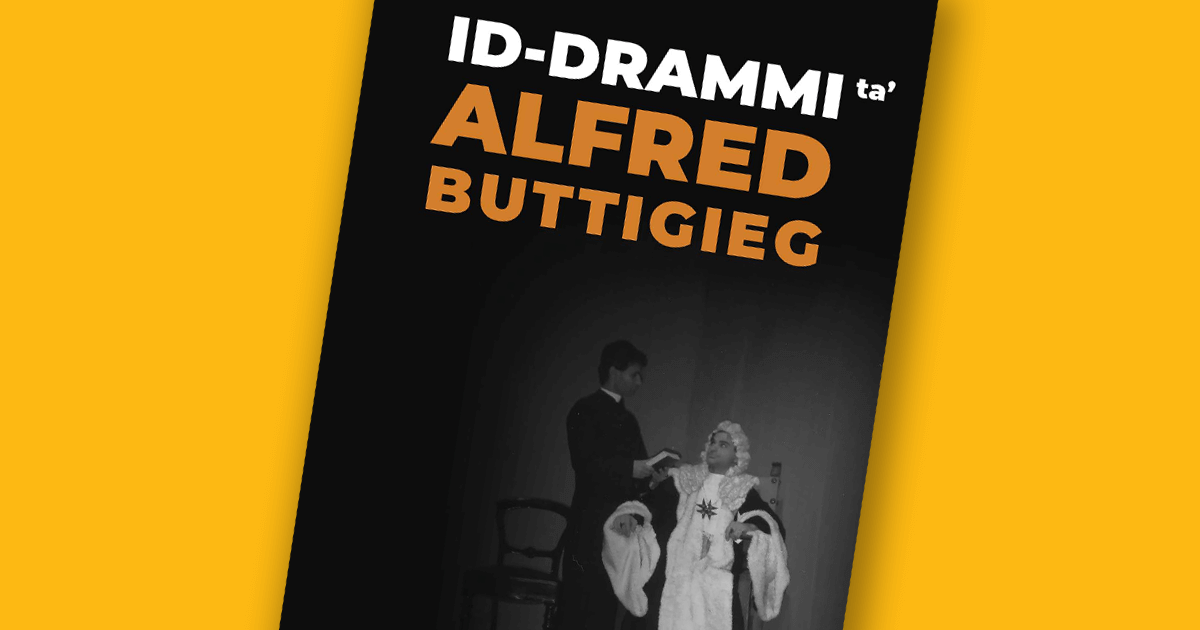
After having published Alfred Buttigieg The Collected Plays, a collection of the his four full length plays in English, Alfred Buttigieg returns seven years later with Id-Drammi ta’ Alfred Buttigieg, which include all the plays which were staged between 1981 and 2023.
This collection contains 10 plays, plays which, for one reason or another, did not seem to have a particularly formidable influence on the viewing and reading public, which is peculiar, given that Buttigieg makes it a point to attempt to be topical with his subject matter.
Consider L-Arrest ta’ Danny Weed, a play loosely based on the arrest of Daniel Holmes, an arrest which was highly publicised and notorious in its controversy in 2011, involving a Welshman in Gozo who was growing cannabis plants. He was eventually sentenced to 10 years in prison.
The play proclaims itself a farce — two minutes into the opening act, this facetious tone comes through quite clearly. Unfortunately, the rather long one-scene play offers very little dramatic tension and the jokes rarely land, making L-Arrest a particularly boring work. The farcical aspect fails in both the subject matter and the structure of the play. The premise’s potential for drama, emotion, and even the expected comedy is not exploited well at all.
Buttigieg stuffs the play with far too many tropes: the wet-behind-the-ears PC who’s clearly an idiot with a gun, the exasperated police sergeant, the references to corruption. When the actors enter the stage, their physical presences immediately signal who is who and the play does not ask much in terms of intelligence from the audience.
Bus Stop is the complete opposite of L-Arrest in both tone and length. It’s a short one-scene play featuring a man and a woman who are seemingly waiting for the same bus. They have a history between them and they start recalling their short-lived past at school.
There are elements of convenience in this play that make it hard for the audience to suspend disbelief such as when Daniel pulls out a bag of peanuts from his pocket which Debbie used to love when she was younger. This is one of the convenient tools that Buttigieg employs to heave out the relationship between the characters. Unfortunately, by the end of the play, we don’t get to know them very well. Debbie is an inconsistent character and Daniel never gets beyond surface level.
Buttigieg’s strongest work comes in Dwar Menopawsi, Minorenni u Muturi High Speed. Here it feels as if the playwright is at his most authentic, most honest. There is more to the characters than just foil or physicality but, even here, the play lingers far too long on superficial elements rather than on the deep implications of Maltese family life.
The story is about a married couple, Henry and Kate, who are in their middle age and clearly both coming face to face with a mid-life crisis. Henry has never amounted to much in life, having served at a local bank as a cashier for the past 20 years. He is well aware of this fact and it has coloured the way he deals with the people in his life.
Kate works as a counsellor at a school, quite satisfied in her work, but she is heavily dependent on affection for her sense of self and this affection is not coming from Henry.
The family unravels when Henry, galvanised by his own son’s girlfriend’s attention, starts behaving like he’s 20 years younger, which translates into a dent to the finances Kate brings home. Kate, on the other hand, wins the admiration of a teenage student who eventually consummates his infatuation in the form of a kiss at the family home.
While Dwar Menopawsi is a comedy, there are moments of serious and heightened drama. Again, the issue here is one of tone. Perhaps a more serious take on the subject matter would have elevated the play because the comedy isn’t particularly effective anyway.
There is much to enjoy in Id-Drammi ta’ Alfred Buttigieg. I would venture to say that reading the plays, rather than seeing them performed, does the writing more justice. The archetypal roles of the characters and the tropes aren’t as obvious on paper. There is comedy here which is better appreciated in writing, which suggests that, perhaps, the past performances left much to be desired.
Alfred Buttigieg knows how to tell a story and to spin a yarn out of very little in terms of premise. He rarely pokes deeper than the surface level, though some serious implications are almost always toyed with in his plays.
Id-Drammi is published by Midsea books.

Culture Editor
Author and Literary Critic

Leave a Reply