



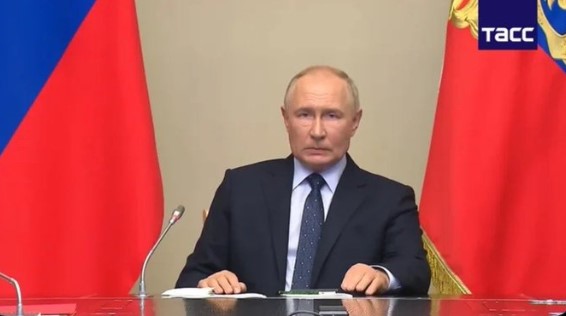
Russia will never be the same again after its brutal and genocidal invasion of Ukraine. Russia’s invasion of Ukraine has galvanised the peoples of its previous Soviet colonies into becoming even more nationalist and protective of their independence. The trust that was built along the years in Western and Russian relations has collapsed and won’t come back again quickly. Russia has made an enemy out of Europe and Ukrainian capitulation to Russia won’t restore relationships with Europe as some pro-Russian propogandists expect.
As students of history, our views on Russia and its history have also become much clearer. With his actions, Vladimir Putin easily discarded all of the historiographic work that rationalised the crimes of Russia and the Soviet Union as political and historical convenience. The works of British historians who sought to rationalise the Soviet Union’s massive crimes, such as Edward Carr and Alan John Percivale Taylor, have largely lost their academic credibility today.
The crimes of the Soviet Union and its most brutal dictator Joseph Stalin, have across the years been rationalised as complex historical incidents that were caused by various material factors. Although social and material causes can not be discarded, Russia has been enjoying the privilege of an excessive and “historicised” focus on its history that denies Russian leaders agency and responsibility. This is why Vladimir Putin feels entitled to justify the war in Ukraine with a Western pro-Russian propogandists like Tucker Carlson with a very long history lesson: we, in the West, enabled this bullshit for many years partly because we have “orientalised” Russian studies as some sort of mythical and unique subject with its own distinct properties and laws.
The problem is blatantly evident in basic education and academia. Russia is not part of the curriculum about the history of imperialism, and instead Russia sits on its own as a privileged entity with its own study subject: Russian studies. This is is the incorrect approach. Russia has to be considered as an imperial power that exists until this very day, and with an imperial history that should be classified as part of the history of empires: including the history of the Soviet Union. The history of the Soviet Union should be studied as part of the same imperialism curriculum that includes the history of French and British imperialism. Extracting the Soviet Union into a separate and unique entity from the history of imperialism is deceptive and historically incorrect.
There is really no contradiction in the fact that the Western world began to decolonise when the Russian empire was at its peak with the Soviet Union, and both these phenomena are related and can be thought in one single academic subject.
Even the crimes of Joseph Stalin have been woven into enough historical rationalisation that, even today, the Soviet Union is often absolved of responsibility for the causes of the Second World War. Yet Stalin bore as much responsibility as Neville Chamberlain for appeasing Adolf Hitler and enabling his war, not only against Europe, but ultimately against Stalin’s own country and empire, the Soviet Union
Putin changed all of this, because he made us witness in real-time the sheer power the leader of Russia can wield with his own arbitrary will: a phenomenon that we as foreigners, could never have witnessed during the Cold War. Suddenly, Russian history didn’t seem to be so complex any longer. And Russians, willfully agreeing to Putin’s war, have made our perspectives even clearer. Russia’s complexity, famously encapsulated by Vissarion Belinsky in the term “Russia’s soul,” reflects an orientalist illusion of a totalitarian empire presenting itself as a rational entity.
The development of the deceptive concept of the Russian soul is rooted in Russian literature, with probably Leo Tolstoy being its most effective advocate with War and Peace: a novel that outlines his philosophy of history. In the novel, Tolstoy breaks down history as an arbitrary and chaotic movement of masses of peoples where the agency of one individual is irrelevant. Somehow, with this warped theory of dehumanising history, God’s will or the fate of history is still pushed by tyrants who have no value for human life as if humanity has and should by default, consume itself. Like Tolstoy, Fyodor Dostoevsky also places the same conclusion in his novels: the individual eventually submits to a higher order or God.
It seems then that after all, the Russian soul is actually no soul at all. The exigencies of the Russian empire and those who run it from Moscow and Saint Petersburg have historically exceeded the priorities of the oppressed peoples of the Russian empire to such an extent, that even its intellectual and literal elite surrendered to its totalitarianism in total submission. There is no room for soul in Russia: there’s only empire which can take your life at any time and moment.
Today, Russia is the world’s champion for disinformation and propaganda. Its global efforts at disinformation warfare are its top foreign policy priority after the war in Ukraine. Disinformation is the only way that Russia can keep deceiving foreigners about the true nature of the Kremlin regime and the Russian empire. Exposing Russia, its crimes and what it actually is weakens the Kremlin regime and exposes its weakness. When Vladimir Putin ranted for an hour about Russia’s history to Tucker Carlson, that wasn’t just a bout of dictatorial madness: it is the dressing that Putin uses to ascribe legitimacy to his criminal regime. A dressing that Russia and the Soviet Union have used consistently but that is now falling apart as fast as Russian troops are dying at the Ukrainian front.

Website Editor
Historian and Publisher

Leave a Reply