



Russia has been increasing its hybrid attacks against Lithuania. On October 23rd, a Russian jet and a refueling aircraft violated the Lithuanian air space near the town of Kybartai after they entered from Kaliningrad. Spanish NATO fighter jets were scrambled in response.
These repeated acts of violations went unaddressed and have now escalated into more creative, yet disruptive methods. In recent days, large helium balloons have repeatedly crossed the Belarusian border into Lithuania disrupting airports as a result. Initial reports stated that the balloons have been used to smuggle cigarettes, however this smuggling method is very unusual in Lithuania and others have described the act as a deliberate security threat. There have been multiple incidents of helium balloons entering Lithuanian space with Vilnius Airport being disrupted in two consecutive nights at least.
The Lithuanian government has vowed to shoot down the balloons, but it is not equally confident about shooting down Russian jets, yet. Lithuania has passed a law last month which enables its armed forces to shoot down drones that violate its airspace. On Russian jets, Lithuania has taken a hard stance during NATO meetings but, NATO Secretary-General Mark Rutte argued to treat violations on a case-by-case and avoid escalation.
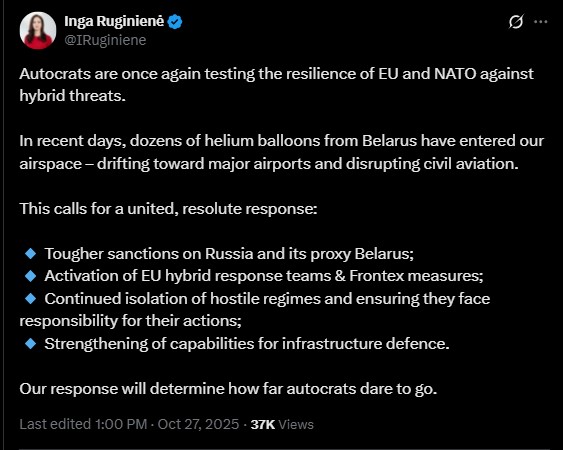
Lithuania Prime Minister Inga Ruginienė is calling for tougher sanctions on Russian and Belarus in response and the activation of the EU hybrid response teams to further strengthen the border. The EU’s Hybrid Rapid Response Teams are short-term, multi-disciplinary expert teams from EU and national services that help counter hybrid campaigns and have been introduced for the first time in 2024.

Website Editor
Historian and Publisher

Leave a Reply