



According to the latest EU’s climate bulleting, the latest climate data for March confirms what has become an increasingly difficult trend to ignore: temperatures continue to rise, both globally and across Europe, with no sign of slowdown.
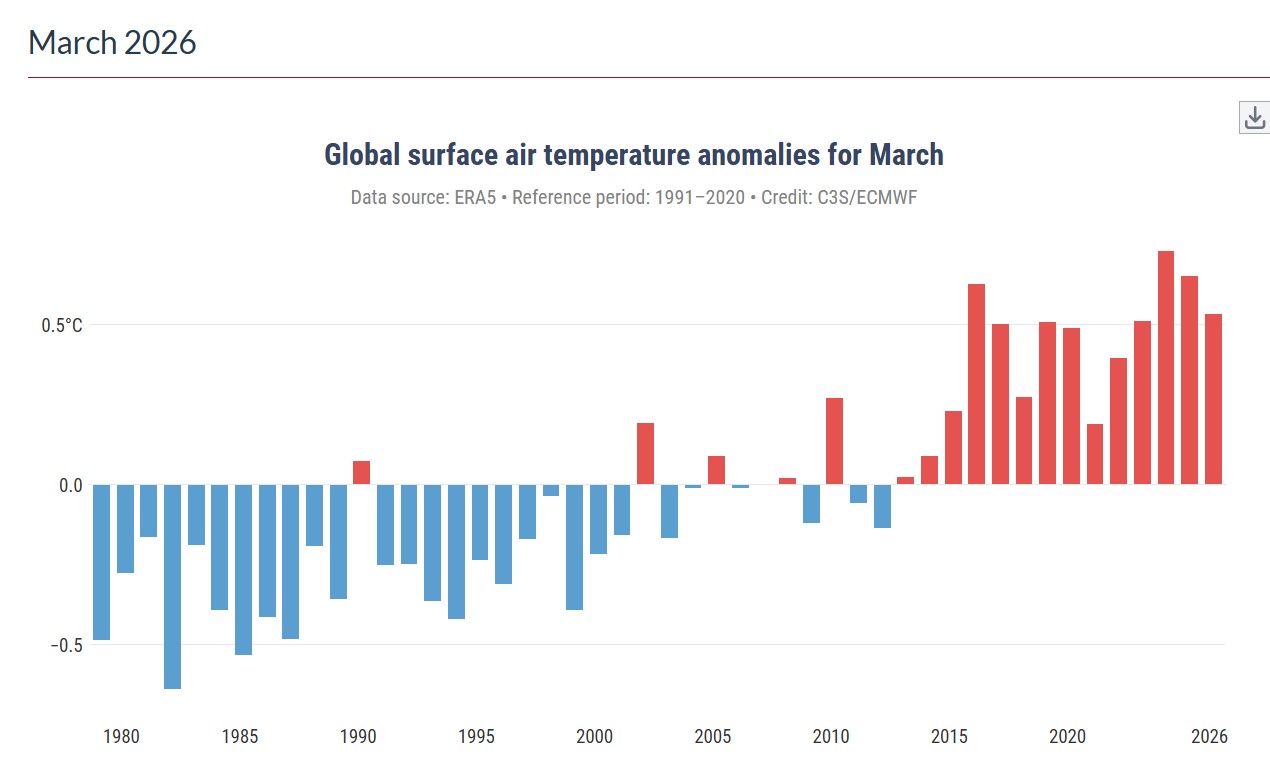
According to the Copernicus Climate Change Service, March 2026 was the fourth warmest March ever recorded globally, with temperatures reaching 1.48°C above pre-industrial levels. In Europe, the figures are even more striking. The continent experienced its second warmest March on record, with temperatures 2.27°C above the long-term average.
Nearly the entire European continent recorded above-average temperatures, with the most severe anomalies concentrated in northern Fennoscandia, the Baltic States, and northwest Russia. This broad and consistent warming pattern mirrors trends that have been repeatedly highlighted in previous reporting.
Europe has been experiencing increasingly frequent and intense heat anomalies, with prolonged periods of above-average temperatures and shifting seasonal patterns. Month after month, the figures continue to point in the same direction: warming is not slowing down.
The trend is not confined to Europe. Outside the continent, a prolonged heatwave struck the western United States during March, breaking temperature records with conditions more typical of midsummer.
What is particularly concerning is not just the occurrence of these events, but their consistency. The repeated appearance of near-record or record-breaking temperatures suggests that what was once considered exceptional is quickly becoming typical.
The numbers are no longer isolated warnings. They are part of a consistent and growing body of evidence pointing in one direction.



Newsroom

Leave a Reply