



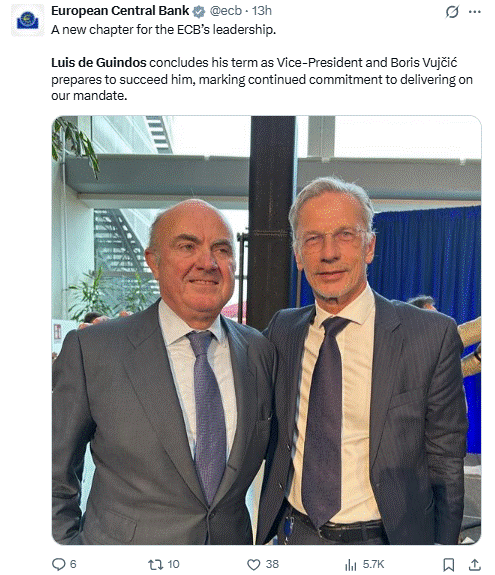
Deputy-President of the European Central Bank, Luis de Guindos has ended his term and has made way for his successor, Boris Vujčić, the previous Chairman of the Croatian National Bank.
Luis de Guindos brought a pragmatic, experience-driven perspective to the ECB, shaped by his traditional finance roots and the volatile post-2018 environment. He consistently highlighted financial stability risks, repeatedly warning about stretched asset valuations, high concentrations in equity and credit markets, and the dangers of a sharp correction — especially in his final weeks when he flagged an “elevated” risk of a market pullback amid record-high European stocks, loose fiscal policies in some countries, and “geopolitical” tensions.
He views geopolitics as the primary threat to financial stability, capable of triggering asset repricings, stress in non-banks, and sovereign fiscal vulnerabilities. On monetary policy, de Guindos evolved from a relatively hawkish stance in 2022 — pushing early rate hikes when inflation proved persistent — to a more cautious “prudence-first” approach in 2025–2026, repeatedly urging colleagues to weigh weaker growth signals, energy supply shocks, and data-dependent decisions carefully before further tightening, while remaining firmly committed to the ECB’s 2% inflation target.
A Madrid-born economist (January 16, 1960), took office as Spain’s Minister of Economy and Competitiveness in December 2011 under Prime Minister Mariano Rajoy at the height of the eurozone debt crisis. From his base in Madrid, he led Spain’s response to the severe banking crisis, negotiating a €100 billion EU bailout specifically for the country’s troubled savings banks (cajas) while overseeing a comprehensive overhaul of the financial sector, labour market reforms, and fiscal consolidation measures that helped pull Spain out of recession and restore market confidence.
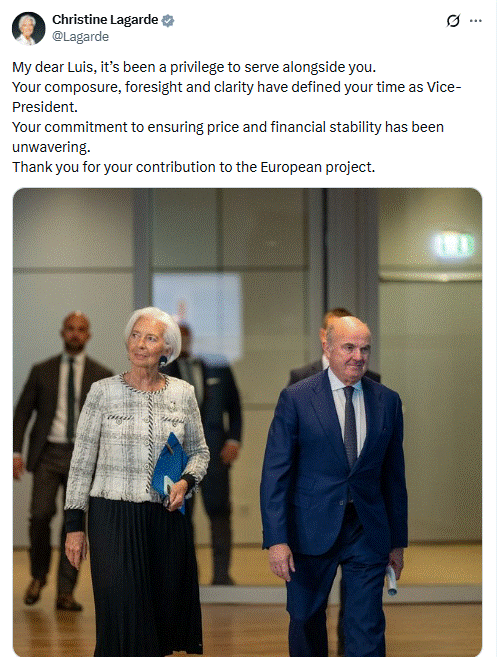
The President of the ECB, Christine Lagarde said that it has been a privilege working alongside her deputy and praised hi for his unwavering commitment to ensure financial and price stability.

Newsroom
Leave a Reply