



A cross-party group of MEPs, German MPs and former Afghan parliamentarians has urged the European Union not to grant political legitimacy to the Taliban, as a Taliban delegation arrived in Brussels for migration talks with EU officials.
Belgium issued five one-day visas to Taliban representatives for Tuesday, 23 June, allowing them to attend a closed-door EU meeting in Brussels. The talks are expected to focus on the return and readmission of Afghan nationals who do not have the legal right to remain in the European Union, particularly those considered by member states to pose security risks.
The meeting is the first known occasion since the Taliban returned to power in Afghanistan in August 2021 that the EU has hosted Taliban representatives in Brussels. No EU member state recognises the Taliban as the legitimate government of Afghanistan.
The delegation includes Abdul Qahar Balkhi, spokesperson for the Taliban’s foreign ministry. The European Commission and Sweden’s Ministry of Justice invited Balkhi and members of his team for talks scheduled for 22 and 23 June. Sweden is involved in the process on behalf of EU and Schengen countries interested in pursuing returns to Afghanistan.
European Commission officials have described the meeting as technical and have insisted that it does not amount to recognition of Taliban rule. Belgium has also said that granting visas under its obligations as host country for EU institutions does not confer legitimacy on the Taliban.
The lawmakers disagree. In an open letter, they warned that every visa, invitation and official meeting carries political significance and risks being used by the Taliban as evidence of international acceptance.
The letter was signed by German Green MEP Hannah Neumann, Renew Europe MEP Raquel García Hermida-van der Walle, who chairs the European Parliament’s delegation for relations with Afghanistan, S&D MEP Alessandra Moretti, German Bundestag member Filiz Polat, former Afghan MP and women’s rights advocate Fawzia Koofi, and members of the Afghan Parliamentary Network.
The signatories urged the European Commission, the European External Action Service and EU member states not to host Taliban representatives in Brussels or other European capitals, and to reject any arrangements that link deportation cooperation to political engagement.
They argued that the Taliban have failed to meet the EU’s own conditions for engagement, including respect for human rights, humanitarian access, counterterrorism commitments and progress towards inclusive governance. Instead, they said, the human rights situation in Afghanistan has deteriorated dramatically, particularly for women and girls.
A separate letter sent earlier this month by 47 MEPs from five political groups — Greens/EFA, The Left, S&D, Renew and the EPP — urged Belgian Foreign Minister Maxime Prévot to refuse visas to Taliban representatives. The first signatory was Belgian Greens/EFA MEP Saskia Bricmont. That letter warned that allowing Taliban officials to travel to Belgium could be perceived as a form of political recognition incompatible with the European Parliament’s own position on non-recognition and non-normalisation.
The European Parliament adopted a resolution on 21 May condemning the Taliban’s latest restrictions on women and girls and regretting the EU’s decision to invite Taliban representatives to Brussels. MEPs called for the continuation of a policy of non-recognition and non-normalisation, stronger sanctions against Taliban leaders responsible for gender persecution, and increased support for Afghan women human rights defenders.
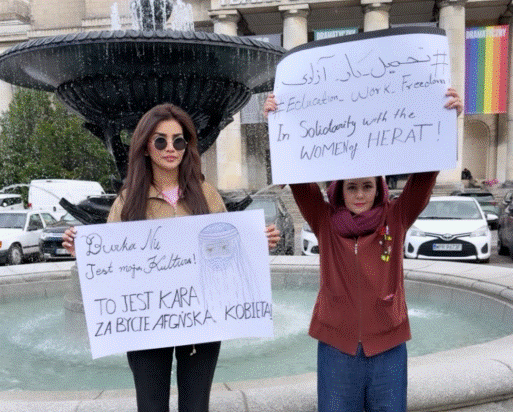
Afghan women’s groups in Europe have also protested against the meeting. In Madrid, Afghan women demonstrated outside the European Parliament’s liaison office, chanting slogans such as “Taliban is not a partner for peace” and calling on the EU to stand with Afghan women rather than normalise relations with the regime.
In a joint statement, the protesters urged the European Parliament to halt any engagement that could contribute to the normalisation or legitimisation of the Taliban. They called on the international community to hold the Taliban accountable for human rights violations and to focus on ending women’s slavery and gender apartheid in Afghanistan.
Human rights organisations have warned that deporting Afghans to Taliban-controlled Afghanistan could expose returnees to persecution, arbitrary detention, torture and other abuses. They also argue that the meeting undermines the EU’s credibility by combining public condemnation of Taliban abuses with behind-the-scenes cooperation on deportations.
Feature photo taken in Poland, Warsaw.


Newsroom



Leave a Reply