




On Monday, 13 July 2026, US Secretary of State Marco Rubio announced a sweeping campaign to isolate and weaken the International Criminal Court, accusing it of legal overreach and of threatening US sovereignty by asserting potential jurisdiction over US officials and military personnel. The US government said it was considering further sanctions, visa and travel restrictions, measures against organisations cooperating with the Court, and diplomatic pressure on states to reject ICC jurisdiction over US citizens or withdraw from the Rome Statute.
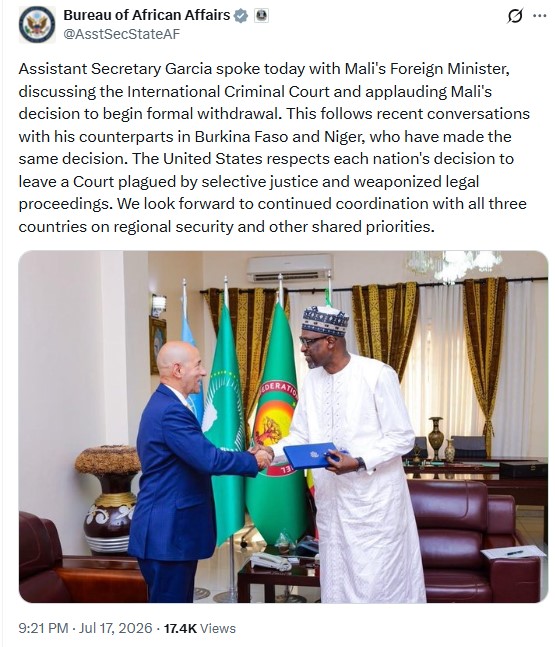
The announcement followed the formal withdrawal notices submitted by Niger, Burkina Faso and Mali.
The US had already sanctioned multiple ICC officials when in June 2025, it sanctioned four ICC judges: two over decisions connected to the investigation of alleged crimes by US personnel in Afghanistan and two over the arrest warrants issued for Israeli Prime Minister Benjamin Netanyahu and former defence minister Yoav Gallant. Further sanctions were subsequently imposed on other judges, prosecutors and Court personnel.
European parliamentarians want the swift introduction of the digital Euro to strengthen Europe’s sovereignty and reduce the effects of US sanctions on European citizens.
The ICC has no pending arrest warrant, summons or named criminal case against a US citizen. However, the broader Afghanistan situation remains within the Court’s authorised investigative framework. Since 2021, the Prosecutor has deprioritised—rather than formally closed—the aspects involving alleged US conduct, concentrating resources principally on alleged crimes by the Taliban and Islamic State.
The Court is governed by the Rome Statute, which the United States has not ratified. Non-membership means that the US has no ordinary treaty obligation to cooperate with the Court, but it does not categorically place every US national beyond the ICC’s jurisdiction. Under the Rome Statute, the Court may exercise jurisdiction over crimes allegedly committed on the territory of a State Party, even when the accused is a national of a non-member state. Jurisdiction may also arise through a referral by the United Nations Security Council or a state’s specific acceptance of the Court’s authority. Conversely, the ICC would generally lack territorial jurisdiction over conduct occurring solely within the United States without US acceptance or a Security Council referral.
The ICC currently has 125 States Parties. Each State Party has one vote in the Assembly of States Parties, the Court’s legislative and management-oversight body. The Assembly approves the budget, elects judges and prosecutors and considers amendments to the Rome Statute. The Court itself has 18 independent judges, elected for nine-year, non-renewable terms.
The US campaign cannot by itself abolish the ICC or invalidate the authority granted to it by the Rome Statute. It may, however, significantly obstruct the Court’s work by restricting officials’ access to banking and travel, discouraging organisations from cooperating with investigations and pressuring member states to withhold assistance. State withdrawals can also reduce the Court’s future territorial reach, but they do not erase jurisdiction or obligations relating to conduct that occurred while a country remained a State Party.
Washington’s position also places it in a tactical alignment with the military-led governments of Burkina Faso, Mali and Niger. The three states announced their intention to withdraw in September 2025 and deposited their formal notices in June 2026, but they remain members until their withdrawals take effect one year after notification. Their governments have increasingly distanced themselves from Western political and military partners and developed closer relations principally with Russia.

Newsroom

Leave a Reply