



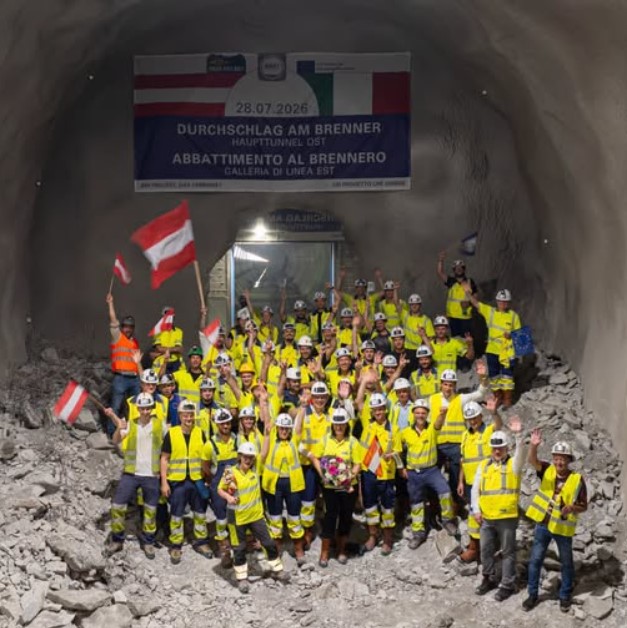
The two main railway tubes of the Brenner Base Tunnel have been connected beneath the Alpine border between Austria and Italy, marking one of the most important milestones in the construction of the major European railway project.
Workers broke through the final rock barriers in the eastern and western tunnel tubes almost simultaneously on 28 July, approximately 1,400 metres beneath the Brenner Pass. The breakthrough connected the Austrian H53 Pfons–Brenner construction section with the H61 Mules 2–3 section, which had already been excavated from the Italian side.
The two sides used different excavation methods. On the Italian side, the tunnel-boring machines Virginia and Flavia excavated the main tubes as far as the national border. Austrian workers approached the same point using conventional drilling and controlled blasting. Following the breakthrough, workers from both countries were able to meet and shake hands beneath the border.
The connection follows the completion of the project’s exploratory tunnel in September 2025, when Austria and Italy were linked underground through the Brenner Base Tunnel system for the first time. That smaller tunnel runs beneath and between the two main railway tubes and will eventually be used for drainage, maintenance and technical infrastructure.
According to the South Tyrolean authorities, the latest breakthrough completes the excavation of the approximately 230-kilometre tunnel system. This figure does not refer to one continuous 230-kilometre tunnel but includes the two main railway tubes, the exploratory tunnel, access tunnels, safety passages, logistical tunnels and other connecting structures.
The principal base-tunnel route will connect Innsbruck in Austria with Fortezza in northern Italy. Together with the existing Innsbruck railway bypass, it will create a continuous underground railway connection of approximately 64 kilometres, which is expected to become the longest of its kind in the world when it enters service.
The project is expected to begin operating in 2032. Its two single-track railway tubes are approximately 8.1 metres wide, positioned between 40 and 70 metres apart and connected by safety passages at intervals of roughly 333 metres.
Passenger trains will be able to travel at speeds of up to 250 kilometres per hour, while freight trains are expected to reach speeds of up to 160 kilometres per hour. The journey between Innsbruck and Fortezza is expected to fall from approximately 80 minutes to 25 minutes for passenger trains and from one hour and 45 minutes to around 35 minutes for freight services.
The flatter underground route will also allow longer and heavier freight trains to cross the Alps using a single locomotive. Trains of up to 740 metres will be able to use the tunnel, compared with the 450-metre limit on the existing mountain railway, where two or three locomotives may be needed to negotiate the steep gradients.
The Brenner Base Tunnel is not the first railway connection between Austria and Italy. The existing railway across the Brenner Pass has operated for more than a century. The new tunnel is, however, one of Europe’s largest cross-border railway projects and is intended to remove one of the main bottlenecks on the route between Munich and Verona.
It forms a central part of the European Union’s Scandinavian–Mediterranean transport corridor, which extends from northern Europe to the Mediterranean and ultimately to Malta. More than 2.5 million trucks and approximately 50 million tonnes of goods currently cross the Brenner Pass every year, making it one of Europe’s busiest Alpine transport routes.
The project is co-financed by the European Union. The EU had allocated approximately €2.3 billion in support through the Connecting Europe Facility by the end of 2025, with Austria and Italy financing the remaining costs.
Feature below by EuroNews released on May 5th.

Newsroom

Leave a Reply