



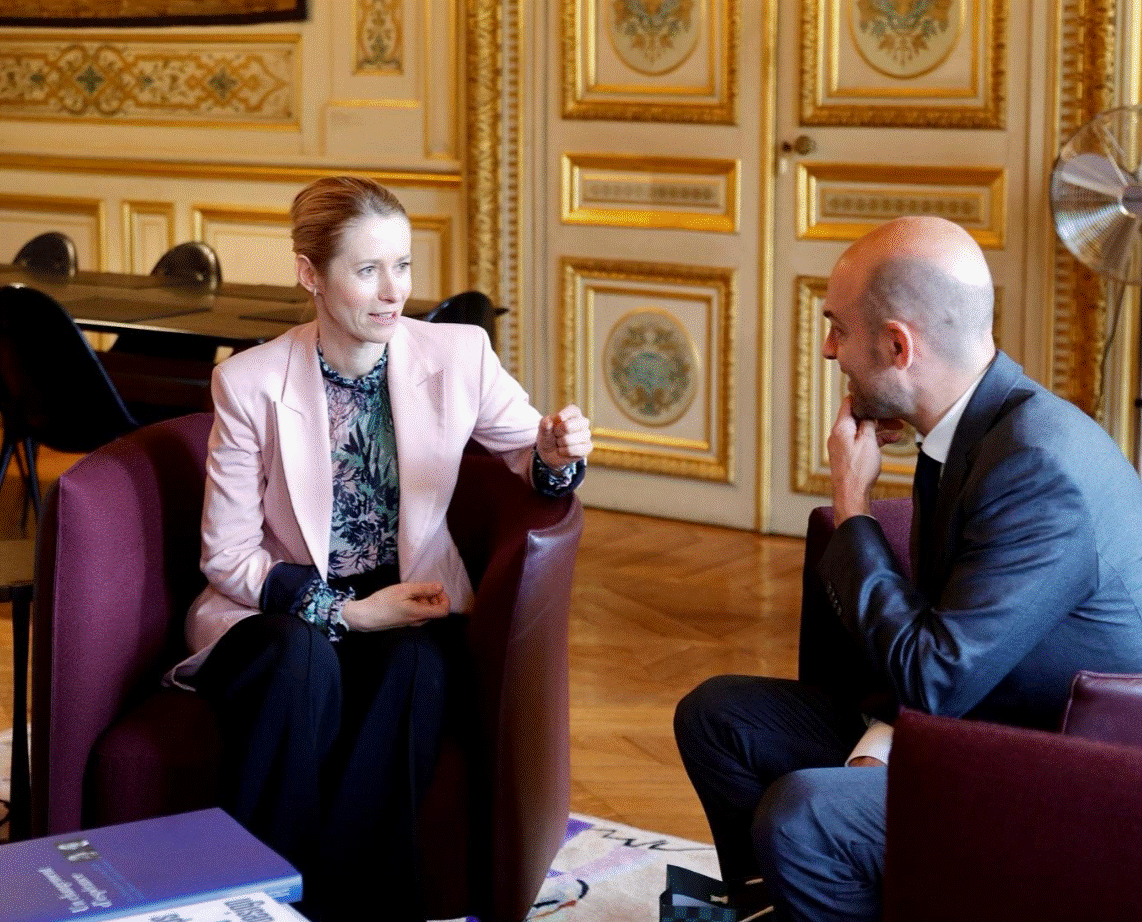
Latest press reports on the European External Action Service and High Representative Kaja Kallas cite the cancellation of a meeting of a new European defence group organised by the High Representative. France and Germany are cited as the countries that blocked the initiative. The meeting was meant to plan to discuss the implementation of Mario Draghi‘s proposals on defence in his report and seek further united and coordinated action by EU member-states.
France has emerged as the latest major opponent of Kaja Kallas in EU politics – but not for mainly ideological reasons. France is wary of the EU’s growing foreign clout which has over-shadowed France’s massive foreign presence. This is making France uncomfortable because Brussels is replacing Paris as Europe’s biggest and loudest voice. Berlin is tagging along Paris not because it has a large foreign presence. It’s diplomatic service is just a miniscule of the French foreign gargantuan. Berlin is seeking to retain its control and influence over the EU and its foreign policy because having a massive EU diplomatic service with a powerful High Representative may insulate Germany’s influence in the Commission. Both Paris and Berlin want the EEAS to be brought under further control of the Commission President.
This does not augur well for further EU integration, especially on defence matters. Currently, France has the lead in Europe over defence matters and its foreign service is one of the biggest in the world enabling it to have a leading voice in international affairs. Paris wants to remain centre-stage and it does not want Brussels to overcome it.
There is nothing surprising in the opposition by France considering its recent European history in which it tried to carve out a distinctive posture on defence, at one point even leaving NATO briefly, but France has always came back to the European fold.
France doesn’t need to give up its diplomatic service but it should and has to be convinced that it is in its own interest to further increase European integration in defence and foreign affairs. The Draghi report should remain as a staple for any future EU policy and development and derailing its implementation would only prologue Europe’s current international weakness.
Germany, being traditionally more conservative in vision and method, would probably need tougher convincing. Germany’s main objections to further European integration aren’t foreign affairs, but rather finances and fiscal imbalances between EU member states.
Eventually we need a wide-European deal which has to be straightened out between the major capitals and Brussels. If Paris and Berlin can get to agree, the road ahead would be much easier.
Separately, there is the fight by small countries like Malta against the Council’s qualified majority system: but Paris and Berlin already agree on this. This major stumbling block for further European integration on foreign affairs seems to be slowly being faded.
President Emmanuel Macron has been eerily quiet on the whole issue. It is clear, however, that Mario Draghi’s ideas on further European integration are gaining ground within the Union’s bureaucracy. Paris has so far avoided an open political and ideological clash, but as Draghi’s thinking grows more popular, a reckoning will have to come.

Website Editor
Historian and Publisher


Leave a Reply