



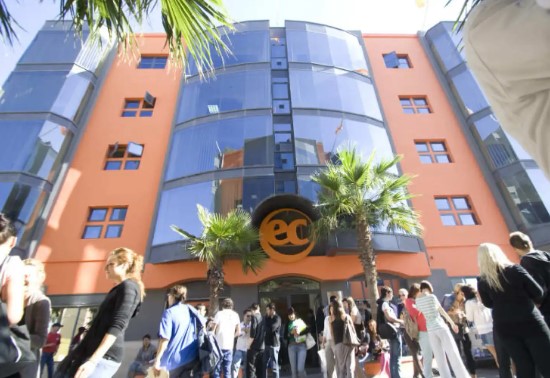
The closure of the EC English language school company in Malta may seem shocking at first glance because EC English was like an institution in Malta’s English-language school industry. It is by far the biggest English-language school company and, for decades, it has been a mainstay of Malta’s tourist-economy infrastructure.
It has now announced that it will be shutting down after giving up on recovering from the serious blow it suffered during the Covid disruption, when its schools had to be closed.
The industry rebounded strongly after Covid, but EC English also had problems of its own, in what appears to be severe financial challenges related to its debt, which amounts to at least €15 million owed to private creditors, apart from ongoing credit obligations and expenses it needs to pay through its companies and subsidiaries, according to the financial statements of EC Holding Company.
The closure extends throughout its international operations. By this year, EC was operating 25 schools across seven countries — Malta, Britain, Ireland, the United States, Canada, South Africa and the United Arab Emirates — serving around 40,000 students annually. Teaching and trading operations ceased worldwide on Monday.
The English-language school industry is still struggling globally after Covid, but in Malta it seems to be doing fairly well, with last year’s figures showing students opting for longer stays despite a reduction in numbers.
The decline in the global industry may also be secular, however, meaning that its impact may lag behind in Malta’s industry. English-language schools are something of the past. Today, you can learn a language directly from the internet. In fact, the English-language school industry in Malta is notorious for having a reputation for bringing over students who are more interested in enjoying their stay in Malta than learning English. Many non-EU third-country nationals have used the system as a way to stay on the island for some time before finding a job. Under current rules, third-country nationals following qualifying courses of more than 90 days may also work for up to 20 hours per week after their first three months, subject to an employment licence.
The prospect of going to a sunny island to learn English may still sell, and the numbers show that. This means that, for now, the closure of EC English in Malta will most likely benefit its smaller competitors rather than critically hit the industry. FELTOM has already coordinated with 13 other Maltese language schools to relocate EC students, providing an immediate indication that competitors have both the capacity and the willingness to absorb at least part of EC’s business.
EC’s collapse therefore appears to be the product of two pressures coming together: a global English-language travel industry that has never fully recovered its old scale, and company-specific financial problems that eventually became unsustainable.


Website Editor
Historian and Publisher


Leave a Reply