



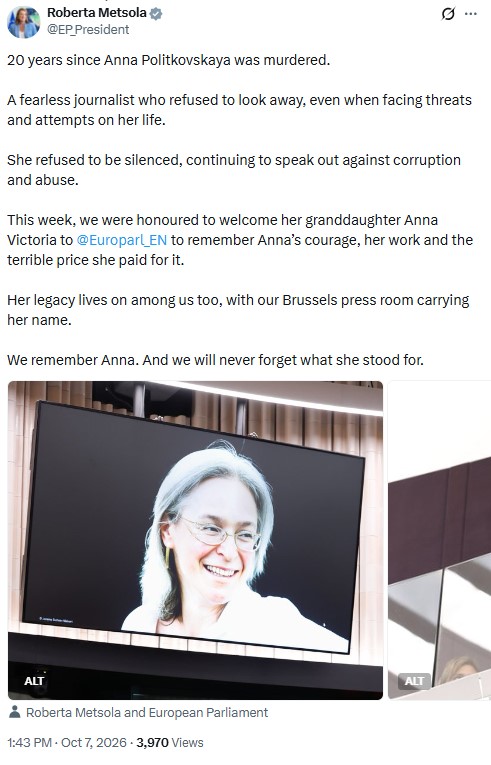
Members of the European Parliament gave a standing ovation following a speech by Anna Victoria Politkovskaya, the granddaughter of Russian investigative journalist Anna Politkovskaya, during a tribute in Strasbourg marking 20 years since the journalist’s assassination.
Some MEPs, however, refused to stand during the ovation, including Harald Vilimsky of Patriots for europe who toe a pro-Russian line.
During the tribute, Anna Victoria Politkovskaya spoke about her grandmother’s legacy and the continuing relevance of her work. She recalled how Anna had warned about the increasing use of violence and repression under Vladimir Putin, arguing that the system had developed into one in which violence and indifference had become increasingly normalised.
European Parliament Vice-President Nicolae Ștefănuță said Anna Politkovskaya’s fearless pursuit of the truth had made her a symbol for those fighting for justice and human dignity in Russia. He also recalled that she had been a finalist for the European Parliament’s Sakharov Prize for Freedom of Thought in 2007 and that the Parliament had named its Brussels press room after her.
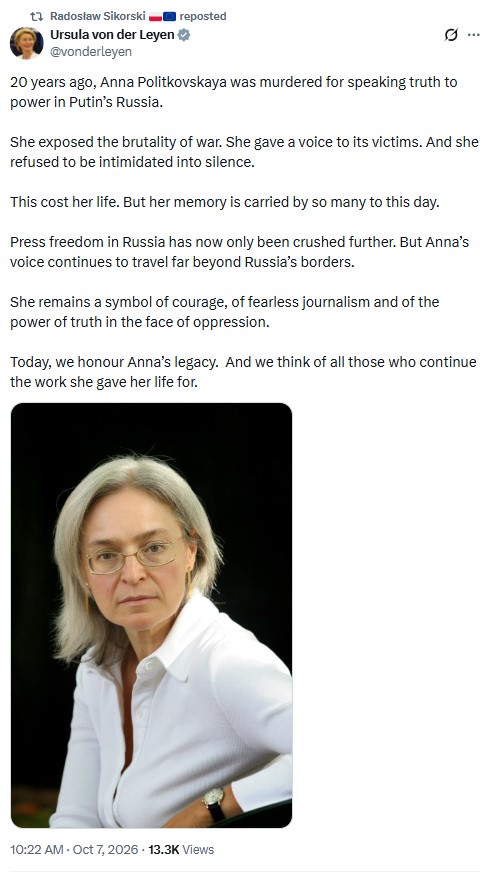
Anna Politkovskaya was murdered on 7 October 2006 in the lift of her apartment building in Moscow. She had spent years reporting on human rights abuses and war crimes in Chechnya by the Russian army and security forces.
She was one of the few Russian journalists of her generation to consistently report from Chechnya and to document allegations of torture, disappearances and other abuses committed by Russian forces and local authorities. Her work also included reporting on the 2002 Dubrovka theatre siege in Moscow and the 2004 Beslan school hostage crisis.
Politkovskaya’s reporting placed her in direct conflict with the Russian authorities and particularly with Vladimir Putin. She received numerous threats during her career but continued reporting on abuses that were increasingly difficult for independent journalists to investigate.
Her murder became one of the most prominent cases involving the killing of a Russian journalist critical of the Kremlin. Several men were eventually convicted for their roles in the assassination, but the person who ordered the killing has never been publicly established through a final conviction. The European Court of Human Rights later found that Russian authorities had failed to take adequate investigative steps to identify those who had commissioned the murder.

Newsroom
Leave a Reply