



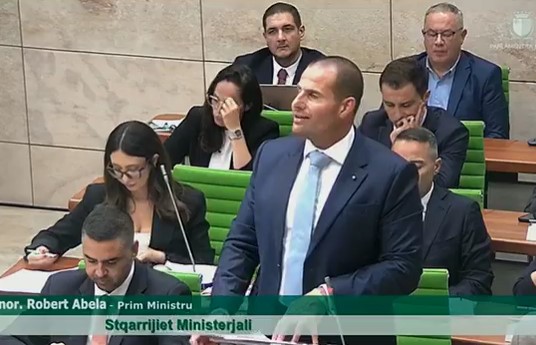
The speech in Parliament by Prime Minister Robert Abela on Monday is very significant historically, but not in a good sense. The Prime Minister repeated the historical fallacy of denying the existence of the Mafia: a denial that is functional and serves the Mafia itself, which wants to pretend and assume that it does not exist as a criminal organisation, but rather as a defamatory myth directed at tradition, culture and the State.
Speaking in Parliament on Monday, Prime Minister Robert Abela imitated a discourse long stated, in very similar terms and words, by the long-time corrupt Mafia politician of Palermo, Salvatore Cuffaro, who in the 1980s waged a political war against the investigating magistrates who investigated the Mafia and worked on the successful Maxi Processo, which indicted up to 346 members of the Mafia. Seperately, Cuffaro was sentenced to seven years in prison for aggravated aiding and abetting Cosa Nostra and served almost five years.
The rhetorical statements made by the Prime Minister are structured exactly the same as those made by politicians who defended the Mafia: they both do not deny the criminal activity; they deny the existence of the Mafia. The fallacy implied here is that the criminal activity is a normative, dysfunctional trait that cannot be permanently erased: it is human nature.
Why are you defaming us? The Maltese government is not a criminal organisation despite having created the conditions of impunity that led to the murder of Daphne Caruana Galizia: it is a normative dysfunction of human nature.
We are thus at the stage where we have to win the battle of the narratives and ensure that the truth is codified into law, and this means that we also need anti-Mafia legislation that acknowledges and defines the existence of a criminal organisation and addresses its financial sources through a law on the provenance of undeclared wealth.
In this way, justice can be more effectively applied because it can identify the structure that sustains this criminal network. The problem is that this criminal network is extended through the Labour Party, and hence why Labour is resisting the fight against organised crime in its full totality.
In Malta’s case, we have Joseph Muscat’s criminal clique, which has asserted and retained control and influence over the Labour Party, enabling its influence in the justice system and compromising the whole system. This has allowed Joseph Muscat’s criminal clique to retain its influence in politics, its impunity and, as a consequence, caused significant dysfunction in the justice system that is leading to consistent failures, including the outcome of the trial of Yorgen Fenech.
Labour wants us to believe that the errors are part of human nature and can be addressed by mild reforms, such as increasing penalties on those who punch journalists.
Back to Sicily, the fight against the Mafia changed fundamentally when the Italian State began to recognise and legally confront the Mafia as an organised criminal structure rather than treating its individual crimes in isolation.
For decades, Cosa Nostra had been able to operate through a combination of violence, intimidation, political influence and omertà, while the existence and nature of the organisation itself was frequently minimised or denied. The decisive legislative breakthrough came through Pio La Torre, a Communist politician and anti-Mafia campaigner who, in 1980, submitted a bill proposing the introduction of a specific criminal offence for Mafia association and measures to confiscate wealth accumulated through criminal activity.
La Torre was assassinated in Palermo on 30 April 1982 by Cosa Nostra. Later that year, the Italian Parliament passed Law 646 of 13 September 1982, known as the Rognoni–La Torre Law, which introduced Article 416-bis into the Italian Penal Code. For the first time, Italian criminal law specifically recognised a “mafia-type association”, defining it through the use of the intimidating power of the organisation, the resulting conditions of subjugation and omertà, and its pursuit of criminal activity or control over economic activities, public contracts and other resources. The law also introduced important measures to confiscate assets linked to such criminal activity.
The importance of La Torre’s intervention was therefore not simply that the Italian State began using the word “Mafia”. It was that the State formally recognised the Mafia as an organised structure with its own methods, economic interests and mechanisms of power, and created legal tools designed to attack both the organisation itself and the wealth that sustained it.
In Malta, we are going through a similar trajectory. A spate of bombings and murders from 2011 to 2017 culminated in the murder of the journalist Daphne Caruana Galizia. It was after her murder that we began to learn how the criminal underworld was linked with the centre of political power and Malta’s businessmen.
The characteristics of the Mafia are intimidating and secretive. So is Joseph Muscat’s criminal clique. After looting the country, Joseph Muscat has used his puppets, such as Neville Gafà, to intimidate his critics, just as he did when he was in government, and holds the Prime Minister hostage with his blackmail. Joseph Muscat and his political associates are given full immunity for their corrupt practices by the Police Commissioner and the Attorney General.
The Prime Minister is right when saying that an anti-Mafia law could be used against State officials, because they have indeed abetted a criminal organisation. Denying that this criminal organisation exists is the first line of defence for Joseph Muscat.

Website Editor
Historian and Publisher
Leave a Reply