



Yesterday, during the Parliamentary Committee for Foreign Affairs, the Labour government and the Nationalist Opposition agreed that the EU Emissions Trading System (ETS) hits Malta’s sea links harder than those of mainland states, and both have asked Brussels for relief.
Foreign Affairs Minister Chris Fearne has stated that this issue is existential for us.
They do not agree on how far that relief should go. The Malta Maritime Forum wants a permanent, automatic derogation for island connections. The parties have so far proposed something narrower.
Since 2024, shipping companies operating large vessels covered by the EU ETS have been required to surrender allowances for their CO₂ emissions. The obligation was phased in at 40% of covered emissions in 2024, 70% in 2025 and reached 100% in 2026. Voyages between EU ports are fully covered, while voyages between an EU port and a non-EU port are covered at 50%. Malta, which has no road or rail connection to mainland Europe, is therefore particularly exposed to the additional cost of maritime transport.
The Forum’s case is that this geographical disadvantage is permanent, so any exemption should be permanent too. In its response to the Commission’s 17 July 2026 proposal, the Forum welcomed the proposed temporary reduction in ETS allowance-surrender obligations for certain transhipment cargo passing through EU ports, but warned that Malta’s ordinary import and export traffic remained largely exposed.
The Forum has repeatedly called for the existing derogation for small islands to be extended to island Member States, for short-sea Ro-Ro and passenger services forming part of intermodal links to be excluded from the ETS, and for EU transhipment ports to be removed from the definition of “port of call” in order to reduce the incentive to divert traffic to competing non-EU hubs. In July, it went further, arguing that all islands, irrespective of size, together with outermost regions and island Member States, should receive a permanent and automatic derogation because their geographical disadvantage is permanent.
Maltese MEPs have previously acted jointly on the issue. In February, Nationalist MEP Peter Agius and Labour MEP Thomas Bajada, together with Italian and Cypriot colleagues, called on the European Commission to introduce an “island clause” to take account of the structural disadvantages faced by island economies. The Malta Maritime Forum publicly welcomed the initiative.
In February, Labour MP Edward Zammit Lewis, chairman of Parliament’s Foreign and European Affairs Standing Committee, wrote to the European Parliament to open a political dialogue on the issue. He argued that the ETS had been designed primarily around continental economies and did not adequately reflect the realities of island states such as Malta and Cyprus. He also described the proposed island clause as necessary.
A meeting hosted by Peter Agius in early March brought Maltese MEPs from both sides together around data presented by the Malta Maritime Forum on the additional cost of ETS rules for shipping through Malta. The Forum has highlighted the competitive disadvantage faced by Malta compared with nearby non-EU ports that are not subject to the same carbon-pricing regime.
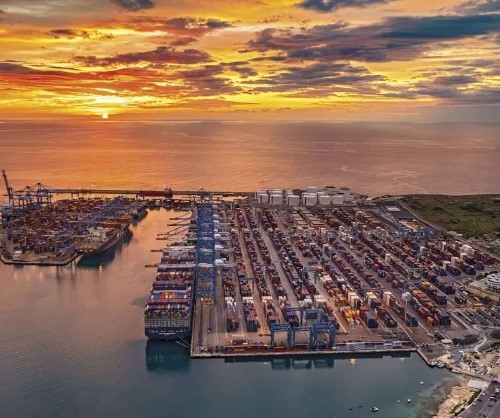
The European Commission’s 17 July proposal addresses part of the problem surrounding Malta Freeport while leaving much of the issue concerning essential supply links unresolved. It proposes reducing ETS allowance-surrender obligations for certain qualifying container transhipment cargo arriving from non-EU ports and not destined for the EU. The measure is targeted at large container vessels and would apply to qualifying voyages of more than 300 nautical miles.
The Commission proposal would also lower the threshold for identifying neighbouring container transhipment ports from 65% to 50% of total container traffic. In addition, ports outside the EU located less than 150 nautical miles from an EU port could be included where they meet specified infrastructure criteria, including minimum draught and berth length and the availability of suitable ship-to-shore cranes.
The proposal would also retain the allocation of a share of ETS auction revenues for Malta, Cyprus and Greece until 2038. In aviation, Malta has secured the continuation of the temporary suspension of full ETS charges on departing flights until 2032.
The government has described these measures as important gains for Malta Freeport and for air connectivity. Transport operators and the Malta Maritime Forum, however, have argued that ordinary trailer and import routes remain exposed to the additional costs.
The Association of Tractor and Trailer Operators (ATTO) has estimated that the ETS and fuel surcharge on a single round-trip trailer operating between Genoa and Malta amounts to €734.40. ATTO has also warned that the 2026 charges will impose a significant additional cost on Maltese consumers and businesses.
In September, Sustainable Mobility Minister Chris Bonett met his Italian, Greek and Cypriot counterparts in Cyprus as part of the four-country maritime cooperation format and agreed to strengthen coordination on the ETS review and related maritime issues.
The government has said that the main objections concerning transhipment are beginning to be addressed, but that the text still requires further amendment, “above all to provide special recognition to states that are, or have, islands whose connectivity and the importation of basic goods… depend primarily on the sea.”
This week, both sides filed amendments in the European Parliament, and the differences between their approaches have become more visible.
On 6 October, Labour MEPs Alex Agius Saliba, Daniel Attard and Thomas Bajada proposed that, on certain direct routes between EU ports and island Member States, ETS obligations should take account of the actual cargo capacity used on each voyage rather than applying the same calculation regardless of how full the vessel is. The proposal seeks to address the imbalance created when ships arrive in Malta carrying substantially more cargo than they take back.
The Labour MEPs also want the existing small-island derogation extended to 2040, together with funding to decarbonise the fleets concerned. They are also calling for at least 20% of maritime support resources to be reserved for SMEs, ferries, short-sea operators and vessels serving islands and peripheral regions. They specifically referred to the Malta–Gozo connection and Malta’s “double insularity”. The Labour delegation has said that a more permanent exemption for the Malta–Gozo link would be preferable, but the amendments it has proposed do not amount to a general permanent exemption.
On the same day, Nationalist MEP Peter Agius tabled 86 amendments seeking an “Islands Derogation”, consisting of a temporary 50% reduction in ETS charges on air and maritime transport to and from islands until 2040. Agius said the measure could save Malta an estimated €60 million a year.
Figures cited by Agius and ATTO put the number of containers transported by sea to and from Malta at around 67,000 annually, with an ETS cost of approximately €530 per trailer or container. A 50% reduction would therefore amount to about €265 per movement.
Agius has also described the Commission’s proposed transhipment measure as a step forward for Malta Freeport, while arguing that it does not adequately address the cost imposed on Malta’s ordinary import and export traffic.
Government, Opposition and the Malta Maritime Forum all maintain that the Commission’s July proposal does not yet sufficiently address the particular needs of island Member States. The Forum is calling for full and permanent relief based on Malta’s permanent geographical disadvantage. Labour MEPs are calling for more targeted measures, including cargo-based calculations and an extension of the small-island derogation, while Peter Agius is proposing a temporary 50% reduction.
The Commission proposal remains under consideration under the EU’s ordinary legislative procedure. It is currently awaiting committee consideration in the European Parliament, with the Environment, Climate and Food Safety Committee acting as the lead committee and the Transport and Tourism Committee providing an opinion. The Parliament’s indicative first-reading plenary date is 14 December 2026, meaning that none of the proposed amendments has yet been adopted.
You can listen to the full session here.

Newsroom
Leave a Reply