



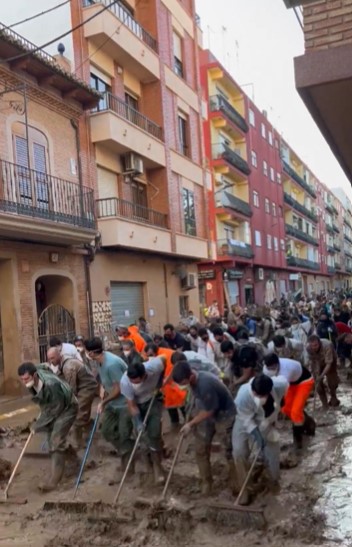
The southern coast of Spain is once again experiencing heavy rain leading to more flooding after massive floods in the Valencia region caused more than 200 people dead and a trail of devastation. Spanish Prime Minister Pedro Sanchez was criticised like never before. In what can be considered his biggest and most scandalous gaffe in his political career, Premier Sanchez told the Spanish public that if the Valencians needed more help, they should ask for it.
Valencians couldn’t afford to spare time begging for help. They were compelled to dig out dead bodies and clean the mess themselves after Premier Sanchez refused to declare a state of emergency. His government officials excused the delays in emergency help due to the “heavy paperwork” that is needed to activate and distribute state resources.
Many Valencians lost everything and the trauma lingers on. Civilians kept digging out dead bodies themselves from the mud and the wreckage of the cars as they joined forces to push back the waters that flooded their homes and destroyed everything they had. The insurance won’t cover the destruction because this is a case of “force majeure”. The government will be handing out €6,000 to every affected resident but the distribution of these funds will be hampered by bureaucracy and “heavy paperwork”. Citizens will have to fight for this money through bureaucracy and a state system that is clearly in total collapse.
One can only be left flabbergasted by the absurd and incredible failure of the Spanish government to react appropriately. However, when one digs down in the Spanish state’s rabbit hole, it is much easier to understand how this failure has come about. This is the result of the accumulation of many years of Spanish state communism and neo-feudalism that has turned the Spanish state into a joke and the Spanish government into a club of incompetent and corrupt opportunists who have become useless and ineffective. Now, as a foreigner observing Spain, the explanations as to why Vox is growing can be more clear.
For those unfamiliar with Spanish history, they may be surprised to know that democracy in Spain is a relatively very new thing. Spain was ruled by a fascist dictator called Francisco Franco Bahamonde until 1975 and experienced the first democratic elections in 1977. So, it may come as a surprise to many to know that the older generations in Spain actually remember fascism and have lived through it, with many men even having served in the national service during the fascist period. These older generations have been accustomed to live under a strict regime where law is sacred and the State is the absolute entity above everything and everyone.
So, even though fascism was over in Spain by 1977 with the onset of the first democratic elections, the excess authoritarianism and power of the state was not dismantled altogether. On the contrary. Spanish politicians found in the the state an incredible tool of power by which they could use to control and manipulate their people. The reality is that despite the fact that Spain was no longer fascist, the bulk and majority of the legal code didn’t change: on the contrary most of it was made even more autocratic.
The Spanish state today, wields incredible and exceptional power over its citizens in many different aspects. The Spanish government has the power to distribute and expropriate private agriculture and urban land as it deems fit. It has the power to redistribute land among private land-owners and even expropriate it at will. Businesses are regulated in a similar way where the state can expropriate their resources at will for a myriad of reasons and taxes can be drawn up at will by regional officials at random and without prior approval from Madrid. Workers, especially self-employed workers are regulated to the letter and are not allowed to do any activity which is not registered with the authorities. Workers who are not registered as self-employed, are barred from doing any freelance work. Self-employed workers are in turn heavily taxed with the first seven months of the year of their earnings going fully and exclusively to the state.
The biggest risk for Spanish businesses is not the financial or economic situation: it’s actually the Spanish state whose federal and regional officials operate with a communist mentality by which they hunt down business in order to expropriate their resources. For example. As of lately, several regional governments have decided to collect new property taxes from property buyers. Spanish tax officials are going through past deeds of property sales and contesting the tax paid upon the purchase of the property. They are contesting these payments by claiming that the price and value of the property purchased does not reflect the market reality. Sounds absurd right? If a market determined the price how can the state claim that the price was incorrect? In order to make this happen, state tax officials are hiring “technical experts” who draw up fictitious values of the sale of property in order to produce new and higher tax bills for the buyer. Added with this state-sanctioned fraud, state officials are targeting Spanish businessmen who have dissident political views with some Spanish businessmen receiving a tax bill that will literally see their property expropriated by the state.
It may sound crazy that this stuff is happening in a European liberal-democracy in 2024, but this is Spain which still has a legal code riddled with 19th century laws and a state and a government run by literal communists with no respect or regard to human rights and personal freedom.
In turn, Spanish politicians use the funds they collect from the state to run a patronising and self-serving propaganda show for themselves. €100 million to support the employment of women, €100 million to support farmers to buy equipment, €100 million to help drug-addicts re-integrate within society and so on and so forth. All of this sounds nice and benevolent in the glossy newspapers printed in Madrid but the reality is that is mostly capital that has been extracted from hard-working Spanish people and used indiscriminately for political purposes. The lives and soul of many Spanish workers and businesses have been destroyed so that a socialist politician can climb a podium and announce a public grant.
There are various and ongoing political reactions to this political mess. Many Catalonians are fed up with this political theatre and want to disengage completely from Madrid. Over the years, the moderate right-wing made many promises to improve the system and change these inefficiencies and injustices, but whenever they have been in power, the politicians of the Partido Popular got too comfortable to have any will to effect any radical change. The socialists and the communists who are now in power, of course, believe that all of this is an acceptable state of affairs and that the Spanish people should keep working for the state so that they may have the daily photo opportunity to announce their benevolence by distributing public funds. In these conditions, the reaction of the Valencians lynching Premier Sanchez is perfectly understandable: the Valencians feel they are being ripped off by what they consider a corrupt political class.
And then, came Vox. No one knows what exactly will they do if they take power and they have changed their position on a myriad of issues multiple times and over and over again. They started out as far-right, Russian-loving fascists, but have gradually moderated and changed many of their positions. One thing is clear though: Vox is distinguishing itself from all other parties by promising radical change and breaking the deadlock of the Spanish state. There already is a blueprint for this political wave of change and it called Javier Milei. His success in the Argentinian elections may be a sign of things that are yet to come in Spain.
Argentina has a very different situation from Spain but some similarities are incredibly striking. Both nations have a recent history of fascism. Both states have a very large welfare state and a byzantine tax system that kills small businesses and bars social mobility. Both states have a class of traditional politicians who benefited greatly from the state without leaving a positive impact in the lives of their constituents. Both states have an ever growing class of people who are fed up with the politicians of the status quo and yearn for something new.
Javier Milei is not an ideological phenomenon but more of a reaction to the failure of the Argentinian state. Today, the Spanish are increasingly harbouring similar feelings to the Argentinians. They are not looking for ideological-political solutions by socialists and communists with beautiful theories and promises of benevolence. They are also getting tired of the promises by the Partido Popular that it will eventually fix all the problems that they already had the chance to fix many times over when they were in power. The Spanish are increasingly demanding something different altogether that will usher them out of this state-sanctioned nightmare and it doesn’t matter for them if it is communist, socialist or neoliberal as long as it improves their living situation.
Spain is a very rich country with a large cohort of the population being very hard-working and entrepreneurial. Apart from having natural resources, Spain is also home to some very large multinational companies in various sectors including banking, energy and manufacturing. Wit the right political reforms, Spain can not only improve the lives of its people, it can also emerge as a new European power-house. It’s not going to happen under the current political regime, and only time will tell if the Spanish will take the risk of voting for something altogether new, but all the signs seem to show that that’s where the Spanish people are heading to.

Website Editor
Historian and Publisher

Leave a Reply