Advertisement

Is this really acceptable? Losing an election in these conditions?

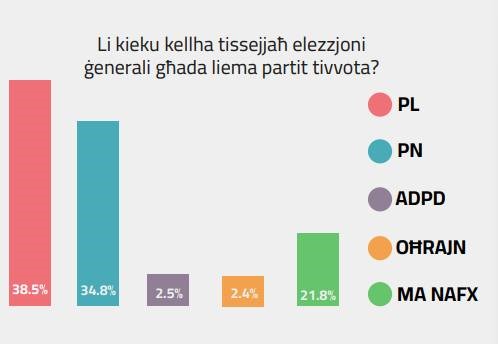
Yesterday, Vincent Marmara released his latest political survey, and it showed the Labour Party with an advantage of up to 16,000 votes and 6% difference over the Opposition and the Nationalist Party.

Nationalists Party politicians should be asking themselves whether they would like to risk losing the next election. They should also consider whether risking defeat in the next election is a responsible gamble or if they are recklessly endangering the lives and future of our country. This is also why I stand by opinion that Opposition Leader Bernard Grech is unfit for purpose.

Considering the gravity of the situation, with Labour Party supporters cheering the freedom of the alleged murderer of a journalist, Labour winning another general election will be a nightmare scenario for the rule-of-law. The repercussions of another Labour victory are already very clear. The Labour Party would consolidate its illiberal regime as by increasing its control over state institutions and continue its clampdown on the rule-of-law. Gradually, Labour is turning our country into a smaller version of Sicily.

The Nationalist Party would receive a massive boost in support if its leader were replaced by a younger, more liberal-minded figure. Such a leadership change within the PN would likely result in an immediate surge in support. Historically, before 2013, changes in the opposition leader often led to a swift and significant boost for the Opposition party.

Politics is all about winning, but apparently, our political parties prefer to adopt a new and innovative political strategy of winning by losing.


Comments

8 responses to “Is this really acceptable? Losing an election in these conditions?”

  1. John Borg avatar

    It is NOT a question of having a leader ” who is younger, more liberal-minded figure”

    Malta needs a leader who possesses a unique blend of moral integrity, strategic insight, and leadership skills. These would include:

    Inspirational Leadership โ€“ having the ability to motivate and unite people around a common vision. Through compelling speeches, personal example, and decisive actions, they instil confidence and a sense of purpose in the nation.

    Great Leadership Skills โ€“ i.e. possess strong decision-making abilities, crisis management skills, and the ability to delegate effectively. One who leads by example, ensuring efficient governance while empowering others to contribute to national progress.

    Zero Tolerance for Corruption โ€“ by implementing strict policies against corruption, ensuring accountability and transparency in government. Establish robust anti-corruption institutions and take decisive action against any wrongdoing, regardless of political affiliations.

    Proven Honesty and Integrity โ€“ a track record demonstrates unwavering ethical standards. Consistently acting in the publicโ€™s best interest, avoiding conflicts of interest and upholding the rule of law.

    Respected by Society โ€“ His or her character, policies, and leadership earn them widespread respect from citizens and institutions and his/her reputation is built on fairness, empathy, and consistent service to the people.

    Deep Understanding of Geopolitics โ€“ by being well-versed in international relations, global economic trends, and diplomatic strategies. Anticipating global shifts and position our country effectively on the world stage.

    Excellent Negotiation Skills with Honesty โ€“ Someone who can engage in diplomatic negotiations with fairness, transparency, and respect for all parties. Securing beneficial agreements without resorting to deceit or manipulation, earning trust from international leaders.

    A leader with these qualities would not only be effective domestically but also command international respect, ensuring our country thrives both politically and economically.

    Anybody fitting these criteria at present – NO.
    Hard to find? – YES
    Possible to find? – maybe, sincerely hope so and I am convinced that I am not the only one yearning for a leader with these characteristics irrespective of any political party.

    1. Simon Busuttil

      1. That ship has sailed. A missed opportunity for Malta but it’s useless hoping that time can be reversed.

  2. Focus inevitably falls on leaders because of the power they hold; however, Malta does not have a presidential system, so looking at prime ministerial candidates alone is not enough.

    Prime Minister Robert Abela does well because he has an able Finance Minister in Clyde Caruana. Opposition Leader Bernard Grech is doing poorly because he has a seemingly hapless shadow finance minister in Graham Bencini. Rather than a change at the top, maybe what is needed is a change in the shadow cabinet to one with more vigour and fresher ideas.

    Repubblika, Jason Azzopardi, OccupyJustice, your good self and fellow travellers may scream about rule of law (for good measure) till blue in the face, but politics very often depends on prosperity more than on other issues. As a new Labour government in the United Kingdom struggles to get growth going, the government in Germany falls apart because of flagging GDP and France tries to pass austere budgets, Malta boasts of a truly impressive 4.9% growth in GDP in the 3rd quarter of 2024: https://themalteseherald.com/2024/11/28/maltas-gdp-in-q3-up-by-7-9-compared-to-last-year/ .

    Finance ministers in the rich world would kill for such numbers, which have become so regular in Malta that they have made austerity or raising taxes taboo, and have made government largesse like electricity subsidies and regular government cheques in the post possible. Yes, people may complain about overbuilding, overcrowding and too much traffic but, deep down, they also understand that this is the price of prosperity. People are stuck in traffic because every household has multiple cars, and although they may complain about someone building in their backyard, people who acquire a property want to exploit it to its full extent and do not want neighbours or the planning authority holding them back.

    The Opposition overplays its hand banging on about too many foreign workers (which sounds lowkey racist), too many tourists, too many buildings, too many tables and chairs in public spaces and so on. Sure, these are not the elements of a high-end economy but they do generate growth and they are sectors the Maltese love investing in. The Opposition seems to want to want to rein back perceived problematic economic sectors but has no coherent plan about what to replace them with. Ultimately, it seems they just want to slow the economy down, so why would people vote for that when they are doing reasonably well in the current economic circumstances?

    NGOs and commentators in the media also like to peddle the line that “growth is not everything and we need to focus more on wellbeing” but this way of thinking is only possible precisely because growth is happening and taken for granted. Only the privileged can think that they are rich enough and can now focus on other things instead of making money. A shadow minister of finance should be speaking for those who are less privileged, not for the comfortably middle class. The solution to lifting more people into the middle and higher class is even faster economic growth, not a slowdown.

    So Clyde Caruana keeps beating the Opposition because he never loses sight of growth, even as the government tinkers with rules governing largely inconsequential sectors like cab drivers and food couriers to allay fears about overpopulation.

    Do the Maltese people care about the rule of law? They probably do, but the vast majority won’t ever come close to a magisterial inquiry, and scandals like Vitals are very arcane for people to understand and stay focused on long term (years-long legal processes also diffuse any political advantages that such scandals in theory have the potential to create).

    People instead vote on prosperity, economic prospects and whether life in general feels good. For many people, life does feel good, so why would they change their government?

    Although some commentators like to hyperventilate about Malta’s supposed extreme partisanship and internal struggles within parties, the country in fact has a very mild political culture nowadays. People are perfectly happy to have the same government run by the same people for around twenty years. They leave rule-of-law issues (wisely or not) in the hands of the police and the judiciary rather than coming out onto the streets en masse. They accepted gay marriage without fuss and have now learnt to live alongside Nepalis and Filipinos too (occasional grumblings aside).

    Malta is mild because its economy is doing well, and the Opposition’s problem is creating a sense of urgency for change. A real coup for Bernard Grech would be persuading Clyde Caruana to cross the aisle. Failing that, Grech needs to find his own growth-focused finance guru, and I do not think Graham Bencini is that. Only with a hyperactive potential finance minister can the Opposition possibly get enough voters to pay attention, regardless of whether their main goal in government would be restoring rule of law.

    1. Honey Bubu avatar

      Fine. Only the growth is based on debt. And electoral success is based on using that debt to keep enough people happy to vote Labour and enough people too disillusioned to vote. Meanwhile the change in the magisterial inquiry law gives them a licence to pillage what’s left (along with the borrowed money itself). And all people do is moan on Facebook while buying cars and properties from the people with whom the thieves are doing the pillaging, or even go into business with them while doing the moaning. Focussing on the opposition rather than the criminal government is partly wrong as an approach, but if one has to have that conversation at all then it is pertinent to point out that the weak apathetic opposition is a reflection of a weak apathetic population. That is Labour’s true success, not debt driven growth.

  3. The Nationalist Party has long ceased to function as a political entity. There are MPs who happen to share the same moniker but work totally independently from one another with no strategy, leadership or vision. The economy is doing well, but wealth inequality, poverty and disillusionment are on the rise as well. As supposed Christian Democrats, the Nationalists should be having a field day but instead they waste time carping on sports, or as you wrote Mark, chasing some army officer posted abroad. It beggars belief.

    The problem is not only Bernard Grech, but all party activists and apparatchiks. Everyone knows Piccinino doesn’t know whether he’s coming or going, but there’s no-one to replace him. With the exception of Carabott and Sammut, the parliamentary group is a motley crew of chest-beating nincompoops. As for the policy advisors they sometimes manage to recruit, they go in, understand how deep the rot runs, and turn away.

    It’s honestly a hopeless case.

  4. […] the Nationalist Party’s efforts to further prove me right about how out of touch it is with the current political trends, yesterday, the Nationalist Party held a political meeting exclusively about […]

  5. […] the Nationalist Party at the polls. Once again, his speech yesterday had very little to do with the ongoing political discourse, and the PN seems to be completely out of touch following a major national protest held yesterday […]

Leave a Reply

Your email address will not be published. Required fields are marked *