



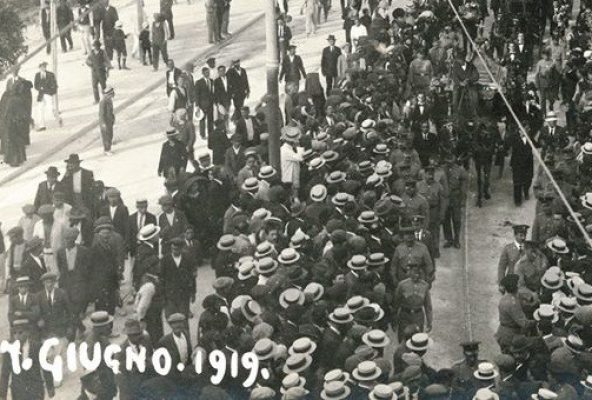
Malta is today celebrating the 106 anniversary of the Seventh June Riots (1919), the event in which the Maltese people rioted and protested on a national scale against the British Colonial Government and the Maltese wheat merchants during its one of its biggest food crisis in history.
The First World War had elevated the cost of living of the Maltese to significantly much higher levels, however the rising cost of living was also offset with a boom of jobs in Malta especially at the Dockyard. The importation of many British workers in the Dockyard led to the formation of the first trade unions and also a wave of socialist and militant influence that inspired the Maltese workers.
Following the First World War, Malta suffered a severe cost of living crisis with the reduction of jobs, but the situation deteriorated to extreme levels with the rising price of wheat in Europe and additionally, when cheap imports of Ukrainian wheat were halted due to Russia’s civil war.
One of largest sources of revenue for the British Colonial Government at that time was the bread tax which made Maltese bread even more expensive. Foreign wheat and flour was tariffed so as to aid Maltese producers and the Maltese milling industry which was run by a monopoly of up to 4 families that owned most of the milling sites.
On the seventh June 1919 the National Assembly, then led by various Maltese clerics and politicians including the Nerik Mizzi met in Valletta to discuss the prospects of a new constitution and called for the Maltese to gather in Valletta in its support. A day prior, the Police Force went on strikes over a salary dispute. The air in the country was overall indignant and dissatisfied with the Colonial Government and the local merchant elite that had contributed to the cost of living crisis with their milling monopoly.
While the local political elite discussed constitutional politics, the Maltese in Valletta vented their frustration and anger at those held responsible for the cost of living crisis. Shops and public places hoisting the British flag were ransacked. Other places that were ransacked were the printing press of The Daily Malta Chronicle, the house of the pro-British politician Francesco Azzopardi and the residential house of the milling monopolist Antonio Cassar Torregiani.
Lacking a strong police presence to control the crowds, the British Colonial Government ordered British troops stationed in Valletta to control the crowds and soldiers fired indiscriminately killing people who were not even part of the protests. The British units used at that time, the Composite Battalion, was often used for difficult and engaging fighting missions and was made up of remnants of different units and also previous convicts. At least four Maltese and 1 British soldier were killed during the riots. The riots continued in the following day in various locations including the residences of milling owners and milling sites.
During the meeting of the National Assembly Monsignor Ignazio Panevecchia declared that Maltese social conditions could improve if Malta was granted a constitutional government that would eventually address the social and economic issues of the Maltese. It was a turning point in Maltese politics as Maltese clerics and the Nationalists adopted social issues as part of their politics for the first time.
Malta was to be granted a self-government constitution in 1921 with elections held for a parliament and a senate. A very restricted number of people were allowed to vote, but the criteria for voting were progressively reduced along the years. A series of social legislation and social projects were introduced in Malta during the 1920s especially from 1927 when the government was composed via a coalition between Lord Strickland’s Constitutional Party and Paul Boffa’s Labour Party.
Malta’s grain taxes were finally abolished by the Labour Party in 1947 as the government switched from a tariff regime to an income tax regime.

Website Editor
Historian and Publisher



Leave a Reply