



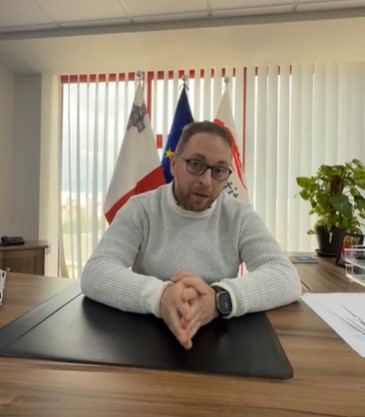
Alex Agius Saliba’s statement that he does not want to apologise for the past violence of the Labour Party is aligned with Labour’s ever growing shift to authoritarianism and illiberalism. Alex Agius Saliba is a genuine authoritarian apart from having far-left views that converge with the far-right. He also has an aversion to journalists and free speech.
I’ve known Alex closely for 22 years and I still follow him regularly today: I know very well who he is and how he thinks and perceives the world. He is much more radical and authoritarian in private than in public and Alex would genuinely won’t mind turning Malta into a Labour Party socialist dictatorship. In leadership meetings he always calls for a hardline stance against the Opposition (usually by banging at the table while shouting unbridled inflammatory invectives such as “NIFQUGĦHOM”).
The Labour Party would establish a dictatorship if it could and the fact that the Deputy-Labour Party Leader does not want to apologise for the violent history of the Labour Party is further affirmation of this. The Labour Party is going to have a very difficult time at revising the history of the 1970s and the 1980s because the Labour Party already acknowledged its violent history. The Labour Party’s own publisher did not have any problem to publish my “Materialist History” some dozen years ago despite clearly stating in a conclusory note that pro-Labour Party working-class was no longer a victim in the late 1970s and 1980s because Labour was in power and its ransacking of Times of Malta has no comparison to the ransacking of the Progress Press in 1919 in the Seventh June Riots. You can read my text here.
The Labour Party can not revise history by holding both political sides equally responsible: this is intellectual dishonesty and empirically incorrect. Even a history undergraduate can easily understand that the violence in the 1970s and the 1980s was systematically conducted by the government. The government exerted tight controls on the press and protestors were routinely beaten and arrested – people who experienced police brutality during those years are still alive.
Government Ministers like Wistin Abela and Lorry Sant had an entourage of violent people who routinely involve themselves in acts of violence against the Opposition. Members of the entourage of Wistin Abela are the suspected murders of Raymond Caruana (1986) – a Nationalist Party member shot and killed at the Nationalist Party’s club in Gudja. The accountant Lino Cauchi is suspected to have been killed in 1982 over a corrupt land deal concocted by Lorry Sant and his associates. Peter Paul Busuttil was framed by the Police and taken to Court over trumped-up charges to cover up the real identity of the murderers of Raymond Caruana.
The Labour Party secret discussed the violence perpetuated by its members in the secretive Party Bureau and the official conclusive implication of these meetings was that the Labour Party did not have control over Lorry Sant, Wistin Abela and other rogue ministers. Dom Mintoff did have control but choose not to exert it. He is ultimately responsible for the violence of the 1970s and the 1980s.
The Labour Party will mention Karin Grech as one of their victims: this is true. However this does not equalise the power dynamics.
Karin Grech was a teenage-daughter of Edwin Grech – a doctor and strike-breaker who refused to join the doctors’ strike against the government during that time. Karen Grech was killed by a parcel bomb addressed to het father. Another parcel bomb addressed to Paul Chectcuti Caruana – a Labour Party MP and also a doctor strike-breaker. The parcel bomb addressed to Chectucti Caruana did not take off.
The murder of Karin Grech preceded the murderous acts of violence of the Labour Party in the 1980s – but this is no historic justification for the violence that exerted the Labour Party later and by no measure can it even be considered as a provocation that would have authentically led to violent upheaval.
Even if the Labour Party would try to build an intellectual argument with dialectics explaining that fomentation of armed political violence in Malta started by the right-wing – even this is not true. The first politically-armed units in Malta were composed of left-wing groups in the 1960s with many of them connected with the Labour Party – especially among the British Service employees. These individuals tried to sabotage British warships and British jets, and carried weapons such as pistols and grenades to the Labour Party protests against the Independence agreement of 1964.
There is no evidence of a concerted and systematic right-wing political violence by a right-wing group that provoked the Labour Party and its government into murderous violence. What we have instead, is a Labour Party that gradually tightened its grip in power, increased its corruption and escalated its violence systematically. During the 1980s, a series of bombings targeting police stations and Labour Party officials. These bombings were amateurish and unsuccessful.
There was thug violence on both sides but the Labour Party had the upper hand. The clashes of Tal-Barrani in 1986 are evidence of Labour’s thugs in actions. There is also archived footage of this event that the public broadcaster which the government is ashamed to show. The Nationalist Party also had its thug-militia called the “Tal-Ġakketta Blu” (Blue Jackets) and these were known to have arms. Back then it easier to procure weapons especially thanks to military surpluses dating back to the Second World War. It is very likely that these Opposition thugs were involved in armed violent actions. However it is also empirically true that the violence in the 1980s was mostly conducted by the Labour government which applied repression and had nearly absolute control over the state.
Dom Mintoff could have stopped the violent climate and repression anytime he wanted: he chose not to. In fact, the violence stopped and repression stopped overnight with a change of government.
That the Labour Party does not want to apologise for its violent history is very chilling: it ultimately means that they would do all over again.

Website Editor
Historian and Publisher


Leave a Reply