



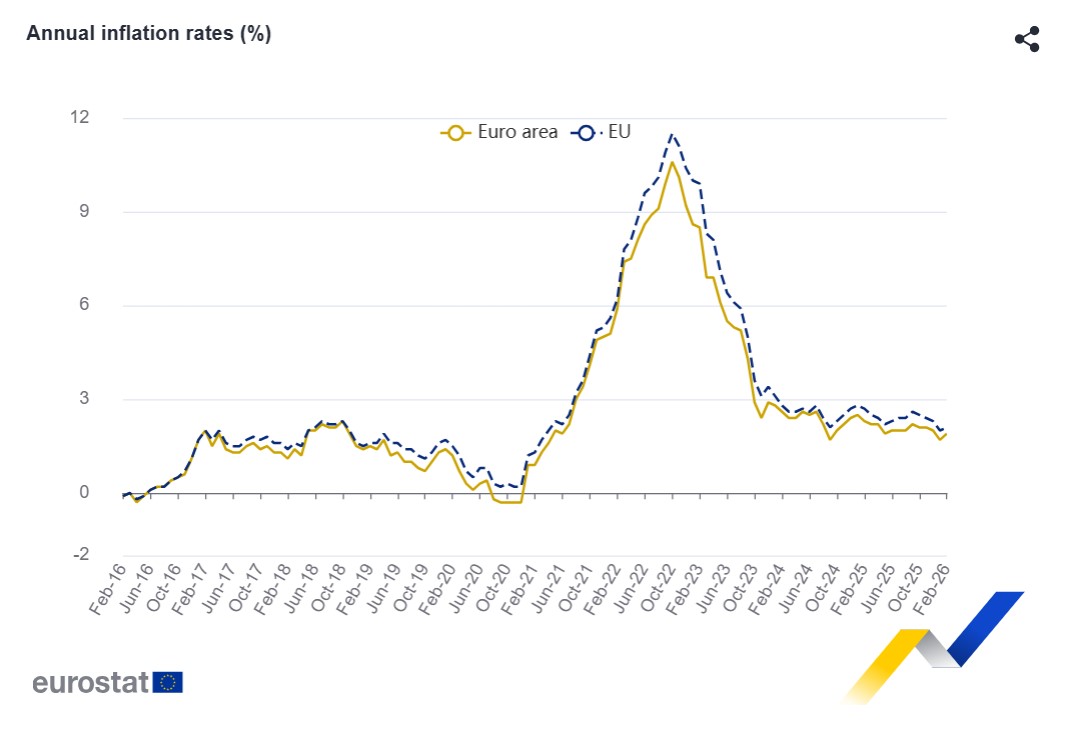
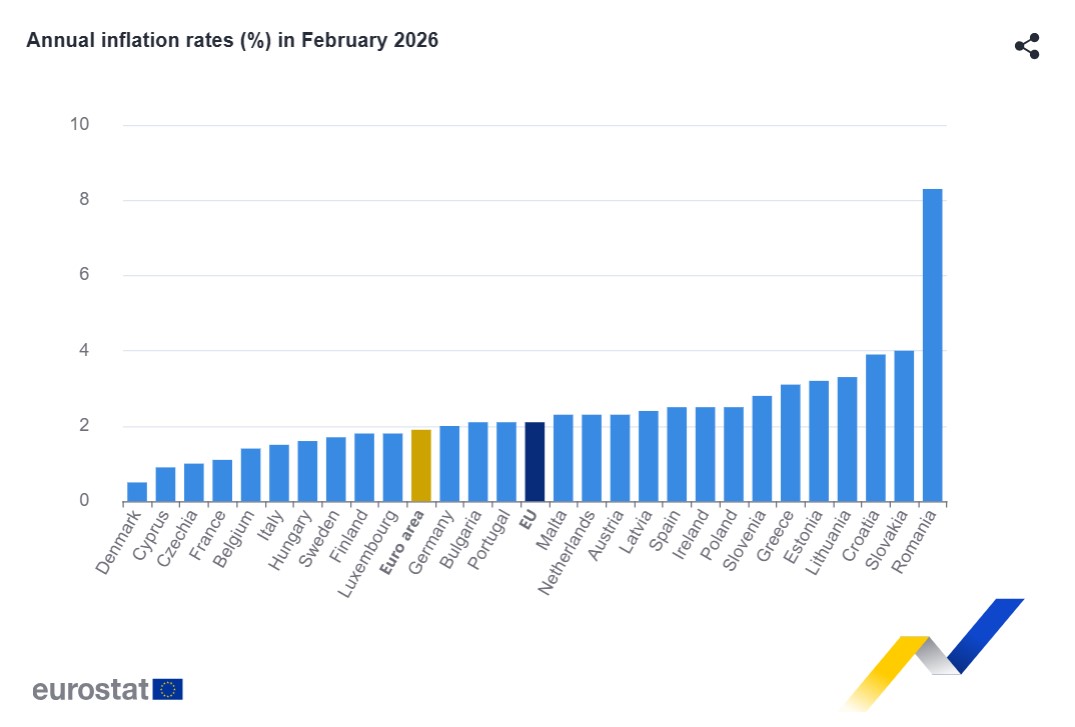
According to Eurostat’s statistics, Malta’s inflation rate remained above the European average throughout 2025, with food and beverages particularly pushing inflation higher in Malta. Housing prices continued to climb and electricity and fuel prices were tamped down with subsidies.
Malta’s yearly inflation fopr 2025 was in the 2.3%-2.4% range while the EU average inflation was at 2.3% and the Euro inflation rate at 2.1%. Latest Euro inflation rate came at 1.9% but this is expected to go higher for March. Inflation has made a comeback in Europe due to the war in Iran but the European Union is seeking measures to address electricity prices. The European Central Bank is warning that risks are tilted to the downside due to the war in Iran which is pushing up inflation.
The highest inflation rates in 2025 were recorded in Romania (around 8.4%), Estonia (4.5%) and Latvia (4.3%), while the lowest rates were seen in Cyprus (0.2%), France (0.8%) and Italy (1.3%).
The Maltese government has vowed to retain its subsides on electricity and fuel prices to keep prices for businesses and households down. This is good news for those who are not wealthy and feel the pinch of higher electricity bills, but the government has no mitigating plans to address these current shocks other than to increase the amount of subsidies. Finance Minister Clyde Caruana said that he estimates that he spend up to €250 million more before exceeding the 3% deficit target. This is not necessarily goods news – it means that the government would be borrowing more just to pay the cost of subsidies instead of investing the capital to mitigate the energy crisis on a long-term basis.
With the latest European Council meeting, the European Union has now prioritised the issue of electricity bills and the energy crisis and will issue measures to mitigate it. The EU will allow extensive subsidisation of prices to mitigate effects and Malta is well positioned for this new policy. The EU will also be taking long-term measures such as working on the grid and interconnectivity. It is yet to be seen whether the EU will heed Antonio Costa’s call to increase the local productivity of energy production.
Malta relies by as much as a third of its electricity from the EU’s interconnector but the local production of energy is also being subsidised by a great cost to the Maltese taxpayer. Malta does not yet have a discussion about how to address this issue. The Labour government plans to build a wind-turbine to increase the sources of renewable energy but there is no plan to address the ongoing subsidisation of local energy production. On the other hand, the Opposition has not offered any serious alternative or plan about these issues.
If Malta does not create a very rigorous and well-detailed plan for its local energy production, Malta has to contend with the fact that it has to retain its electricity and fuel subsidies on a long-term basis accumulating a massive sunk cost capital on a long-term basis.
On the other hand, Malta has few options to address its food inflationary crisis but a strategy on this issue is also lacking. The government may issue more subsidies once again and try to control the prices but the government has no current strategy to reduce dependency and external risks with regard to food and food supply. Even if the war in Iran abates, Malta is still faced with the very high risk of compounding food inflation.

Website Editor
Historian and Publisher



Leave a Reply