



Germany has agreed to participate for the first time in a French nuclear-deterrence exercise as part of President Emmanuel Macron’s “forward deterrence” initiative, which seeks to involve European partners more closely in consultations, training and conventional support surrounding France’s independent nuclear forces. German personnel will participate only with conventional capabilities, while France will retain exclusive control over its nuclear weapons, doctrine and financing. The initiative is intended to complement—not replace—NATO’s nuclear deterrence and the US nuclear umbrella.
Germany is among several European countries that have entered discussions with France over closer deterrence cooperation. These include Poland, Sweden, Denmark, Belgium, Greece, the Netherlands, the United Kingdom and Norway. Lithuania, is separately debating whether to remove its constitutional prohibition on nuclear weapons and foreign military bases, which would provide greater flexibility for future NATO planning.
At a joint press conference with Macron on Friday, 17 July 2026, German Chancellor Friedrich Merz said Franco-German cooperation had become indispensable at a time when Russia was threatening European security, China was challenging Europe’s economy and US security is no longer guaranteed. Chancellor Merz said the two countries were pursuing a new common approach to deterrence while maintaining Germany’s participation in NATO’s existing nuclear-sharing arrangements.
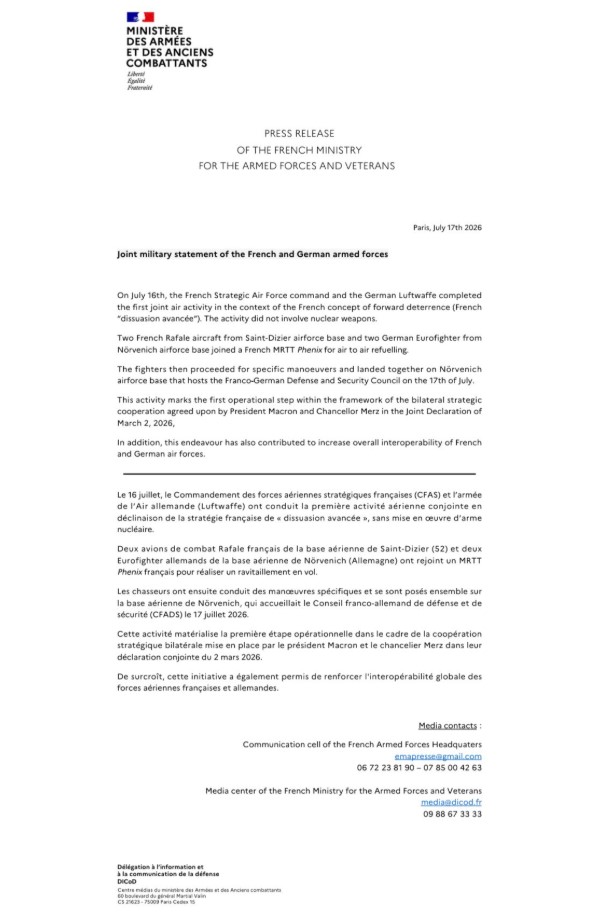
The announcement followed a joint-exercise involving French Rafale aircraft and German Eurofighters. The aircraft conducted an aerial-refuelling exercise near Nörvenich Air Base in Germany, but no nuclear weapons were used during the operation.
France and Germany have also established a high-level Nuclear Steering Group to conduct strategic and doctrinal consultations. Their cooperation will cover the relationship between conventional forces, missile defence, early-warning systems, long-range precision weapons and French nuclear capabilities. Both governments have stressed that the arrangement will remain coordinated with NATO, the United States and the United Kingdom.

Newsroom


Leave a Reply