



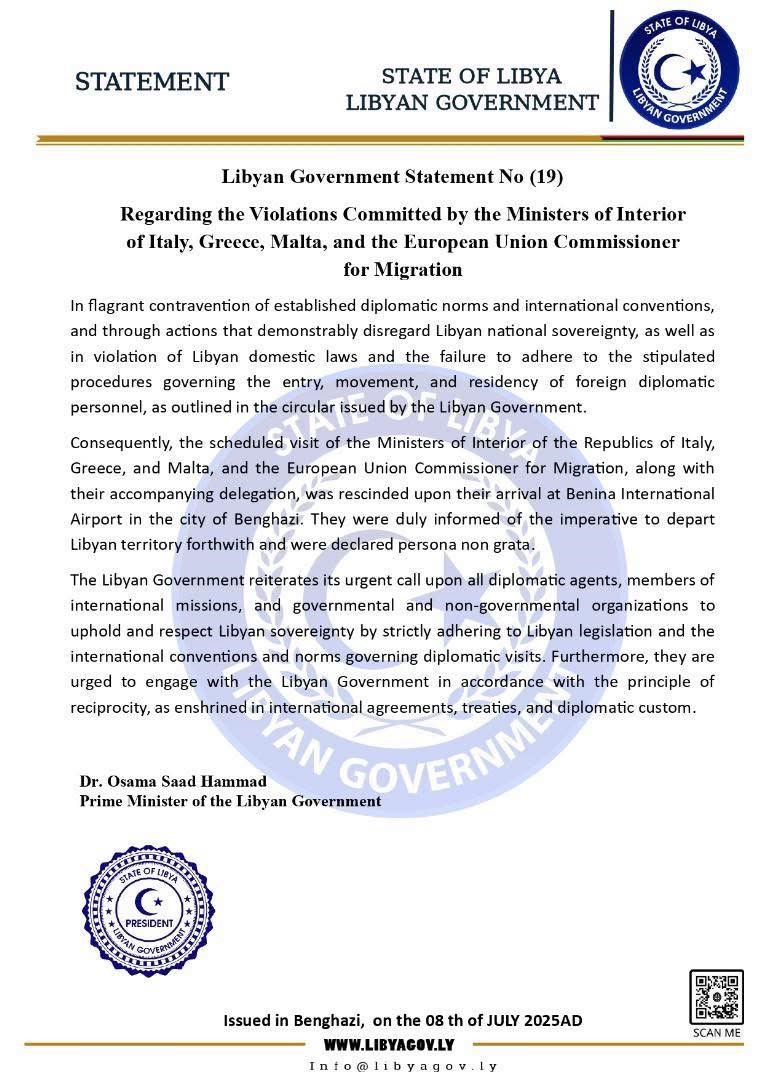
Following its visit to Libya’s capital Tripoli to discuss migration, the EU delegation flew to Benghazi but was told to turn away upon arrival at Benina International Airport. The EU delegation was composed of EU Commissioner for Internal Affairs and Migration Magnus Brunner, Maltese Home Affairs Minister Byron Camilleri, Italian Interior Minister Matteo Piantedosi and Greek Migration and Asylum Minister Thanos Plevris.
The EU Commissioner and the Ministers commented positively on their meeting with their counterpart, Libya’s Interior Minister Emad Trabelsi. Cooperation is to be renewed between the Libyan government of Tripoli and the EU over coast-guard operations with further assistance and aid provided by the EU to the Government of National Unity of Tripoli.
The EU is ensuring that migrants do not cross the Mediterranean Sea by supporting and enhancing the authorities of north African states, however this practice is being condemned due to the ill-treatment of migrants by north African governments.
EU relations with the government of Khalifa Haftar are beginning to grow more tense as Haftar is blackmailing the EU and European countries with boatloads of migrants in exchange for trade and business deals.
The official reasons given by Haftar’s government for the refusal of entry to the EU delegation was visa and protocol but the EU Commissioner demanded a meeting directly with Khalifa Haftar which Haftar refused. Prior to the delegation’s arrival, Youssef Al-Agouri, Chair of the Foreign Affairs and International Cooperation Committee of Haftar’s rump parliament, said that “Libya will not serve as Europe’s coast-guard”. Haftar’s government is also currently engaged in a dispute with Greece over maritime borders.
Migrant crossings from Libya have not decreased, in contrast to other migration routes which have seen a reduction in activity. From eastern Libya, territory controlled by Haftar, the migrant route to Crete is becoming increasingly active.

Newsroom



Leave a Reply