



Italian Prime Minister Giorgia Meloni wants to play the role of the responsible adult in Europe after hitting out at the Spanish government’s failure to control its border in its North African enclave of Ceuta where up to 60,000 Moroccans breached the border in chaotic scenes last week.
First, the Italian Prime Minister called for Spain to to be suspended from Schengen, something exceptional which can only be done unilaterally via a member-state and another member-state. There is currently no legal mechanism in the EU which would suspend a member-state from the Schengen Treaty. Italy can re-instate border checks for Spanish travelers to Italy, but Spain can’t be effectively suspended from Schengen unless treaties change.
The crisis was quickly resolved with most of those who breached the border sent back, and the Spanish government reiterated that Ceuta doesn’t even form part of the Schengen zone. The Spanish Prime Minister wrote a letter to the European Council and to the Commission lamenting the lack of solidarity by European member-states. Now, the Italian Prime Minister has organsied a letter to the European Commission citing “serious concern” about the events that took place in Ceuta and urged the Irish Presidency of the European Council to convene an urgent meeting via videoconference to assess the situation. The letter also calls for urgent assistance to Spain to restore its borders and reiterated on the importance of securing Europe’s borders.
The Spanish government blamed the Ceuta incident on organsied criminal groups and praised the assistance of Morocco. Whether it is Morocco or Spain that should deter these criminal groups is an important issue. The letter organised by the Italian Premier refers to “hybrid threats” which is ironic given that the Italian Premier has long been part of the European policy that has tolerated the existence of these “hybrid threats”.
The Italian Prime Minister’s solution to these “hybrid threats” was to contain them by appeasing North African dictators in response to their blackmail—a policy originally drawn up for Turkish President Recep Tayyip Erdoğan who blackmailed Europe with Syrian migrants. European leaders, particularly Prime Minister Giorgia Meloni herself, have long supported outsourcing the security of Europe’s borders to North African dictators by rewarding them with funding and assistance in exchange for controlling their borders and preventing migrants from crossing the Mediterranean. If the EU does not provide the funds they demand, these governments threaten to open their borders and send as many migrants as possible.
Prime Minister Giorgia Meloni not only supported the EU’s policy of appeasing North African dictators but also expanded it. Before 2023, Tunisia had received up to €200 million in EU funding and assistance in exchange for strengthening border security. Under a new agreement championed by the Italian premier in 2023, Tunisia was offered up to €1 billion in EU financial assistance, including loans and as much as €150 million in direct support for the Tunisian government’s budget.
Then there is the case of Khalifa Haftar, who can carry Russia’s water into Europe by blackmailing European leaders over migration, both on his own behalf and on Russia’s. Haftar, too, is being appeased, with European governments turning a blind eye to his repeated violations of oil sanctions, his hosting of Russian troops and North Korean personnel in Libya, his supply of weapons to the RSF, and even starting a border conflict with the Sudanese government. The rump dictator, who believes he can rule a North African territory like a brutal warlord presiding over a kingdom created for his sons, is slowly being legitimised in Europe thanks to the Italian government.
This willingness to appease the dictators of the Mediterranean by any means possible is entirely consistent with the Italian government’s behaviour. The Italian government was even planning to rehabilitate Bashar al-Assad on the eve of his downfall, with the intention of coordinating with him the return of Syrian migrants.
Let’s be clear about what is going on here. The Italian government is not resolving the migrant crisis in the Mediterranean Sea; it is merely containing it by handing border security over to North African dictators, while creating a new bill for future generations: the cost of paying Mediterranean dictators to secure Europe’s own borders. The Italian premier is dumping a problem she has created onto future generations, and eventually these dictators will demand even more.
We can only take the Spanish government at its word when it describes Morocco as a reliable partner on border security. The relationship between Spain and Morocco, however, reflects Europe’s broader approach towards North Africa: Madrid works to preserve close political and economic relations with Rabat through investment, trade, infrastructure projects and financial assistance, while relying on the Moroccan authorities to control migration routes towards Ceuta, Melilla and the Spanish mainland. The EU is supporting Morocco with assistance in a 45-kilometre bus rapid-transit network in Rabat, Salé and Témara through its Global Gateway programme, combining an EU grant with loans from the European Investment Bank and France’s development agency.
Europe is losing control of its borders because it has treated North African dictators with kid gloves, and these dictators now have an incentive to keep the threat to European border security alive so that they can continue raking in funds to prevent migrants from crossing into Europe en masse. Once again, the case for a European army, or a joint military and security architecture, is clear: Europe needs the capacity to deter and prevent further blackmail by North African dictators. Europe should not only send a message, but also enforce a policy making it clear that threatening its border security comes at a very high price.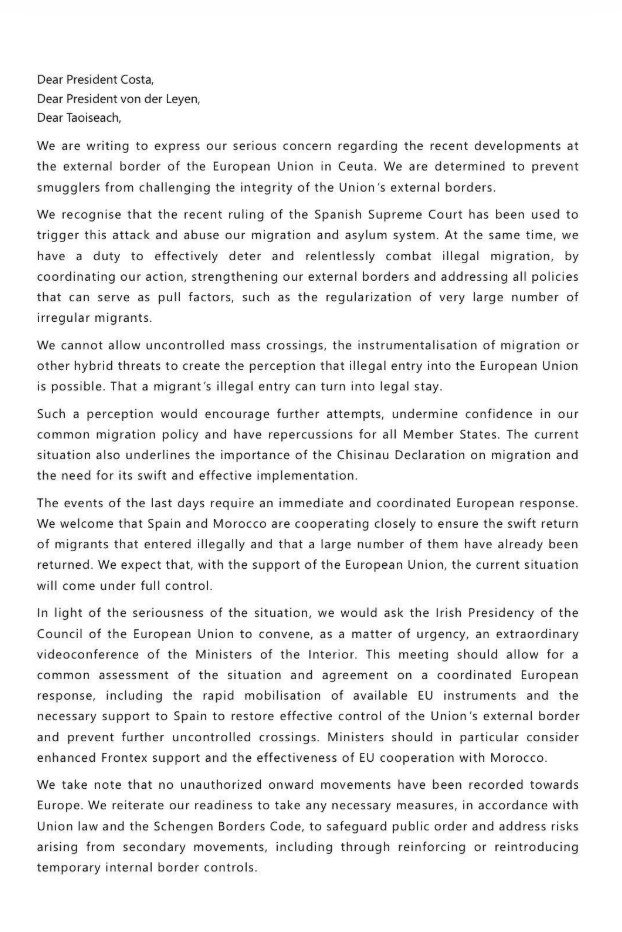


Website Editor
Historian and Publisher



Leave a Reply