



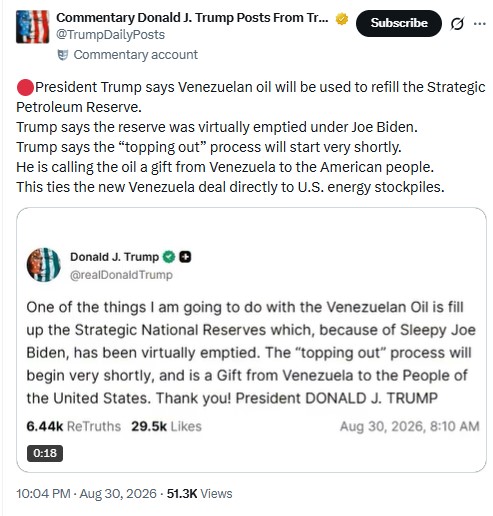
President Donald Trump reached an oil agreement with Venezuela’s interim president, Delcy Rodríguez, last Friday, August 28. He described the agreement as “the biggest oil deal in history.” In addition, it gives the United States majority control over 65 billion barrels of crude oil, which represent approximately 21.5% of Venezuela’s proven oil reserves. The US Energy Information Administration (EIA) estimates these reserves at around 303 billion barrels.
So far, no written agreement has been published. The Venezuelan government has, however, formally and publicly confirmed the agreement. Rodríguez’s government issued a statement confirming the development of 17 fields, and Rodríguez subsequently addressed the country on state television, describing it as a 25-year bilateral project, targeting more than 1.5 million barrels per day and asserting that Venezuela retains ownership and sovereignty over its natural resources.
However, while the United States gains a privileged position over Venezuela’s natural resources, what concessions will there be regarding democracy in Venezuela?
Following the departure of Nicolás Maduro, the United States has reiterated its position and involvement in Venezuelan politics. Likewise, Washington has demanded support for the South American country and called for new presidential elections. Several months into the transition, the main democratic objectives remain unresolved, which is beginning to raise questions among the public.
Since Delcy Rodríguez came to power and the supposed beginning of a transition, the United States has maintained talks which called for an electoral calendar and a solution to the situation of political prisoners in Venezuela. Washington’s strategy consisted of using economic pressure to obtain political concessions. The concern now arises because the two countries have reached an agreement that benefits both economies, while the democratic and political situation remains unresolved. Many political prisoners still remain in jail.
The United States may have found a functional relationship with the Venezuelan regime after reaching an agreement of such importance over Venezuela’s most valuable economic resource. The focus of the negotiations could be changing. Washington used oil as one of its main tools to apply pressure and achieve a transition towards democracy. However, with a result of such magnitude, the importance o the democratic transition could be significantly reduced.
While both countries stand to benefit economically, the political situation in Venezuela remains a concern. Now that the United States has secured this privileged position, where do the political concessions stand?

Journalist


Leave a Reply