



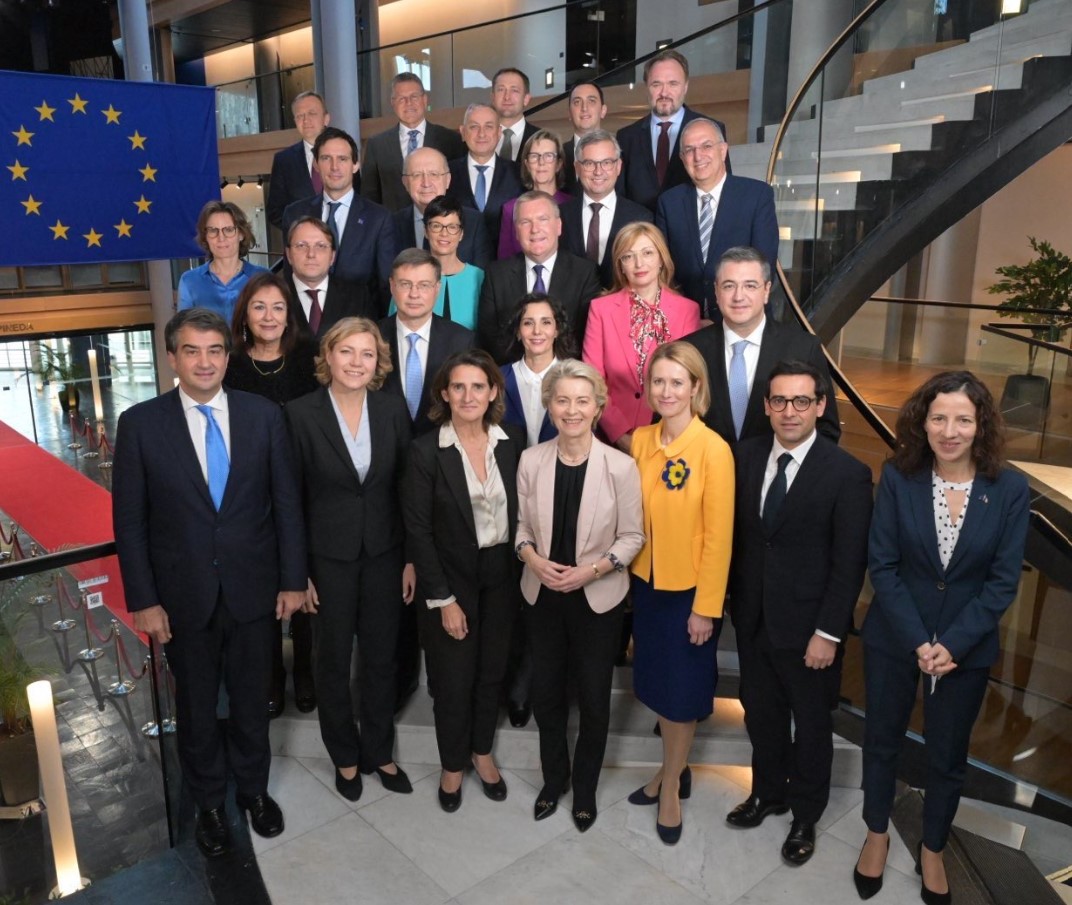
Last week, a new European Union Commission was inaugurated for the next five years. Ursula von der Leyen, who served as the President of the previous Commission, had her term renewed and now leads the new cabinet.
The previous EU Commission was overshadowed by a Covid pandemic and the Russian invasion of Ukraine. Talk on EU policy was muted by the glaring and immediate crisis Europe faced. Now, policy is making a comeback, and it’s mostly about the EU’s Green Deal which aims to cut carbon emissions in the EU to zero by 2050. This plan is being laid out via various directives on industry, agriculture, energy and others: all promoted with buzzwords such as “enhancing competitiveness”.
As part of this plan, the EU is allocating a large portion of its budget to this Green Deal. The EU has a budget of €200 billion for next year, which is tiny compared to the EU’s total GDP of €20 trillion a year. Its regulations and laws are surely more visible and extensive than its total budget, half of which is mostly dedicated to the Green Deal.
Apart from aiding EU-member states to build energy and transport connections between each other, the EU is also investing in an energy infrastructure for hydrogen, apparently, a new efficient source of energy, according to the EU. Other subsidies will go for the usual subsidies to farming and agriculture (up to €53 billion) and renewable-energy projects such as solar panels and wind-turbines.
The EU is spending only €1.8 billion on defence.
How’s the Green Deal doing?
Germany and its Green Party were the original and historical proponents of the European green deal. Germany has also been at the forefront of adopting this vision and in doing so, it has bizarrely shut down its nuclear-energy plants and temporally turned to coal to offset the difference. Today, reports state Germany is actually producing most of its energy from renewable sources such as wind turbines, with coal making up to 8%. This transition didn’t help German electricity prices which today are exorbitantly high compared to pre-Covid pandemic levels. Higher electricity prices are partly causing Germany productivity to decline: all of this has got nothing to do with “enhancing competitiveness”.
Yet, the malaise of German productivity also seems to be an inherent and structural problem in Europe but if the Green Deal is having any effect it is not making it better: it’s only making it worse.
Mario Draghi’s report
Mario Draghi’s report was so underwhelming that no one talks about it any longer. One can fully agree with Mario Draghi’s report and it proposes good solutions such as increased spending by the EU on infrastructure, energy and electricity, a common market for power-purchase agreements and increased efficiency in energy procurement by having member-states buy energy supplies together (common energy procurement). Even though Draghi’s proposals are underwhelmingly logical, there is no sign the European Commission is set to implement them.
We don’t need no security
As an institutional entity, the EU is currently in an open political and hybrid war waged against it by Russia using subversive methods. China is also aiding Russia in this subversive and hybrid war against Europe and is even suspected of having deliberately cut a telecommunications cable. Russia is mainly trying to damage the EU by supporting European the political parties which are against it both in terms of resources and direct financial support, and also indirectly through propaganda and disinformation. Hungary’s Prime Minister Viktor Orban has become a prime example of a Russian puppet in Europe. His government’s policies never fail to meet Russia’s interests whether if its about energy purchases from Russia, Ukraine, or democratic principles (the only EU-member state to recognise Georgia’s illegitimate government) and human rights and international law (inviting Israeli Premier Benjamin Netanyahu to Hungary after an arrest warrant is issued against him by the International Criminal Court).
The EU Commission doesn’t mind that a potatoes/gas/nuclear-neighbouring state is undermining it from within as it invades our neighbouring allies. It’s just €2 billion for defense and security and carry on.
The legacy of EU Commissioner President Ursula von der Leyen
President Von der Leyen failed to fully enforce EU sanctions against Russia, allowed European member states to keep purchasing Russian oil and gas despite sanctions, and put the EU in a very weak position with regard to Russia. Having failed to organise significant and meaningful support that could help Ukraine win the war, Ursula von der Leyen will be one of the leaders who will be blamed if Ukraine loses this war.
Meanwhile, Europe is divided, there are more Europeans who are against the EU than ever before, and despite the buzzwords behind the Green Deal, Europeans still don’t see any meaningful and positive change with its policies.
Who are the new Commissioners?
There are some familiar faces. Andrius Kubilius, Commissioner for Defense and Space was the Prime Minister of Lithuania and an MEP prior to becoming Commisioner. Valdis Dombrovskis, the Latvian candidate is EU Commissioner for the fourth time (Commissioner for Economy Productivity), and still hiding in Brussels from very serious corruption allegations back home. Replacing Josep Borrell as High Representative for Foreign Affairs and Security Policy will be previous Estonian Prime Minister Kaja Kallas: her appointment provides a sense of security in the backdrop of Russia’s hybrid war against Europe, but she will be limited by her very myopic superior EU Commissioner President von der Leyen who is sitting for her second term.
Undoubtedly, one of the most important commissioners will be the Commissioner for Clean, Just and Competitive Transition Teresa Ribera Rodríguez. She is also one of the six Vice-Presidents out of 26 Commissioners excluding the President. Spanish politicians accuse of being responsible for disaster in Valencia, having failed as Minister of the Ecological Transition to allocate and tap government and EU funding for anti-flooding prevention all the while going on a public binge-adverstising-spending spree. They also accuse her of being insensitive and opportunistic as she prepared for her European Parliament hearing in Brussels instead of being present in Valencia to attend to the disaster. She will now be one of Europe’s main political leaders of the Green Deal.
The EU Commissioner for Climate, Net Zero and Clean Growth is Wopke Hoekstra. He was the Dutch Deputy-Prime Minister and Minister of Foreign Affairs and his most meaningful work experience was with McKinsey as an MBA-graduate with whom he worked for more than ten years. Previous Finnish Minister of Education Henna Virkkunen is now Commissioner for Tech Sovereignty, Security and Democracy. French politician Stéphane Séjourné is Commissioner for Prosperity and Industrial Strategy.
A Commissioner with some relevant experience is the Commissioner for Energy Dan Jørgensen who had an easy job as the Danish Energy minister until Russia invaded Ukraine and electricity prices in Denmark still shot up, despite his claims that Denmark was mostly consuming electricity derived from renewable energy sources.
The Romanian Commissioner Roxana Mînzatu, who seems to be an experienced bureaucrat specialising in procurement, has been made responsible for “preparedness”: a Nordic European concept about having society prepared and ready to withstand and major crises. This term was used by the European Commission in a report proposing security and defense policy priorities.
More of the same
Overall, with a few exceptions, most EU Commissioners appear to have reached Brussels through the traditional political practice of kicking local rejects upstairs to Brussels. There used to be a time when this tradition was a convenient form of politics for EU-member states, yet having been through two major crises in a short span of time, we still don’t seem to be taking European politics seriously enough to send the best individuals available to Brussels.
The new European Commission projects more of the same. Productivity rates will keep declining as the energy and electricity issues keep mounting. Russia will escalate its subversive war against the EU, and the Commission will retaliate by sanctioning an obscure Russian airline in Central Asia. Vice-President and High Representative Kaja Kallas will make bold statements in public which won’t be followed by the Commission to her constant and ever0rising frustration. We will be wasting time and resources building a ridiculous hydrogen infrastructure while more nuclear-power plants will mushroom in China. Russia will keep funding and supporting European politicians who attack the arms industry and call for peace while China builds aircraft carriers and Russia fires missiles on civilians in Ukraine.
The European theatre can continue. Carry on.

Website Editor
Historian and Publisher
Leave a Reply