



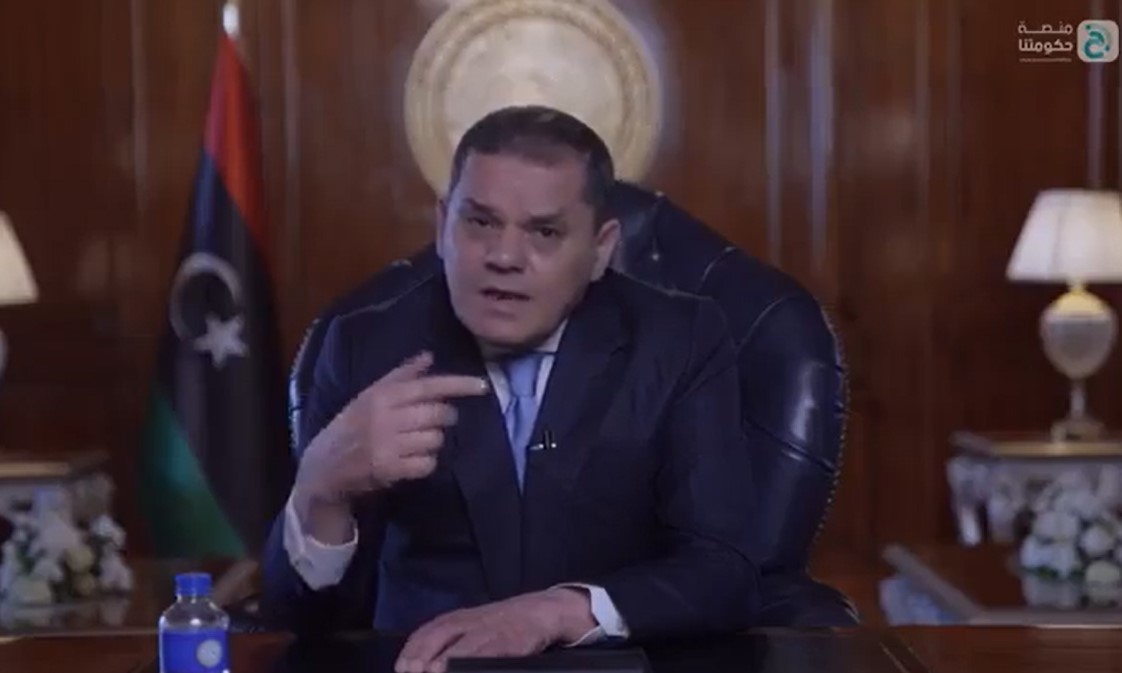
Yesterday, the Libyan Prime Minister heading the Government of National Unity in Tripoli, gave a historic speech in which he demanded armed-militias to join regular state institutions. In a surprise announcement, the Prime Minister took responsibility for the killing of the armed-militia leader, Ghnewa, who was previously his ally, accusing him of becoming a corrupt and criminal tyrant.
The Libyan Prime Minister’s speech gave some clarity to the chaos that ensued Ghnewa’s assassination. No one had taken responsibility for the killing, and the press immediately reported that Ghnewa’s armed military factions, namely the 444 Brigade were fighting against the Rada Forces on behalf of the government. Now, we know, that the government is not actually on the side of the 444 Brigade any longer.
Did Prime Minister Dbieba throw a strategic and divisive move that enabled him to weaken armed-militias? The Prime Minister described the fighting as a mistake. The fighting between armed-militias, backfired against him as residents came out in the streets to demand his resignation. As much as half of his cabinet members have resigned. The question, however remains, are the protests genuinelly aimed against him or the armed-militias?
The Maltese Herald has contacted an intelligence source in Libya who is currently in Tripoli, and has extensive background knowledge on the country. This is what they told us.
Prime Minister Dbieba’s move against armed militias was a surprise.
The Prime Minister’s move to try and take control over the militias was a surprise and a closely guarded secret with his top officials. The move is surprising because Dbieba does not have strong direct military force or capabilities without the armed-militias.
The Prime Minister runs a state with a strong civil service.
Although the Prime Minister’s military capabilities are very weak, the Prime Minister is resting on a strong and functional civil-service. The Prime Minister’s efforts to build a functional state and root out corruption are paying off as the civil-service is still running smoothly during this time of crisis.
Residents in Tripoli are genuinely demanding an end to armed-militias.
Residents in Tripoli genuinely want an end to the rule by armed-militias and Dbiebah may still be politically successful if his new campaign to disarm the militias is successful. The militias know this very well and strong warlords may challenge Dbeibah’s power for political clout.
Dbiebah’s existential support comes from Misrata.
The Prime Minister’s existential military support comes from the armed-factions of Misrata who played a crucial role in defeating Muammar Ghaddafi. A lot depends on what the armed-factions of Misrata will do next.
Unclear what position will the 444 Brigade take
The 444 Brigade hasn’t yet made its position public. The ceasefire in Tripoli still seems to be holding but much depends on whether the armed-militias will heed the call of the Prime Minister to join regular state institutions or decide to keep their weapons.
The Prime Minister’s potential peaceful exit.
The predecessors of Dbeibeh left office by securing their future through political deals. Dbeibeh has plenty of leverage to do the same, but the fact that he remained in the capital during the fighting, risking his life in the process, suggests that he may actually be serious about what he is trying to achieve.

Website Editor
Historian and Publisher

Leave a Reply