



For the first time since the 1930s, two state powers are negotiating over the spoils of a European country without its approval. On September 30th 1938, UK Prime Minister Neville Chamberlain signed The Treaty of Munich which handed over the Sudetenland to Germany, or as it was then called, “The Third Reich”. Just less than a year later, on the 24th August 1939, German Foreign Minister Joachim von Ribbentrop signed a pact with Russia’s Foreign Minister Vyacheslav Molotov to divide Poland between their countries.
Europe went to war against Nazi Germany so that no European empire or power would ever again impose its will on the rest of Europe with war and military dominance. The Allied victory in the Second World War consolidated and set in stone the right for small and poor nations in Europe to co-exist peacefully next to their larger or more powerful neighbours: a right which small European nations had already fought for dearly in the First World War.
Securing peace in Europe and the right of small nations to exist was an arduous and complex task which took many years of political mediation and the development of international structures. First and foremost, Europe built a defensive alliance to protect itself from foreign threats: namely the threat by Russia (then the Soviet Union which) which had already occupied as much as half of Europe where it also installed its dictatorial regimes. In order to make sure that European countries, big and small alike, find an incentive to cooperate together peacefully, Europe built a system of economic interdependence through the European Community, eventually turning it into the European Union. Ironically, the first step towards this union was to cut steel and aluminum tariffs between European countries. Europe also fostered its strong Trans-Atlantic alliance throughout the years with economic trade and cooperation in defence and security. Europe helped the Untied States in Afghanistan and the United Kingdom, Spain and Portugal also helped the United States in Iraq.
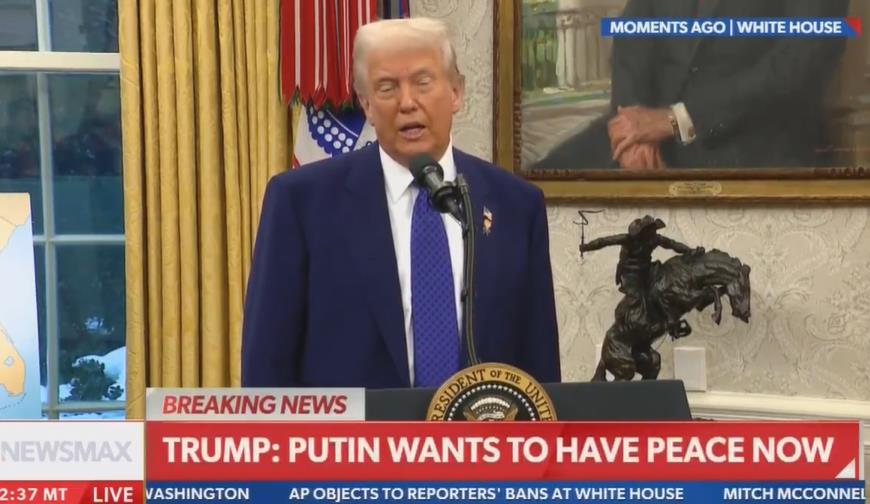
Today, the new US administration and President Donald Trump want to change all of this primarily, by negotiating over the Ukraine’s territorial and material spoils directly with its aggressor, Russia, without Ukraine’s consent and Europe’s involvement. This is something Europe has worked hard to avoid for many years, and now, that this situation is being imposed on Europe once again, it is clear that we are back to a state where Europe can’t guarantee the existence of its small and vulnerable states. Effectively, Europe is losing what it gained after the Second World War, exposing it to a long-term cycle of instability and security risks.
As President Trump announced that he was discussing Ukraine with the Russians behind Ukraine’s back, Russia launched 71 drones and 7 ballistic missiles at the city of Kyiv. He then said to the press that the Russians could keep the territory they captured after having lost many men to acquire it. The US does not want to give security guarantees to Ukraine, opposes its membership with NATO, but demands from it a large payment in rare earth metals. Effectively, the United States and Russia are jointly proposing to maintain Ukraine’s vulnerable status, allowing both to exploit it for territorial and material gains.
According to the words of subtle propaganda, Ukraine appears as an exception, or as a sacrificial lamb for the sake of world peace. According to Russian propaganda, Russia’s war in Ukraine with the intent of Russifying Ukrainians and destroying the Ukrainian nation is the “result of NATO provocation”. In reality, Russia is being strengthened as it is handed over just another victory in its long set of victories over its neighbours. And ultimately it is the return of ethnic cleansing and old-fashioned imperialism in Europe.


Website Editor
Historian and Publisher



Leave a Reply